Why Is My Basil Dying? 7 Quiet Mistakes That Kill Basil Plants (And How to Fix Them)
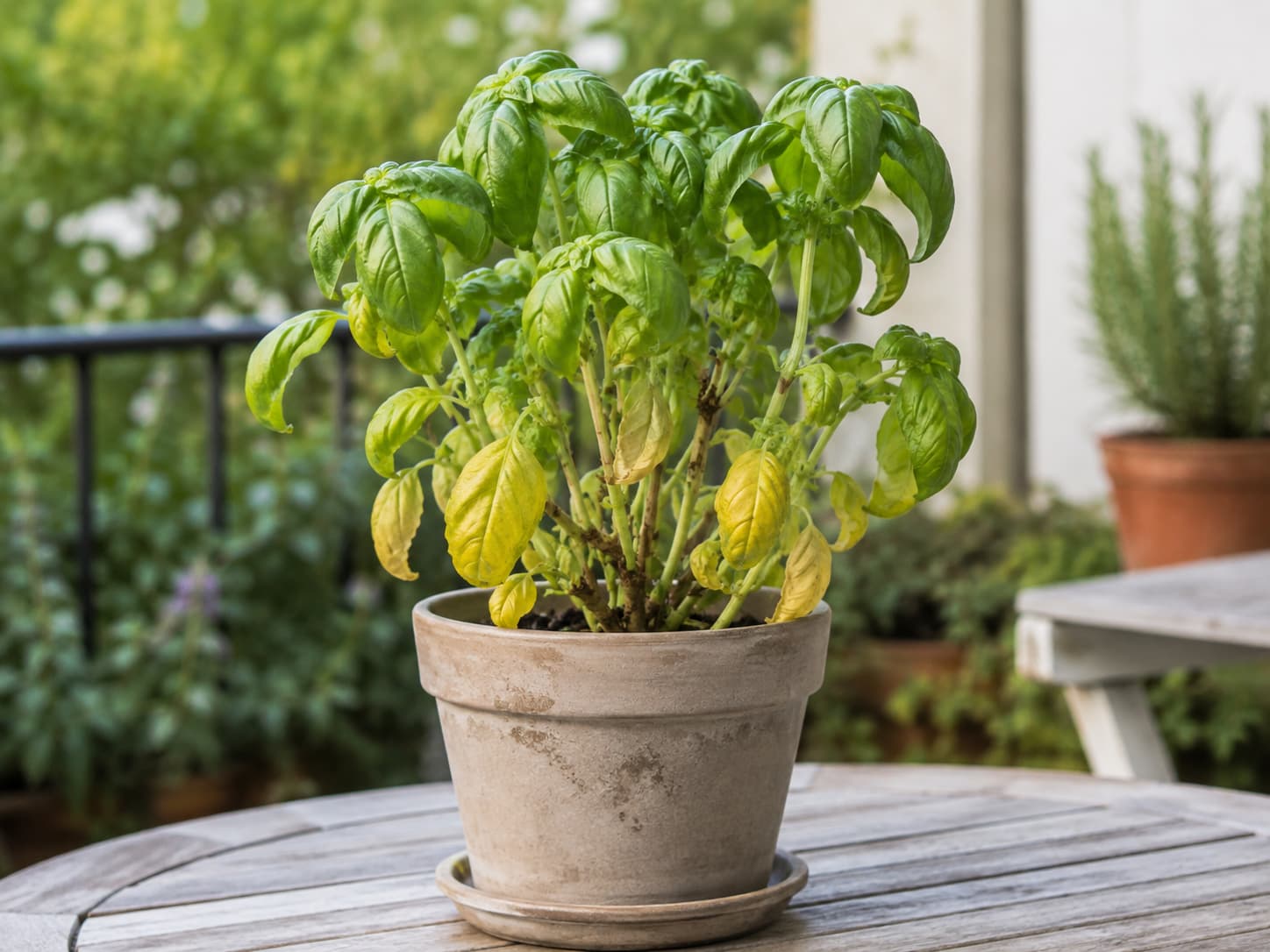
If you've ever asked why is my basil dying when it seemed fine a few days ago, you're not alone. Basil is often sold as an easy kitchen herb, yet it can decline quickly when watering, light, drainage, or temperature are slightly off.
Here's why: basil rarely dies from one dramatic event. It declines through small, quiet problems that accumulate—a little too much water, a little too little light, a drafty windowsill you didn't notice. By the time you see yellow leaves or collapsed stems, two or three issues are already working together.
This guide identifies the 7 most common mistakes that kill basil, helps you diagnose which ones are happening to your plant right now, and gives you specific fixes. I've made every one of these mistakes myself—sometimes more than once—so each fix comes from actual trial and error in my Zone 6b garden and kitchen windowsill.
greenmuse-illustration-basil-dying-symptoms-overview.jpg
Why Is My Basil Dying? Quick Diagnostic
Before reading ahead, match your dying basil plant's symptoms to this table. It will help you identify which of the 7 mistakes to focus on first.
| Your Basil Looks Like... | Most Likely Cause | Jump To |
|---|---|---|
| Yellow leaves from bottom up; soil feels wet | Overwatering + poor drainage | Mistake #1 & #2 |
| Drooping even though soil is moist | Overwatering (root suffocation) | Mistake #1 |
| Long, thin stems; wide gaps between leaves | Not enough light | Mistake #3 |
| Pale color; slow growth; leaves feel thin | Low light + possible nutrient deficiency | Mistake #3 & #6 |
| Black/brown spots on leaves; fuzzy growth | Poor airflow + fungal disease | Mistake #5 |
| Sudden collapse after moving outside | Cold shock | Mistake #4 |
| Thick stems, small bitter leaves, flower buds forming | Flowering too early | Mistake #7 |
Drag the bar below or swipe horizontally to view the remaining columns.
Mistake #1: Overwatering (The #1 Basil Killer)
greenmuse-illustration-overwatered-basil-wet-soil-wilting.jpg
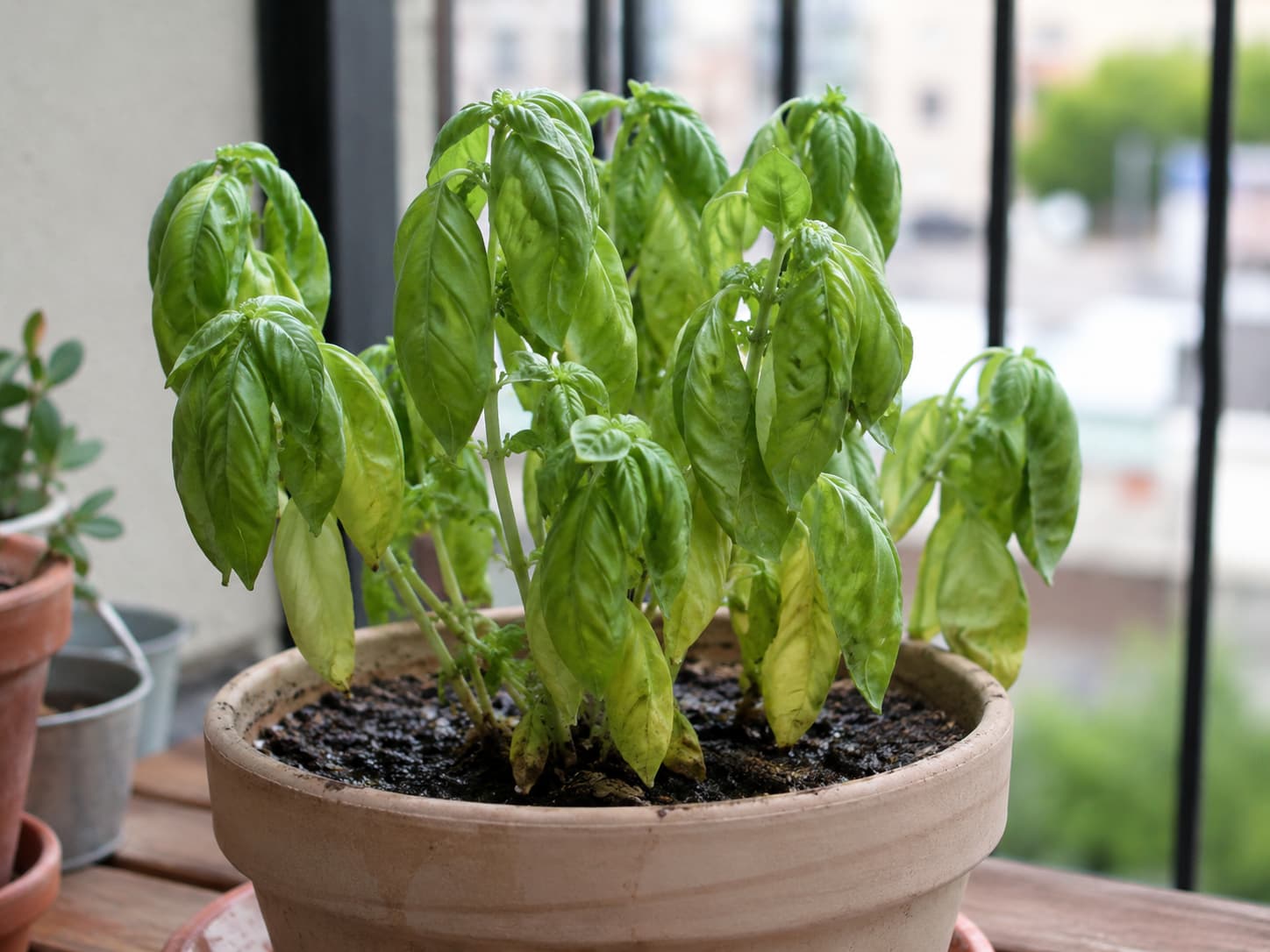
If you're asking why is my basil dying while the potting mix is still wet, excess moisture is one of the first conditions to check. Overwatering often looks like a plant that's wilting in wet soil—a contradiction that can tempt gardeners to add even more water and make the problem worse.
Here's what happens underground: basil roots need oxygen as much as they need moisture. When soil stays constantly wet, the air pockets between soil particles fill with water. Roots suffocate, begin to rot, and lose their ability to take up water. So the plant wilts from thirst—while sitting in a puddle.
Signs You're Overwatering
- Leaves droop but feel soft and limp (not crisp like drought wilting)
- Lower leaves turn pale yellow first, then brown
- Stems feel soft or mushy at the base
- Soil smells sour or swampy
- Small fungus gnats hovering around the soil surface
The Finger Test Fix
Forget schedules. Use your finger:
- Stick your index finger into the soil up to the first knuckle (about 1 inch).
- Dry at 1 inch? Water thoroughly until it drains from the bottom.
- Still moist? Wait 24 hours and check again.
- Wet? Don't water. Check drainage (see Mistake #2).
In summer heat, a container-grown basil outdoors may need water daily. The same plant indoors might need water every 3–4 days. The finger test accounts for both scenarios without you needing to guess.
In June 2024, I was watering my windowsill basil every morning because the top of the soil looked dry. When I finally stuck my finger in, the soil was soaked 2 inches down—the top had dried from air exposure while the root zone was drowning. I lost that plant to root rot. Now I test before every single watering, no exceptions.
Mistake #2: Poor Drainage in a Dying Basil Plant
greenmuse-illustration-basil-container-drainage-holes-saucer.jpg
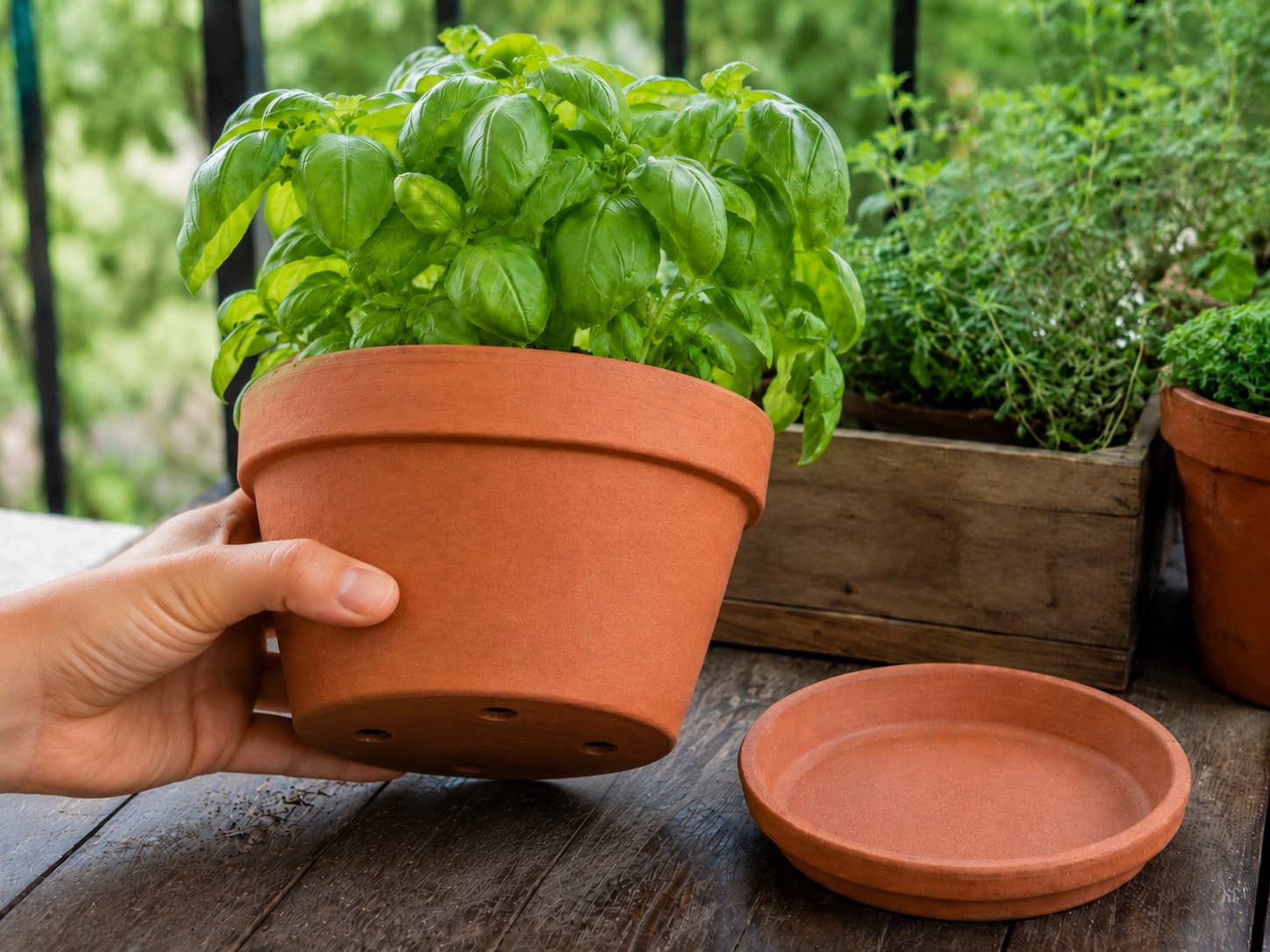
Overwatering and poor drainage are a feedback loop. You can water correctly and still kill your basil if the water has nowhere to go.
4 Common Drainage Traps
| Trap | Why It Kills Basil | Fix |
|---|---|---|
| No drainage holes in pot | Water pools at the bottom; roots sit in a swamp | Drill 3–4 holes in the bottom, or repot into a container that has them |
| Saucer left full after watering | Water reabsorbs into soil through drainage holes, keeping it constantly wet | Empty the saucer 30 minutes after watering. Always. |
| Garden soil in containers | Compacts into concrete within weeks; zero drainage | Use container potting mix only—it contains perlite for airflow |
| Pot too large | Excess soil holds more water than a small root system can absorb | Use a pot 2 inches wider than the root ball; a 6–8 inch pot is ideal for one basil plant |
Drag the bar below or swipe horizontally to view the remaining columns.
Mistake #3: Not Enough Light (Especially Indoors)
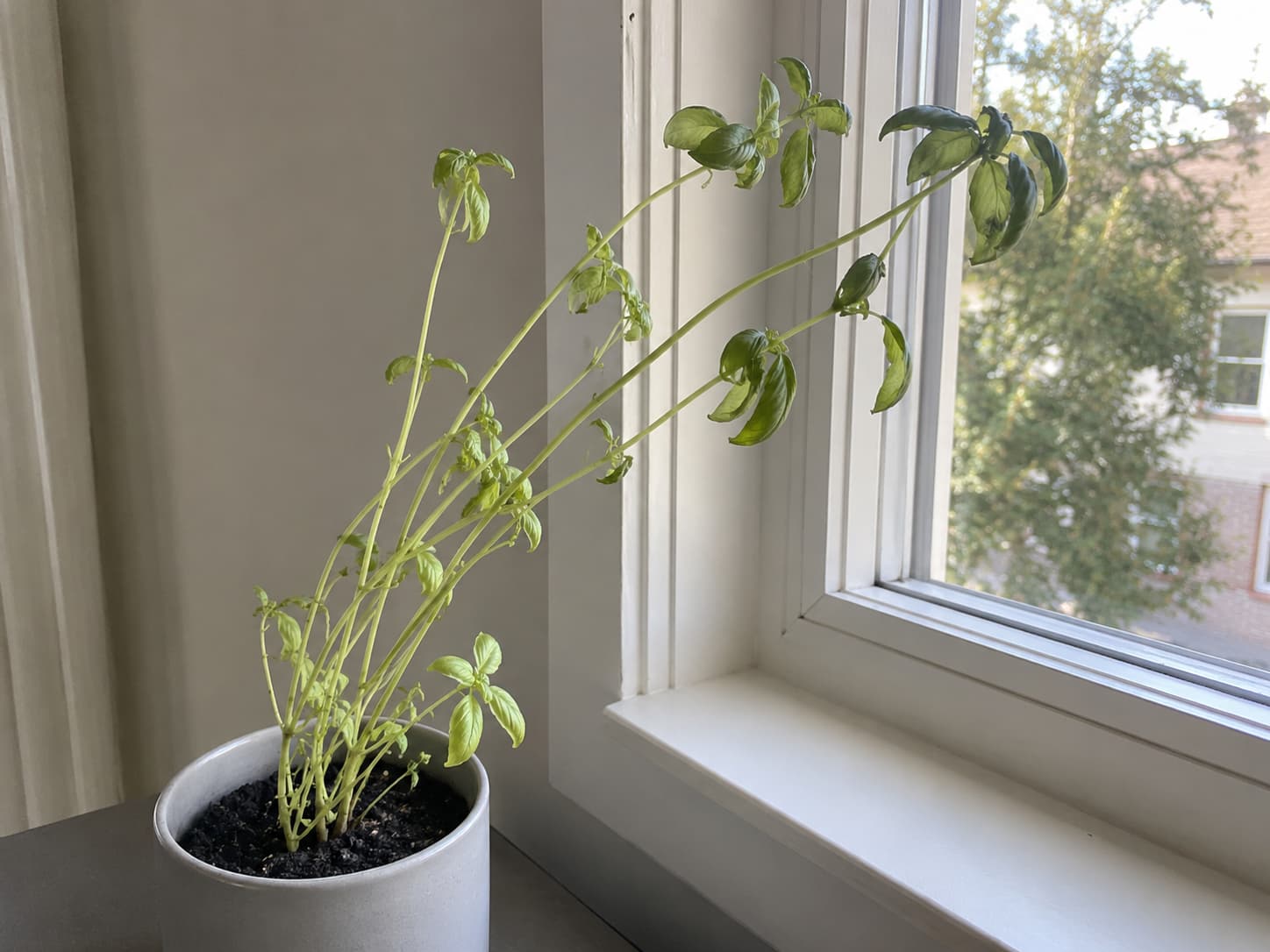
greenmuse-illustration-leggy-basil-insufficient-window-light.jpg
A bright room is not the same as bright exposure. If you're wondering why is my basil dying indoors, insufficient light is one of the first environmental factors to compare with watering and drainage. Human eyes adapt to low light very well, so a room can look bright to us while a basil plant still receives too little usable light.
Basil needs 6–8 hours of direct sunlight (not filtered, not ambient—"direct" means the sun's rays hit the leaves). On a south-facing windowsill, you might get 5–6 hours. On an east-facing one, 3–4. That gap is enough to make the difference between a thriving plant and a leggy, pale one.
Signs of Insufficient Light
| Sign | What It Means | Severity |
|---|---|---|
| Stems stretch toward the window | Plant is reaching for light | Early warning |
| Wide gaps between leaf pairs | Internode elongation—classic etiolation | Moderate |
| Pale green or yellowish leaves | Chlorophyll production reduced due to low light | Moderate to severe |
| Leaves thin and fragile | Plant can't build robust tissue without enough photosynthesis | Severe |
| No new growth for weeks | Energy deficit; plant is in survival mode | Critical |
Drag the bar below or swipe horizontally to view the remaining columns.
3 Light Fixes Ranked by Effectiveness
- Move to a south- or west-facing window. This is the single most impactful change. If you don't have one, consider growing basil outdoors in a pot instead—you'll get 2–3× the growth.
- Add a grow light. A simple LED grow bulb (like the SANSI 24W full-spectrum bulb, $16 on Amazon) in a standard desk lamp, positioned 6–8 inches above the plant and run for 12–14 hours per day, transforms indoor basil. For detailed picks, see our grow light guide for herbs and succulents.
- Rotate the plant every 2–3 days. This doesn't increase total light but ensures even growth—preventing the one-sided lean that eventually makes the plant unstable.
Mistake #4: Cold Stress (The Silent Slowdown)
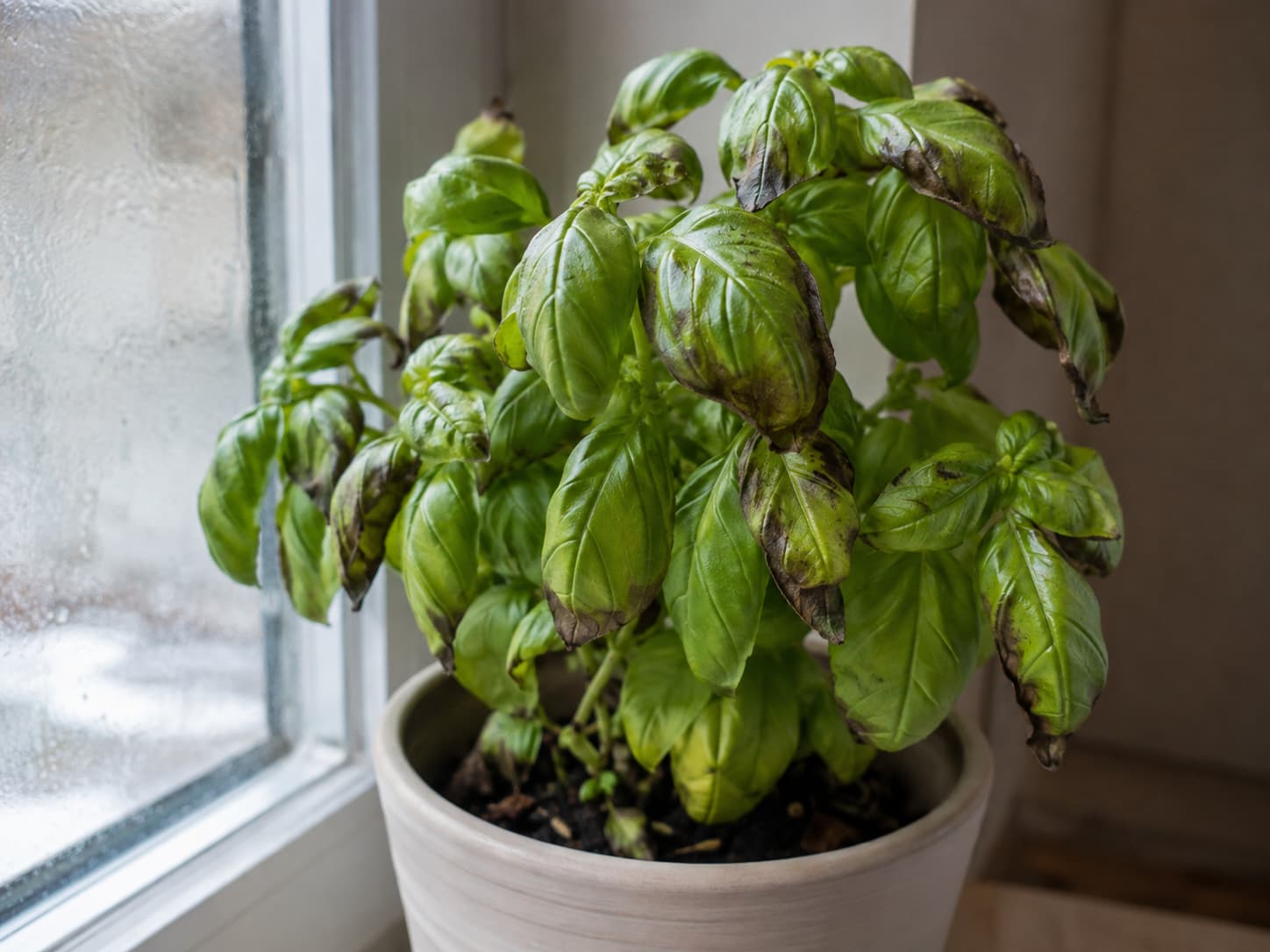
greenmuse-illustration-basil-cold-stress-darkened-leaves.jpg
Basil is a warm-season herb and is sensitive to chilling. Cool conditions can slow growth, damage leaves, and reduce how quickly the potting mix dries. A basil plant dying after a sudden temperature drop may show darkened, curled, or collapsed foliage, especially when cold stress overlaps with wet soil.
When Cold Stress Happens
- Overnight lows below 50°F — Basil stops growing. Leaves may darken or curl.
- Sitting near cold glass — Windowsill basil in winter can be 10–15°F colder at the leaf surface than room temperature suggests.
- Planted outside too early — Nighttime temps in May can still dip into the 40s in Zones 5–6. Basil transplanted before nights are reliably above 55°F will sulk or die.
- Refrigerated basil — Storing fresh-cut basil in the fridge turns leaves black within hours. Room-temperature water (like a bouquet) is the correct storage method.
For exact timing on when it's safe to move basil outdoors in spring, see our guide to moving tomatoes, peppers, and basil outside—the rule is consistent 55°F+ nights.
Cold Stress vs. Overwatering: How to Tell Them Apart
| Symptom | Cold Stress | Overwatering |
|---|---|---|
| Leaf color | Darkens, may purple slightly | Pale yellow to brown |
| Soil moisture | Dry to normal | Wet or soggy |
| Stem texture | Firm but slow-growing | Soft, mushy at base |
| Speed of decline | Gradual (over 1–2 weeks) | Rapid (2–4 days after a cold night) |
| Fix | Warm location; wait | Reduce water; improve drainage |
Drag the bar below or swipe horizontally to view the remaining columns.
Mistake #5: Poor Airflow When a Basil Plant Is Dying
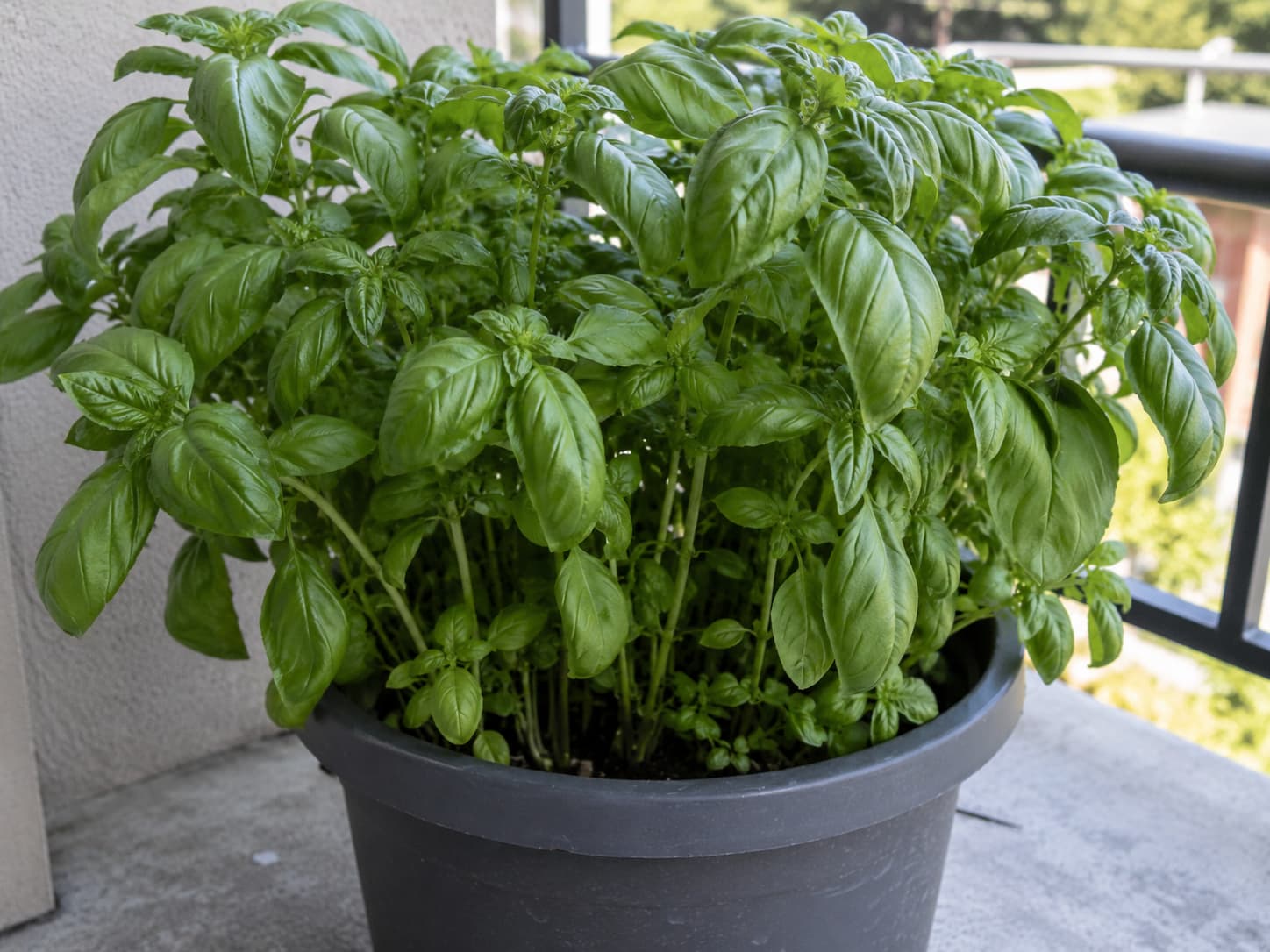
greenmuse-illustration-crowded-basil-poor-airflow-container.jpg
Basil grows fast and lush. That density is a feature—until it becomes a problem. When leaves overlap and stems crowd each other, moisture gets trapped between them, creating a perfect environment for fungal diseases (downy mildew, gray mold/botrytis) that spread rapidly in warm, humid conditions.
3 Signs of Airflow Problems
- Yellowing or browning on inner/lower leaves that the outer leaves shield from light and air
- Fuzzy gray or white patches on stems or leaf undersides (this is botrytis or powdery mildew—act fast)
- Stems rotting where they touch the soil in dense plantings
How to Open Up Your Basil
- Thin seedlings early. If you started from seed, don't let 5 plants compete in one 6-inch pot. Thin to the strongest 1–2 plants when they have 2–3 sets of true leaves. I know it hurts to pull healthy seedlings—transplant the extras to their own pots instead.
- Prune from the center. Cut stems that are crossing, pointing inward, or growing straight up without branching. This opens the center of the plant to air and light.
- Space multiple plants 10–12 inches apart. In a container, one basil per 6–8 inch pot. In a garden bed, 10–12 inches between plants minimum.
I planted three basil seedlings in one 10-inch pot in 2023 because they looked tiny and I wanted a full display. By July, the center plant had developed gray mold on its lower stems from trapped moisture. I lost it and had to cut back the other two aggressively to save them. One plant per pot. Always.
Mistake #6: Nutrient Imbalance in a Dying Basil Plant
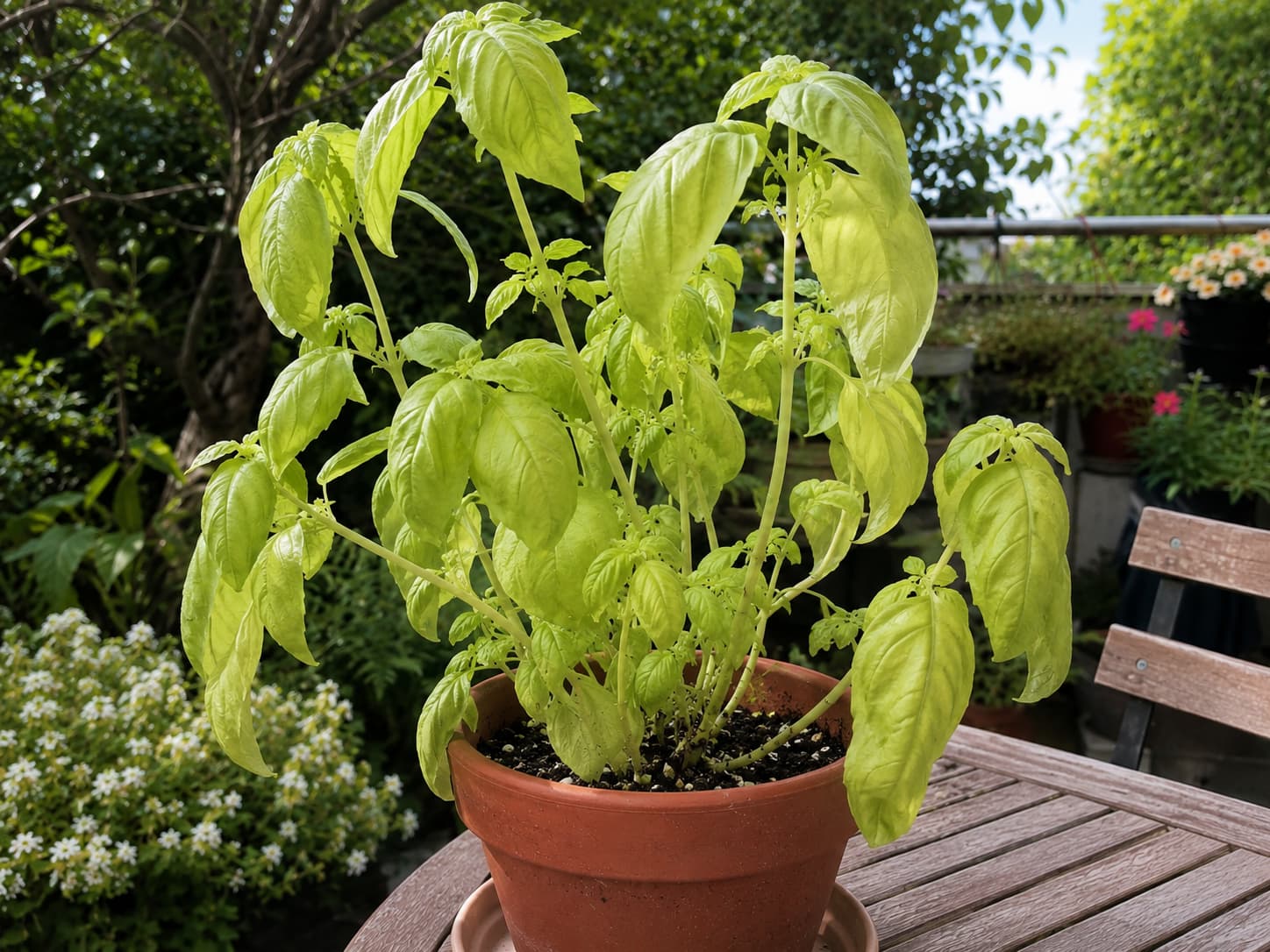
greenmuse-illustration-overfertilized-basil-leggy-pale-growth.jpg
Most beginners assume yellow leaves mean the plant needs fertilizer. With basil, it's often the opposite—over-fertilizing is more common and more damaging than under-fertilizing.
Excess nitrogen produces fast, leggy growth with large, pale leaves that have weak flavor and reduced essential oils. The plant looks "productive" but is actually more susceptible to pests and disease because its cell walls are thin and its immune response is suppressed.
How to Fertilize Basil Correctly
| Situation | What to Use | How Often | How Much |
|---|---|---|---|
| Container basil, active growth | Diluted liquid fertilizer (fish emulsion or half-strength 10-10-10) | Every 2–3 weeks | ½ teaspoon per gallon of water |
| Garden bed basil | Compost mixed into soil at planting | Once at planting; optional top-dress midseason | 1 inch of compost worked into the top 3 inches |
| Basil in recovery | Nothing | Skip fertilizing until the plant shows new healthy growth | N/A—fertilizing a stressed plant makes it worse |
| Indoor basil under grow light | Very dilute liquid feed | Once a month | ¼ teaspoon per gallon (half the outdoor rate) |
Drag the bar below or swipe horizontally to view the remaining columns.
Mistake #7: Letting Basil Flower Too Early
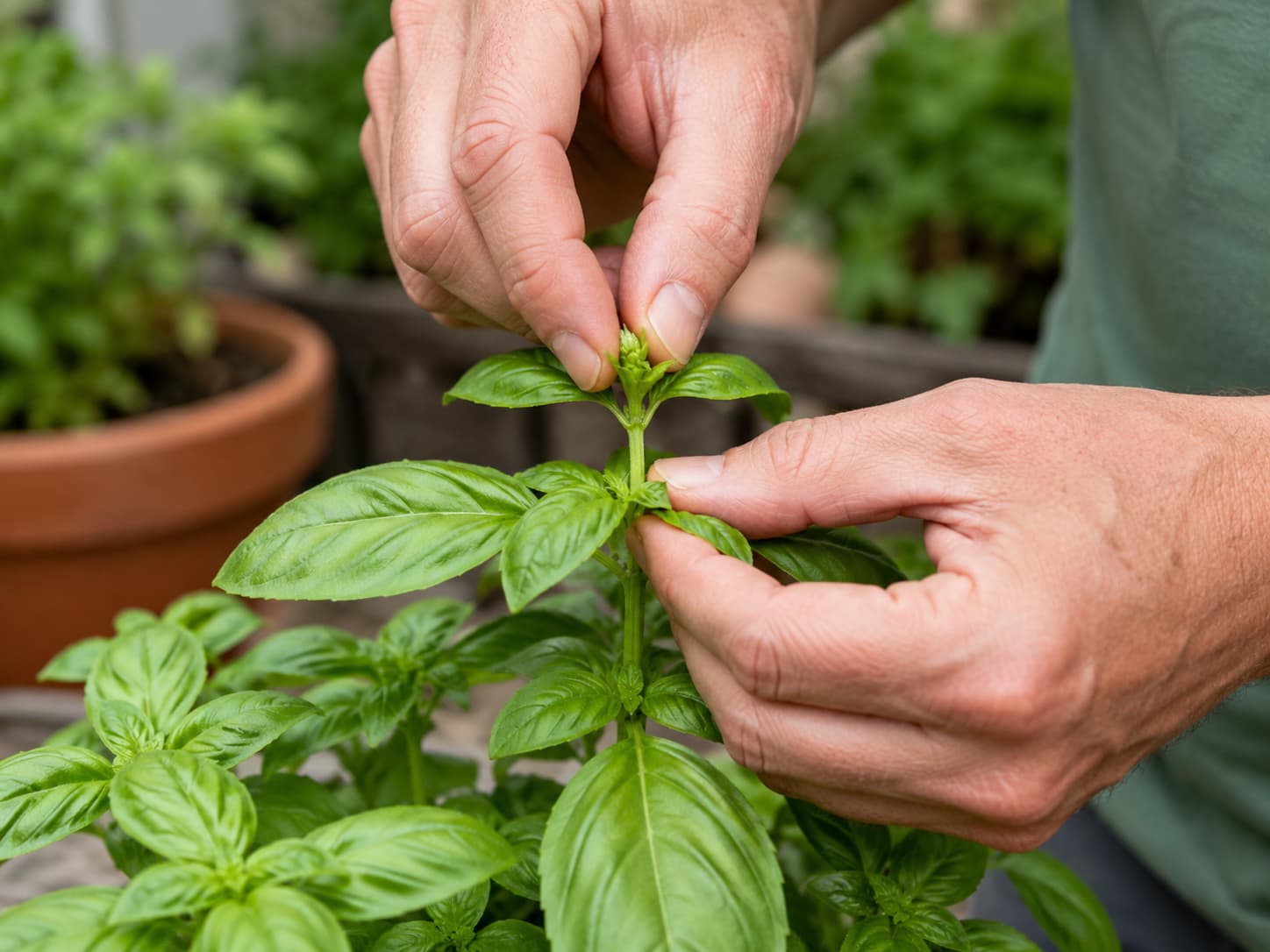
greenmuse-illustration-pinching-basil-flower-buds-leaf-node.jpg
Basil's life cycle is simple: grow leaves → produce flowers → set seed → die. Once the plant flowers, it has completed its biological mission. Leaf production drops dramatically, remaining leaves become smaller and bitter, and the plant's energy goes entirely into seed production.
This isn't a failure—it's the plant doing exactly what it evolved to do. But if you want to keep harvesting leaves, you need to delay flowering as long as possible.
How to Pinch Basil Flowers
- Check your basil every 2–3 days once it reaches 6 inches tall. Flower buds form at the top of each stem, initially looking like tiny tight clusters of green beads.
- Pinch the bud + the two leaves below it. Use your fingernails or snips to cut just above a lower pair of leaves. Those leaf nodes will branch into two new stems, giving you a bushier plant.
- Harvest regularly. Every time you pick basil for cooking, cut a stem back to a leaf pair. Regular harvesting IS pruning—it prevents the plant from ever reaching the flowering stage.
My rule: every time I walk past my basil, I pinch the top two leaves off the tallest stem. It takes 5 seconds, and the plant stays bushy and productive for months instead of weeks.
When Flowering Is Actually Okay
Let your basil flower if you want to save seeds for next year—the flowers produce seeds you can harvest and store. Let one or two plants go to seed at the end of the season while keeping the rest pruned for leaf production. Basil flowers are also excellent for pollinators; I always let a few bloom in late September for the bees before frost takes the plant.
Emergency Rescue: Why Is My Basil Dying, and Can I Save It?
If your basil looks nearly dead, here's the rescue protocol in order of priority:
- Check the soil moisture. If wet → stop watering immediately. If bone dry → water thoroughly.
- Fix drainage. If the pot has no holes, repot immediately into one that does. If the saucer is full, empty it.
- Inspect the roots. Gently slide the plant out of its pot. Healthy roots are white and firm. Rotting roots are brown, black, or mushy. Cut away all rotted roots with clean scissors, then repot in fresh dry potting mix.
- Prune heavily. Remove all yellow, brown, or damaged leaves and stems. If the plant is more than 50% affected, cut it back to 3–4 inches—this shocks it into new growth and eliminates diseased tissue.
- Relocate. Move to a warm spot (70–80°F) with at least 6 hours of direct light. Avoid cold drafts and AC vents.
- Wait 3–5 days before doing anything else. No fertilizer. No extra water unless the finger test says dry. Let the plant recover before pushing it.
Recovery timeline: If the roots are still mostly healthy, you'll see new leaf buds within 7–10 days. If more than 70% of the roots are rotted, start a new plant—it'll be faster and less frustrating. I've tried saving basil with 3 living roots out of a mass of rot. It took 4 weeks and the result was a sad, stunted plant. A fresh seedling would have been harvestable in the same time.
Basil Dying Indoors vs. Outdoors: Different Rules
The 7 mistakes apply everywhere, but their frequency and severity differ based on where you grow:
| Mistake | Indoor Basil Risk | Outdoor Basil Risk |
|---|---|---|
| Overwatering | High — soil dries slowly indoors | Low — heat and wind accelerate drying |
| Poor drainage | High — decorative pots often lack holes | Low — garden soil usually drains well |
| Low light | Very high — most windowsills don't provide enough | Rare — full sun is default outdoors |
| Cold stress | Moderate — cold glass, AC vents | High — spring/fall nights, early planting |
| Crowding | Moderate — one pot = one plant | Moderate — planting too close in beds |
| Over-fertilizing | Moderate — slow growth means nutrients accumulate | Low — rain flushes excess; faster growth uses more |
| Early flowering | Low — indoor basil grows slower, flowers later | High — heat and long days trigger flowering fast |
Drag the bar below or swipe horizontally to view the remaining columns.
If you're growing indoors, your top 3 priorities are: light, drainage, watering discipline. Outdoors, it's: cold protection, pinching flowers, and watering during drought. The same pattern applies to other Mediterranean herbs—the problems shift based on environment, not plant species.
5 Basil Varieties and Their Specific Weaknesses
Not all basil is equally fragile. Here's how the most common varieties differ in what tends to kill them:
| Variety | What It's Best For | Most Vulnerable To | My Experience |
|---|---|---|---|
| Genovese (sweet basil) | Pesto, Italian cooking | Cold stress, overwatering | The classic. Produces huge leaves but wilts below 50°F. I grow 3 plants every summer. |
| Thai basil | Stir-fries, curries | Overwatering (hates wet feet more than sweet basil) | More heat-tolerant but equally cold-sensitive. Anise flavor is irreplaceable in Thai cooking. |
| Lemon basil | Seafood, teas, desserts | Low light (needs full sun for essential oil production) | Finicky. Grew it once and it bolted in 4 weeks. Best in full-sun outdoor containers. |
| Purple basil ('Dark Opal') | Garnish, vinegars, ornamental | Downy mildew (dark foliage hides early symptoms) | Check undersides of leaves weekly—the purple color makes spotting disease harder. |
| Greek bush basil | Small pots, windowsills, garnish | Crowding (naturally compact, don't overplant) | The most forgiving variety for beginners. Stays under 8 inches, tolerates imperfect conditions. |
Drag the bar below or swipe horizontally to view the remaining columns.
Basil Pests: The 3 You'll Actually See
Basil has relatively few pest problems compared to other herbs, but three show up reliably:
| Pest | Signs | Organic Treatment |
|---|---|---|
| Japanese beetles | Lace-like holes in leaves; beetles visible on plant in June–July | Hand-pick early morning (they're sluggish); drop into soapy water. Don't use traps—they attract more beetles to your yard. |
| Aphids | Curling new leaves; sticky residue on surfaces below | Spray with neem oil (1 tsp per quart + 1 drop dish soap); repeat every 3 days |
| Slugs/snails | Irregular holes in leaves; slimy trails on pot/soil | Beer trap (shallow dish of beer at soil level); copper tape around pot rims; hand-pick at night with a flashlight |
Drag the bar below or swipe horizontally to view the remaining columns.
For comprehensive pest identification and treatment, see Summer SOS: How to Spot & Stop Common Pests on Heat-Stressed Plants.
The Basil Survival Routine (5 Minutes a Day)
Once your basil is healthy, keeping it that way takes almost no time if you build a simple routine:
| Task | When | Time |
|---|---|---|
| Finger-test soil; water if dry at 1 inch | Daily (morning) | 30 seconds |
| Pinch top leaves on tallest stems | Every 2–3 days | 10 seconds |
| Check for flower buds; remove if found | Every 2–3 days | 15 seconds |
| Rotate plant 90° (indoor only) | Every 3 days | 5 seconds |
| Inspect for pests or yellow leaves | Weekly | 1 minute |
| Fertilize (during active growth only) | Every 2–3 weeks | 2 minutes |
Drag the bar below or swipe horizontally to view the remaining columns.
Total weekly time investment: about 5 minutes. That's less time than it takes to drive to the store and buy a $3 clamshell of basil that will go bad in your fridge in 3 days.
If you keep coming back to the question why is my basil dying, re-check the basics in this order: soil moisture, drainage, light, temperature, then pests or disease. Fix one variable at a time so you can see what the plant actually responds to.
Frequently Asked Questions
1. Can a basil plant with brown stems be saved?
2. Why does my basil wilt every afternoon but looks fine in the morning?
3. Should I cut off basil flowers or let them bloom?
4. Can I grow basil indoors year-round?
5. Why are my basil leaves turning black?
Sources
- University of Minnesota Extension. "Growing Basil Indoors." extension.umn.edu, 2023. extension.umn.edu
- Cornell University Cooperative Extension. "Basil: Downy Mildew." vegetablemdonline.ppath.cornell.edu, 2024. vegetablemdonline.ppath.cornell.edu
- University of Florida IFAS Extension. "Herbs in the Florida Garden." edis.ifas.ufl.edu, 2023. edis.ifas.ufl.edu
- National Gardening Association. "Home Garden Trends Survey." garden.org, 2024. garden.org