Best Grow Lights for Indoor Herbs and Succulents: 5 Practical Picks for 2026
A grow light can solve the winter-window problem, but only if enough usable light actually reaches the leaves. This 2026 refresh compares five practical options for herbs and succulents, updates current product specifications, and separates hands-on observations from manufacturer claims so you can choose a light without relying on vague “full spectrum” marketing.
Quick Picks Before You Compare
5 Grow Lights Compared
| Pick | Best for | Current verified spec highlights | Price tier |
|---|---|---|---|
| Barrina T5 2FT 5000K | Mixed plant shelves | 10W per bar · 5000K · 2 ft · 120° beam · linkable | $ |
| GooingTop HY-021 | One small herb / desk plant | 10W actual draw · 6000K · 5 brightness levels · 4/8/12h timer | $ |
| Soltech Aspect Gen 2 | Visible living spaces | 36W · 3000K · 3000 lm · 50 μmol/s PPF · 10–100% dimmer | $$$ |
| GE Grow PAR38 Seeds & Greens | Focused high-output bulb setup | 32W · 2000 lm · 50 PPF · E26 base | $$ |
| SANSI PAR20 10W | Compact single-plant bulb setup | 10W · 4000K · 16.8 μmol/s PPF · E26 · 60° beam | $ |
Current specifications were rechecked against manufacturer pages in September 2026. Exact bundles, cords, timer inclusions, pricing, and stock can change.
Why Herbs and Succulents Often Need More Than a Winter Window
My rosemary was the plant that pushed me to take grow lights seriously. In late fall, it began leaning toward the glass and producing thinner growth, while an echeveria nearby slowly lost its compact rosette shape. The window looked bright to me, but the plants were telling a different story.
In other words, this is the central grow-light lesson: human-visible brightness is not the same thing as plant-usable light at the leaf surface. Window direction, glass, clouds, season, latitude, distance from the window, and the number of useful daylight hours all matter.
For plant-light comparisons, PPFD is more useful than Kelvin because PPFD describes the density of photosynthetically active photons reaching a surface. PPF describes the total photon output of a fixture. Lux can still be a rough comparison tool for similar white LEDs, but it is weighted for human vision and should not be treated as a universal plant-light target.
Therefore, the old shortcut—“this light is 6500K, so it must be good”—is not enough. A 5000K or 3000K fixture can grow plants perfectly well if it delivers enough usable light over the right area.
What Actually Matters in a Grow Light
1. PPFD at the distance you will actually use
If a manufacturer publishes a PPFD chart at several distances, that is more useful than a vague “100W equivalent” label. Compare the measurement at the height you can realistically maintain above your plants.
2. Coverage before wattage
A narrow spotlight and a long bar can use similar electrical power but solve completely different problems. Bar-style lights are easier for a shelf because they spread light along a line. A PAR bulb is better when you want to concentrate light over one or two plants.
3. Spectrum and color temperature—but in the right order
Most modern white grow lights cover a useful range of visible wavelengths. Color temperature mainly changes how the light looks in your room and how its spectral balance feels to your eyes. A neutral 4000K light, a daylight 5000K light, and a warmer 3000K fixture can all grow plants when output is sufficient.
4. Timer, dimming, heat, and mounting
A technically strong light can still be a poor everyday choice if it is awkward to mount or annoying to control. Timers reduce missed days. Dimming helps you acclimate plants. A wider beam makes placement less fussy. LEDs run cooler than older grow-light technologies, but the fixture still produces heat and very intense light can stress leaves even when the air does not feel hot.
Best Overall for Shelves: Barrina T5 2FT 5000K Grow Lights
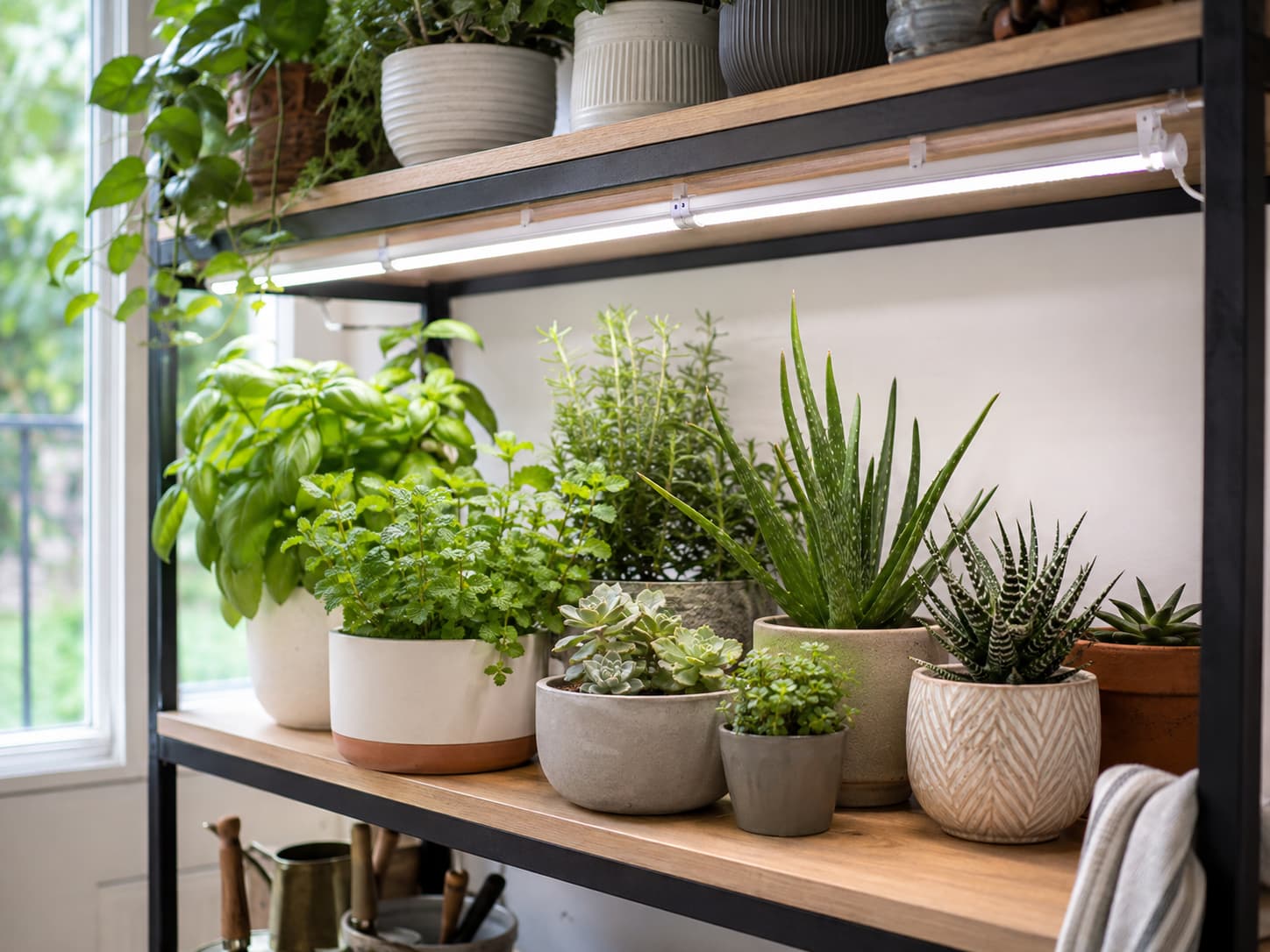
Why it is still the easiest shelf recommendation: Barrina’s current 2-foot T5 grow-light line is designed around narrow linkable bars, which makes it easy to place one or more fixtures over a shelf without giving every pot its own lamp.
The important correction from the older Greenmuse article is the specification. The current 2-foot 5000K T5 grow-light variants are 10W per bar, not 20W. Barrina also sells longer T5 versions with higher wattage, which is where the earlier mixed specification came from.
What current manufacturer data says: the 2-foot 5000K version is 10W per light, uses a 120-degree beam, and is linkable. Some current variants add magnetic mounting hardware. Because Barrina sells several T5 families and pack sizes, match the model number before comparing output or accessories.
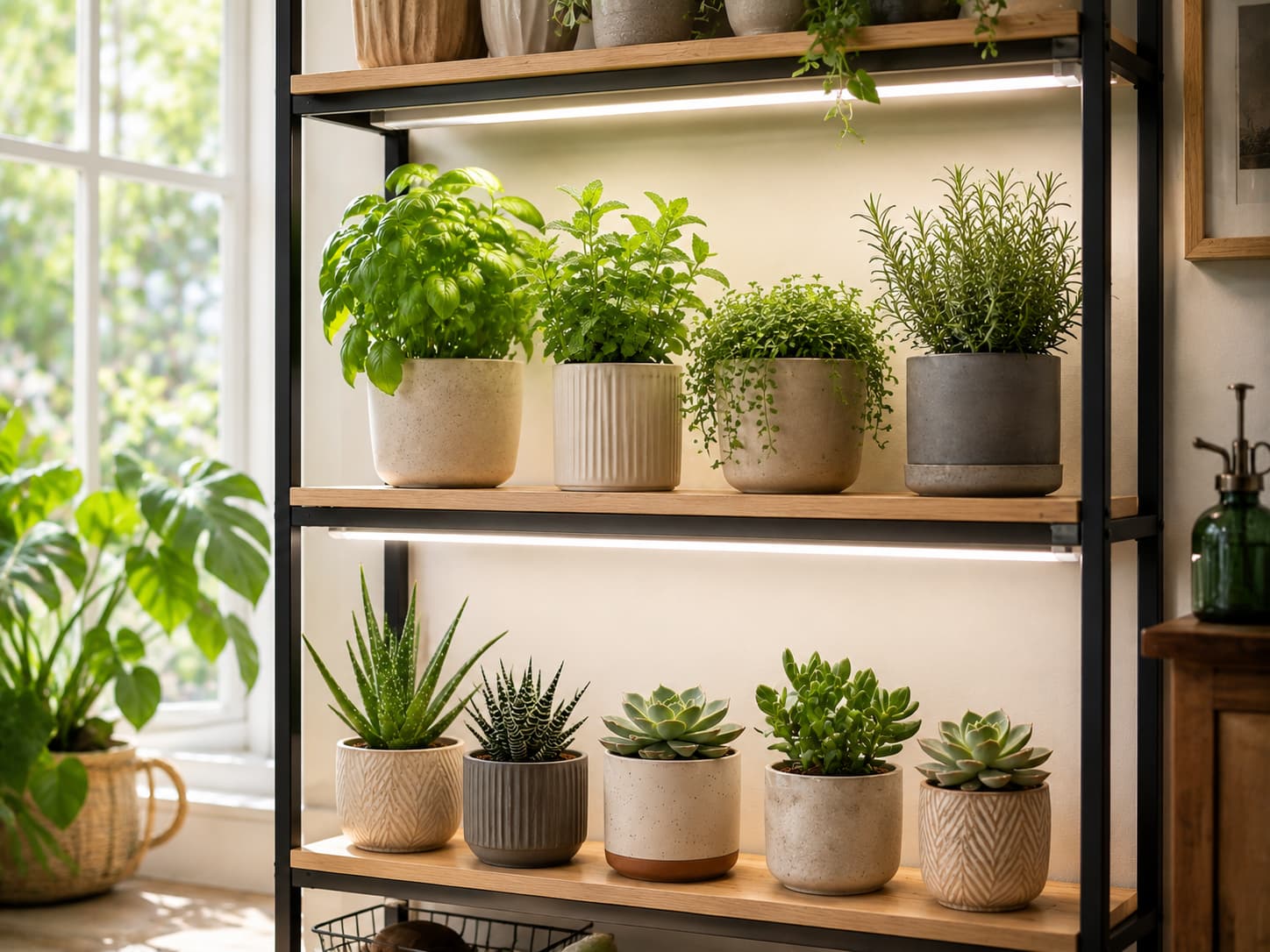
Greenmuse use case: choose this style when you have a shelf of rosemary, basil, mint, aloe, haworthia, echeveria, or seedlings and want even coverage more than a decorative fixture.
Best Budget Clip Light: GooingTop HY-021 6000K
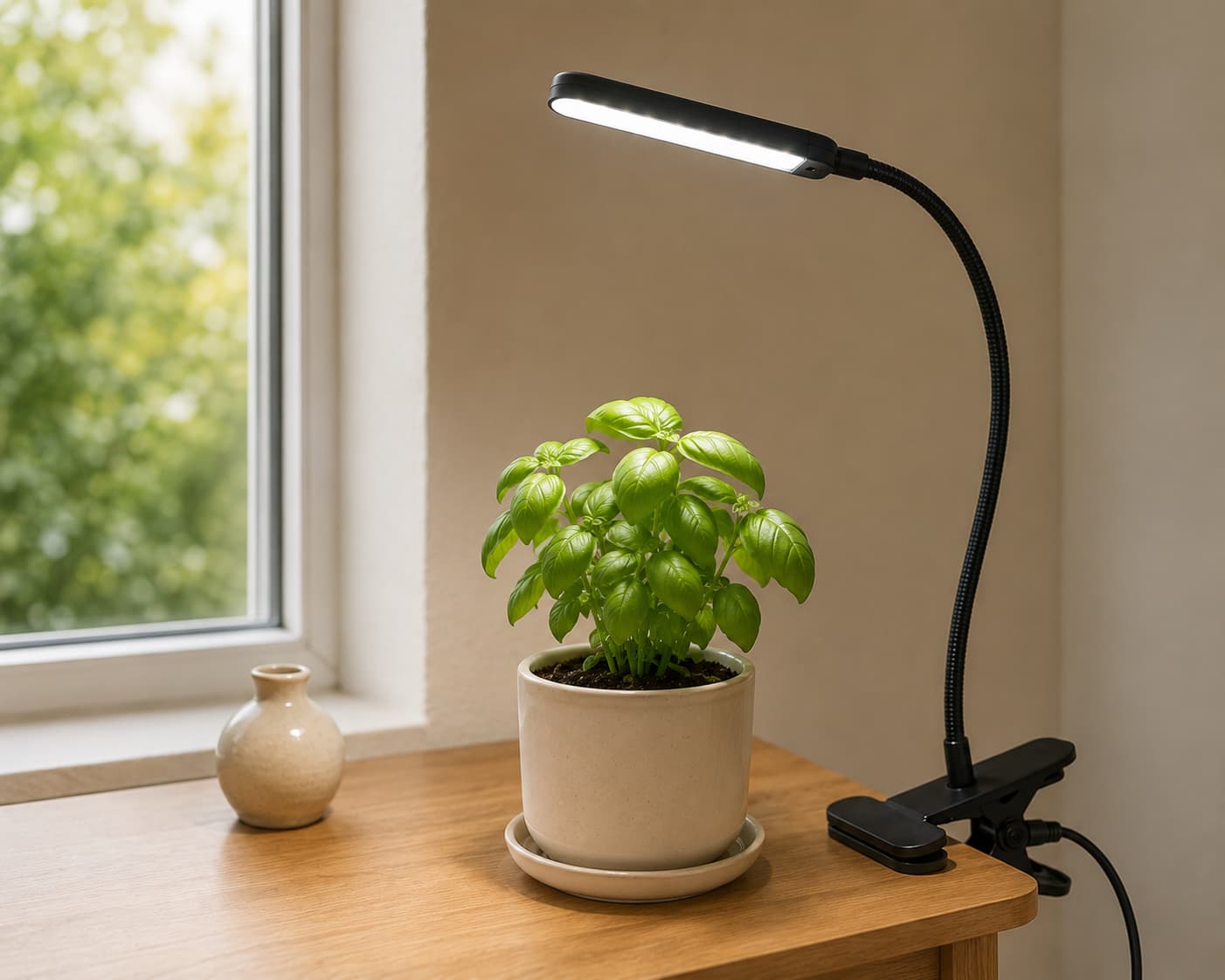
Why it makes sense: the GooingTop HY-021 is a practical “one small plant or a couple of compact pots” light. It uses a clamp and flexible neck, so you can aim it without installing a shelf fixture.
The older Greenmuse article listed “5 color modes + 10 brightness levels.” That does not match the current HY-021 specification. GooingTop currently describes this 6000K model as a 10W actual-draw light with five brightness levels and a repeating 4/8/12-hour timer.
Best use: basil, mint, parsley, seedlings, a small haworthia, or another compact plant that already receives some window light. For a broad tray or a very light-hungry echeveria collection, move up to a wider or stronger fixture.
Best Looking: Soltech Aspect Gen 2
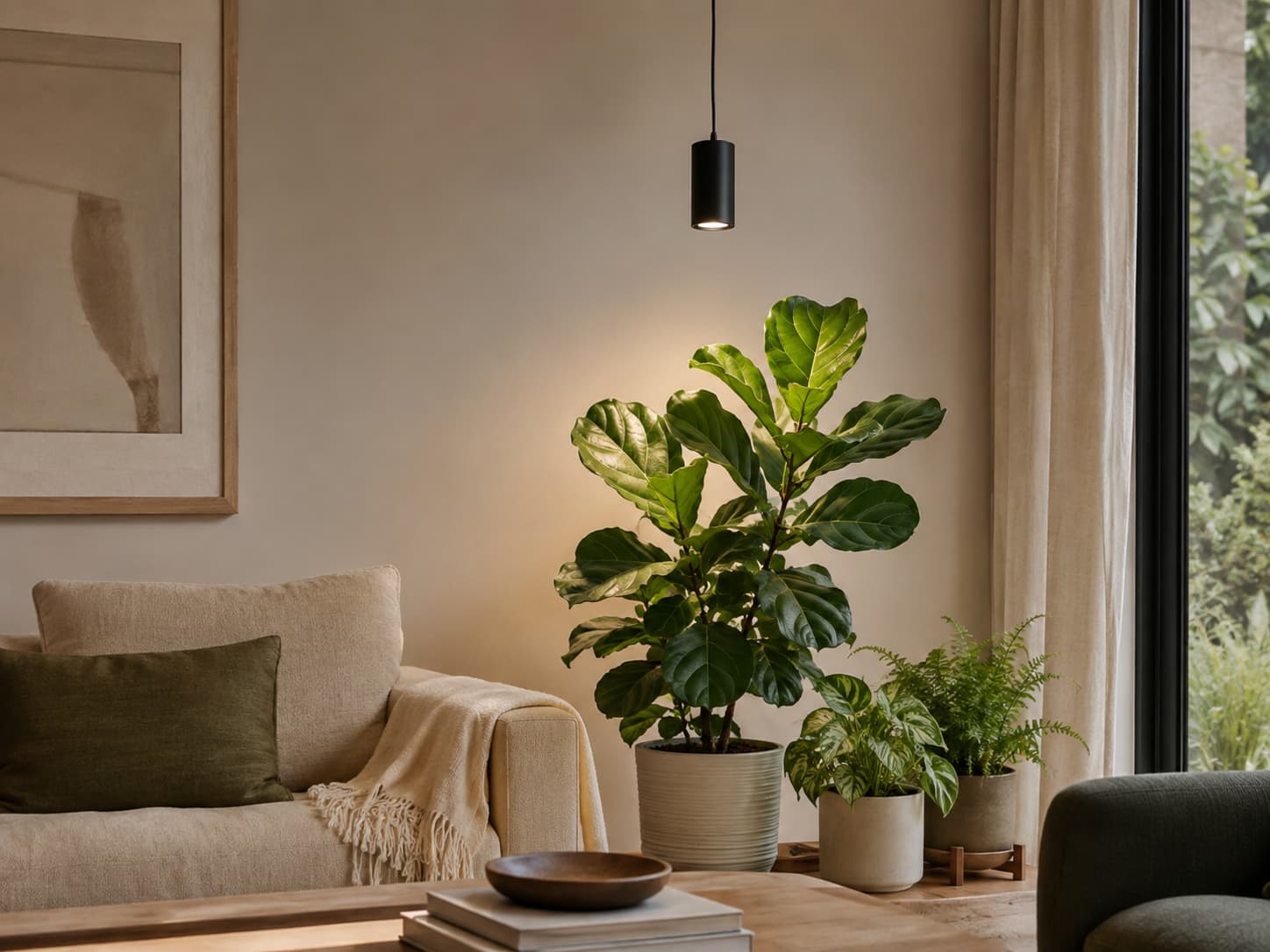
Why it is different: most grow lights look like equipment. The Aspect is designed to look like a pendant fixture, which makes it easier to use above plants in a living room, dining area, or visible kitchen corner.
Important transparency note: Greenmuse’s earlier hands-on observations were based on the previous-generation Aspect. The current product is Aspect Gen 2, and its specifications have changed enough that the old 20W / 4000K / 2000-lumen numbers should not be carried forward.
Soltech currently lists the Aspect Gen 2 at 36W, 3000K, 3000 lumens, 50 μmol/s PPF, with a 10–100% inline dimmer, 60-degree beam, and an 18-foot fabric cord. Soltech also publishes PPFD at several distances, which makes this model easier to position responsibly than a fixture that publishes only lumens.
Best use: one visually important plant grouping where aesthetics matter as much as output. It is expensive for a utility shelf, but it solves a different problem than a Barrina bar.
Best Concentrated Bulb: GE Grow PAR38 Seeds & Greens
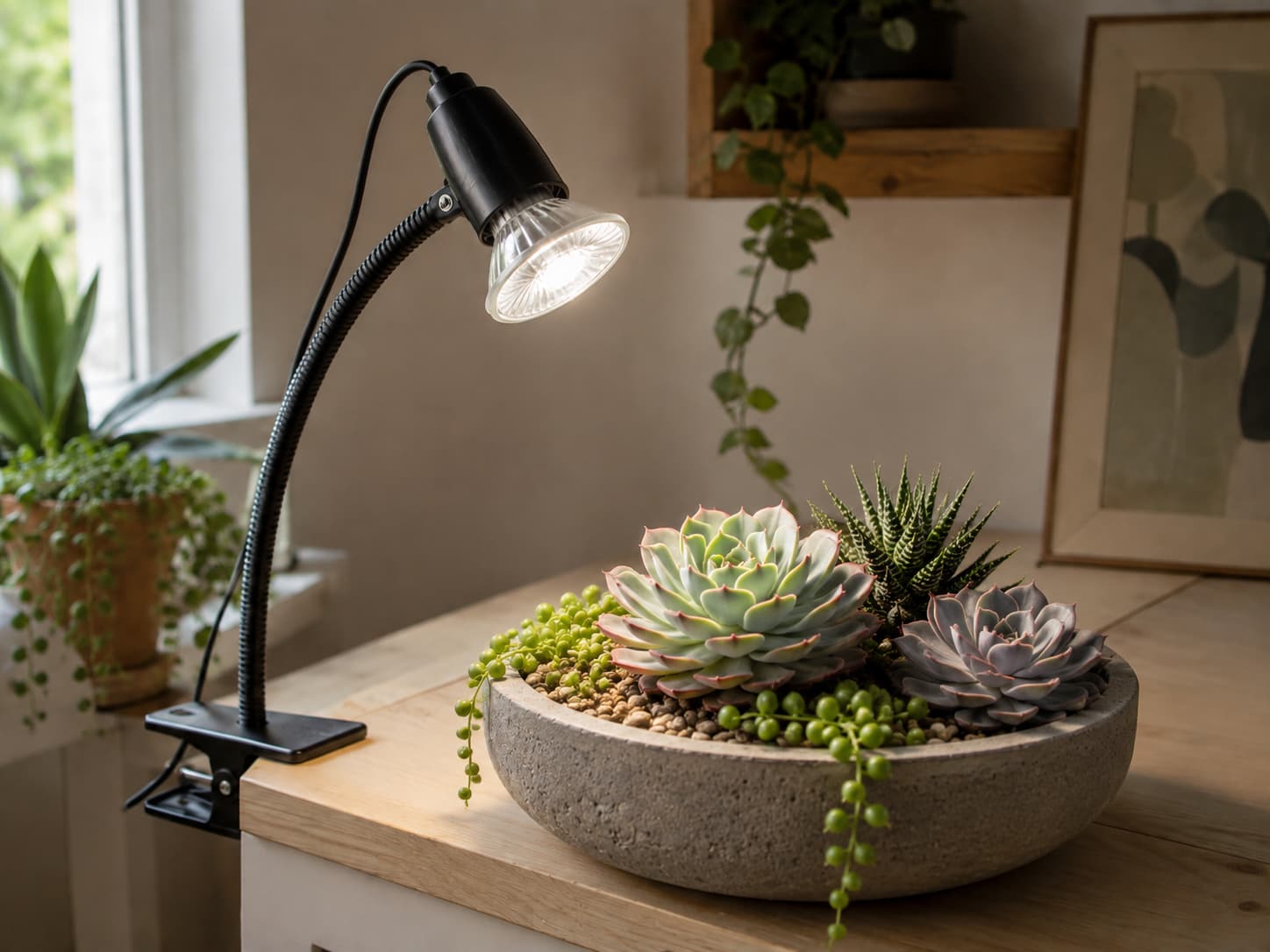
Why it belongs here: a PAR38 bulb gives you a focused beam without committing to a shelf system. Screw it into a suitable E26 fixture and aim it at a compact group.
The old Greenmuse article listed this bulb at 1,200 lumens. GE’s current Seeds & Greens PAR38 is listed at 32W and 2,000 lumens, with 50 PPF. GE also publishes model-specific hanging guidance; use that current guidance instead of assuming the bulb belongs 4–8 inches from every succulent.
Best use: one compact high-light plant group where you can control fixture height. Echeveria, crassula, compact herbs, and other plants that visibly stretch in weak winter light are reasonable candidates, provided you acclimate them rather than moving the bulb dramatically closer overnight.
Best Compact Screw-In Bulb: SANSI PAR20 10W
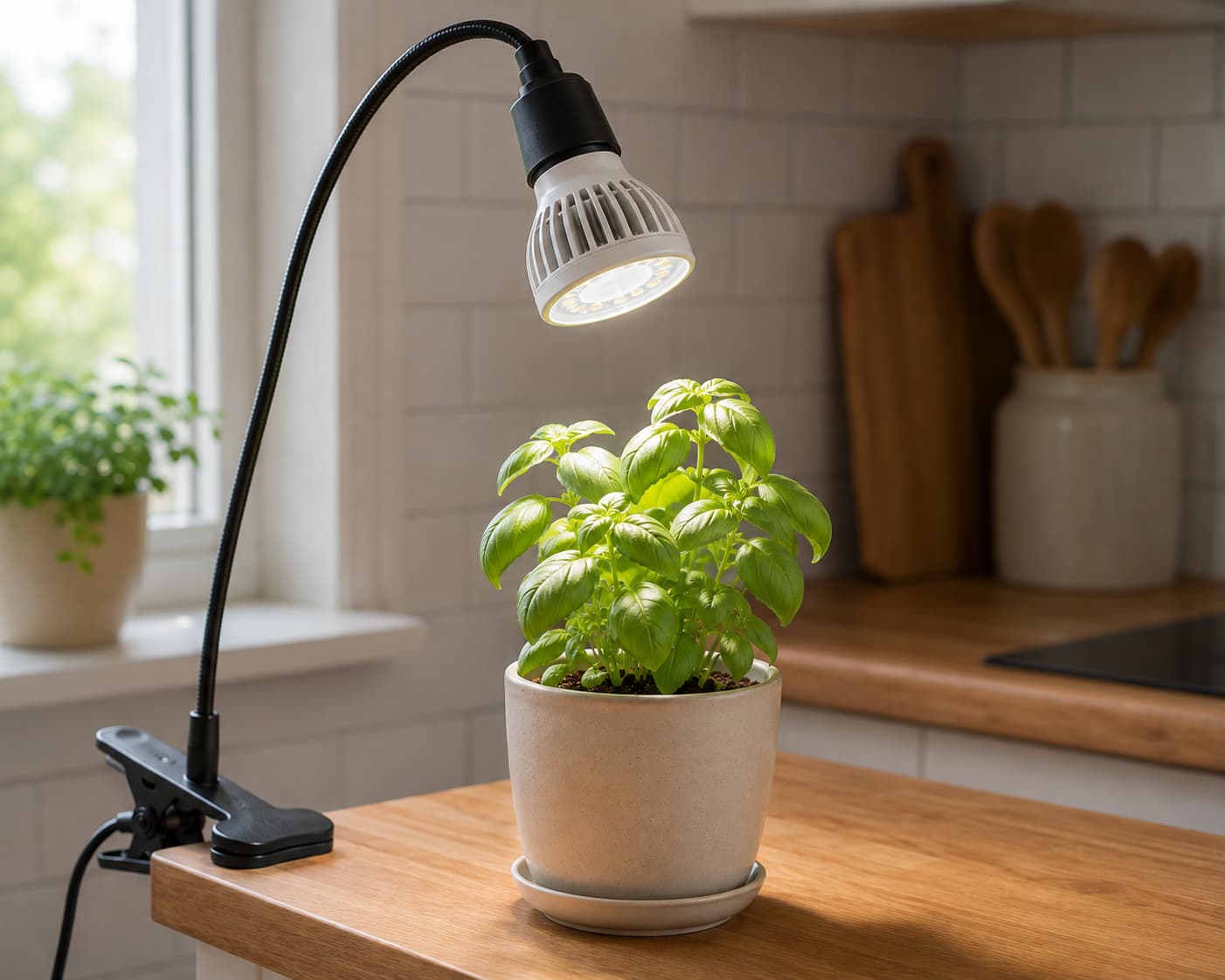
Why this replaces the old Leoter recommendation: the previous article’s Leoter section could no longer be tied confidently to one current model. Rather than keep mixed timer, head-count, and wattage claims, this refresh replaces it with a current bulb whose manufacturer publishes PPF and PPFD data.
SANSI lists its PAR20 10W grow bulb at 4000K with 16.8 μmol/s PPF and about 97.9 μmol/m²/s PPFD at 1 foot. It uses a standard E26 base in the U.S. version and a 60-degree beam.
Best use: one herb pot, one medium-light succulent, or a small plant corner where you already own a suitable lamp. It is not the right choice for a wide multi-pot shelf.
How Far Away Should a Grow Light Be?
There is no single correct number for “herbs” or “succulents.” Distance changes usable intensity, but the relationship depends on fixture shape, optics, reflectors, and coverage. A long bar does not behave like a point-source bulb, so the simple “double the distance = one-quarter the light” shortcut should not be applied blindly.
For a practical setup, use this order:
- Start with the manufacturer’s PPFD or hanging-height guidance.
- Place the light toward the conservative end of the range.
- Run a consistent schedule for several days.
- Watch new growth rather than old leaves. Stretching suggests more usable light may be needed; bleaching, pale patches, or sudden curling suggest you should back off.
- Change one variable at a time. Move the light or extend the schedule gradually rather than doing both at once.
Starting Schedules by Plant Type
| Plant group | Reasonable starting schedule | What to watch |
|---|---|---|
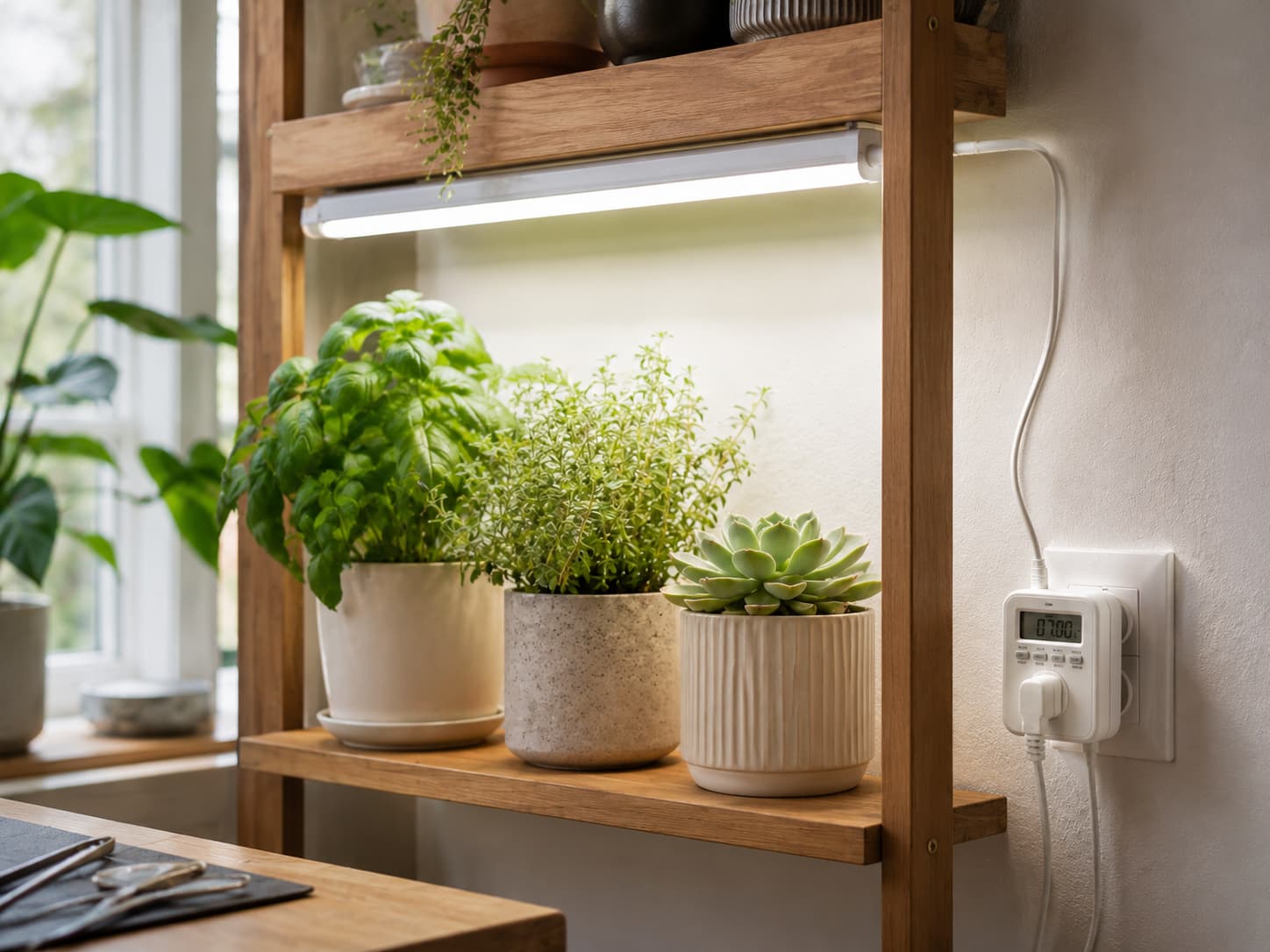
| Rosemary, thyme, lavender | About 12–14 hours when grow light is the main winter supplement | Compact tips, normal leaf size, no pale stretched internodes |
| Basil, mint, parsley | About 10–14 hours depending on natural window light | Full leaves, sturdy stems, no leaning toward the window |
| Echeveria, crassula, sedum | About 12–14 hours as a common home starting point | Compact rosette / internodes, no bleaching or sudden scorch |
| Aloe, haworthia, gasteria | About 10–12 hours in many mixed-light home setups | Normal leaf posture and color; avoid abrupt high-intensity changes |
However, these are starting points, not universal prescriptions. A plant receiving several hours of strong window sun may need less supplemental light than the same species in a windowless corner.
Do plants need darkness?
Yes. In general, most household plants benefit from a regular dark period, but not because respiration only happens at night. Plants respire during both day and night. Darkness matters for circadian rhythms, photoperiod responses, and normal regulation of growth.
For most herbs and succulents in a home setup, there is rarely a reason to run grow lights 24 hours a day.
4 Grow-Light Mistakes That Waste Money
1. Buying by “watt equivalent” instead of useful output
Marketing names such as “100W grow light” can describe an equivalency rather than actual electrical draw. Check actual watts, PPF or PPFD when available, beam shape, and coverage.
2. Treating Kelvin as the main plant metric
A 6500K light is not automatically stronger or more plant-effective than a 3000K light. Kelvin describes the appearance of white light. Output at the leaves matters more.
3. Hanging the fixture far away because the room looks bright
A light can make a room look bright while delivering little useful intensity at the plant. Follow the model-specific guidance and adjust gradually.
4. Changing distance, hours, watering, and fertilizer at the same time
When a plant stretches, it is tempting to fix everything at once. That makes it hard to know what helped. Improve light first, then watch new growth. Remember that moving a plant under stronger light can also make the pot dry faster, so watering frequency may change afterward.
Which Grow Light Should You Choose?
- You have a multi-level shelf: Barrina T5 2FT bars are the simplest coverage-first choice.
- You have one herb pot and want a cheap clip light: GooingTop HY-021.
- The fixture will be visible in your living room: Soltech Aspect Gen 2.
- You want a strong focused E26 bulb: GE Grow PAR38.
- You want a compact bulb with published PPF/PPFD: SANSI PAR20 10W.
Finally, if you are unsure, choose by space first: shelf, single plant, living room grouping, or focused high-light corner. Once the form factor is right, compare output and placement data.
Frequently Asked Questions
Light Strength, Timing & Safety
Can I use a regular LED bulb instead of a grow light?
Yes. A sufficiently bright white LED can support plant growth because white LEDs include wavelengths plants can use. A dedicated grow light is often easier because it may publish PPF or PPFD data, use optics designed for plant coverage, and come in a form that is easier to position close to leaves.
How do I know if my grow light is strong enough?
Use the manufacturer’s PPFD chart when available and watch new growth. Stretching, widening spaces between leaves, or repeated leaning toward another light source often means the plant needs more usable light. Increase intensity or duration gradually rather than making a dramatic change overnight.
Should grow lights stay on 24 hours?
No. Most household herbs and succulents benefit from a regular light-dark cycle. A common home starting point is roughly 10–14 hours of supplemental light, adjusted for species and natural daylight. Plants respire during both day and night; the dark period is important for circadian and photoperiod processes rather than being the only time respiration occurs.
Can LED grow lights burn plants?
Yes. LEDs often produce less radiant heat than older grow-light technologies, but too much light intensity can still bleach or stress leaves. Heat from the fixture can also matter at close range. Acclimate plants to stronger light gradually.
Choosing Spectrum, Placement & Bulb Life
Do herbs and succulents need different grow lights?
Not necessarily. Many can share the same white full-spectrum fixture. The difference is more often placement and intensity: light-hungry succulents may need the brightest central area or a closer position, while softer herbs may perform well slightly farther away.
Is 5000K or 6500K always best for plants?
No. Those daylight-looking color temperatures are comfortable for many indoor setups, but Kelvin alone does not tell you how much plant-usable light reaches the leaves. A 3000K fixture with adequate PPF and PPFD can grow plants very well.
How long do LED grow lights last?
Life ratings vary by model. Current examples in this guide range around 25,000 to 50,000 hours. LEDs usually lose output gradually rather than failing all at once, so an aging fixture may still turn on while delivering less useful light than it did when new.
More Indoor Plant Help
- Echeveria Care Guide — use this if a rosette is stretching or losing its compact shape.
- Why Is My Aloe Vera Dying? — diagnose drooping, mushy, or brown leaves before assuming light is the only issue.
- How to Grow Rosemary Indoors and in Pots — light, airflow, watering, and root-zone care for a demanding Mediterranean herb.
- How to Grow Mint — use the main Mint guide rather than the older “Grow Mint Anywhere” page that Greenmuse is consolidating.
Sources & Current Product References
- University of Minnesota Extension. Lighting for indoor plants.
- UW–Madison Extension. Indoor lighting for plants.
- Barrina. T5 Series Grow Lights.
- GooingTop. Current grow-light models.
- Soltech. Aspect Gen 2 specifications.
- GE Lighting. Grow PAR38 Seeds & Greens specifications.
- SANSI. PAR20 10W Grow Light Bulb specifications.