Why Your Monstera Leaves Are Turning Yellow (And How to Fix It)
Quick summary: Monstera is the Instagram plant of the 2020s, but those iconic split leaves come with a catch - they yellow loudly when anything is off. This guide walks through a 5-minute Monstera-specific diagnostic method, 8 common causes (including aerial root stress and missing support that most guides miss), a step-by-step rescue plan, seasonal patterns, and variety-specific advice for Deliciosa, Adansonii, Albo, and Thai Constellation.
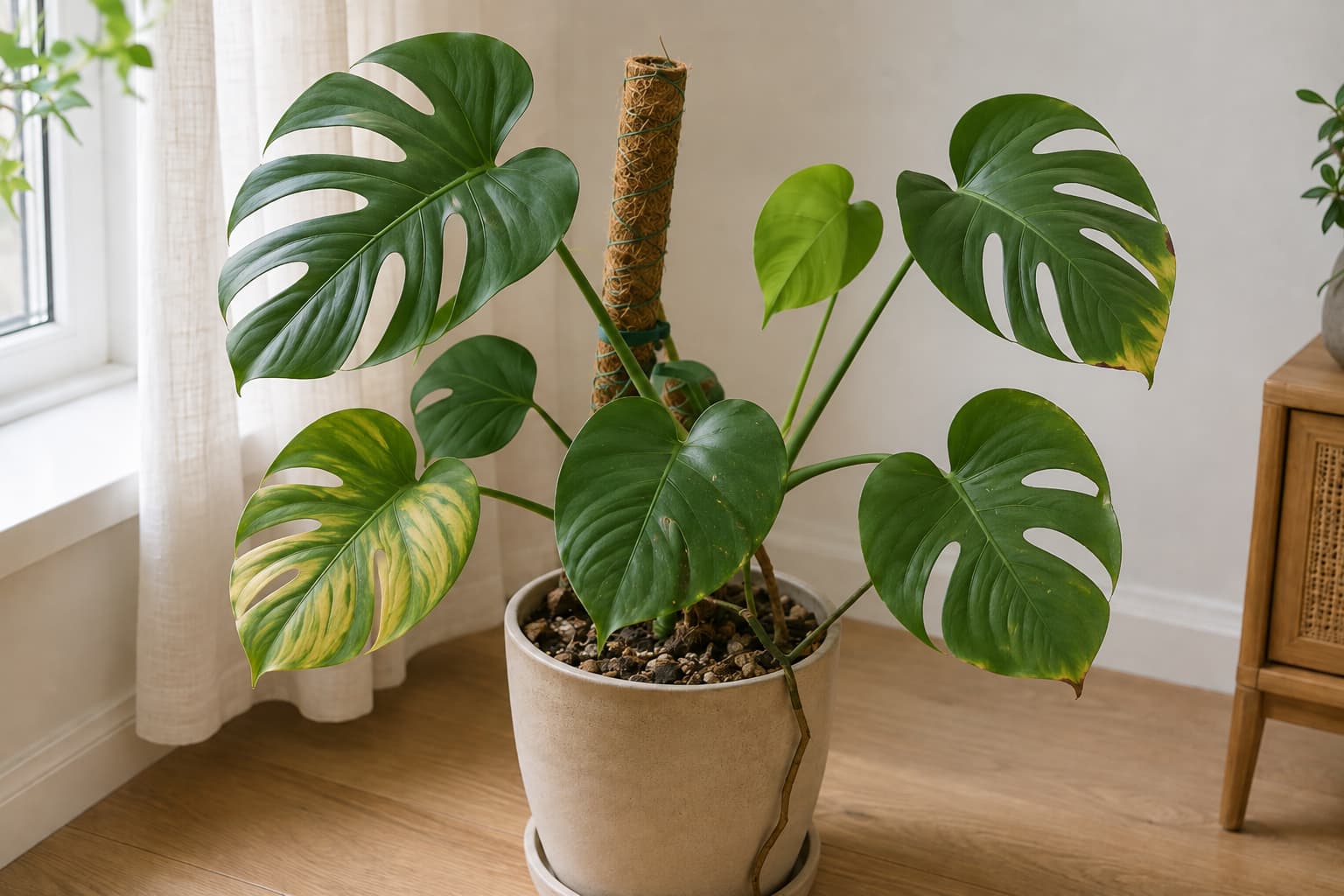
Monstera deliciosa has become the houseplant of the past decade - those big fenestrated leaves are irresistible, and the plant seems to forgive a lot. But there's a catch: Monstera leaves yellow loudly. When something is off, you'll see it on the leaves within days, and once a leaf turns yellow, it won't recover. The good news is that almost every cause is fixable if you catch it early.
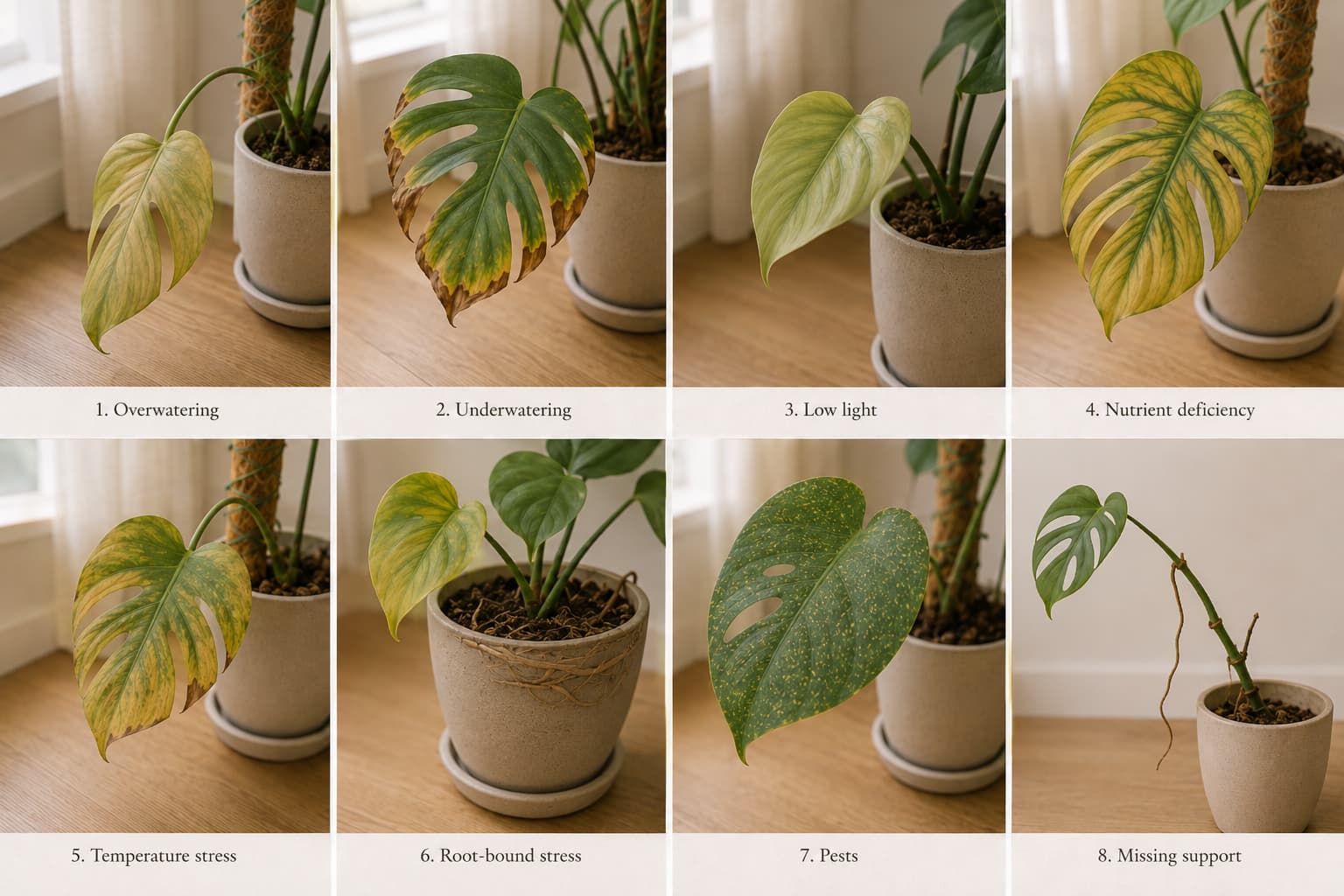
The challenge is that Monstera yellowing can come from at least eight different directions - and they overlap. Overwatering is the most common, but underwatering, low light (which also causes leaves not to split), nutrient gaps, temperature swings, root-bound pots, pests, and the often-overlooked issue of missing climbing support can all produce similar yellowing. This guide gives you a Monstera-specific diagnostic method, walks through each cause with specific symptoms, and finishes with a rescue plan for severely yellowed plants.
I bought my first Monstera in 2021 - a small two-leaf plant from a local nursery. I put it in a north-facing window of my apartment and waited for the iconic split leaves to appear. Six months later, the lower leaves had yellowed and dropped, and the new leaves were small, solid, and unsplit. It took me a while to understand that Monstera needs more light than most people think, and that the missing fenestrations were a yellow leaf warning I'd missed. The lessons below come from those mistakes and from years of answering reader questions. If you want the complete growing guide (not just the troubleshooting), see our indoor plant care guides.
The 5-Minute Monstera Diagnostic Method
Before doing anything, run through these five checks. They will narrow down the cause in under five minutes and save you from making the wrong fix. Monstera-specific signals are highlighted - including whether new leaves are splitting, which is a diagnostic clue Pothos and Philodendron owners don't have.
| Check | What to look for | Likely cause |
|---|---|---|
| 1. Leaf position | Yellowing on the lowest (oldest) leaves | Often overwatering or natural aging |
| Yellowing on top (newest) leaves | Often a nutrient or light issue | |
| Yellow patches on mature leaves facing the light | Possible sun scorch on recently moved plant | |
| 2. Leaf texture | Soft, limp, or slightly translucent | Often overwatering / possible root rot |
| Crisp, dry, papery - especially leaf tips | Underwatering or low humidity | |
| 3. Soil moisture | Stays wet for several days after watering | Often overwatering or poor drainage (confirm with root check) |
| Bone dry, pulling away from pot edges | Underwatering | |
| 4. Roots | White or pale tan, firm, smells earthy | Healthy - look elsewhere |
| Brown, black, soft, or foul smell | Root rot from overwatering | |
| 5. Fenestration (Monstera-specific) | New leaves smaller than previous ones, no splits or holes | Low light - even if yellowing hasn't started yet |
| New leaves fully formed with splits | Light is adequate - yellowing is from another cause |
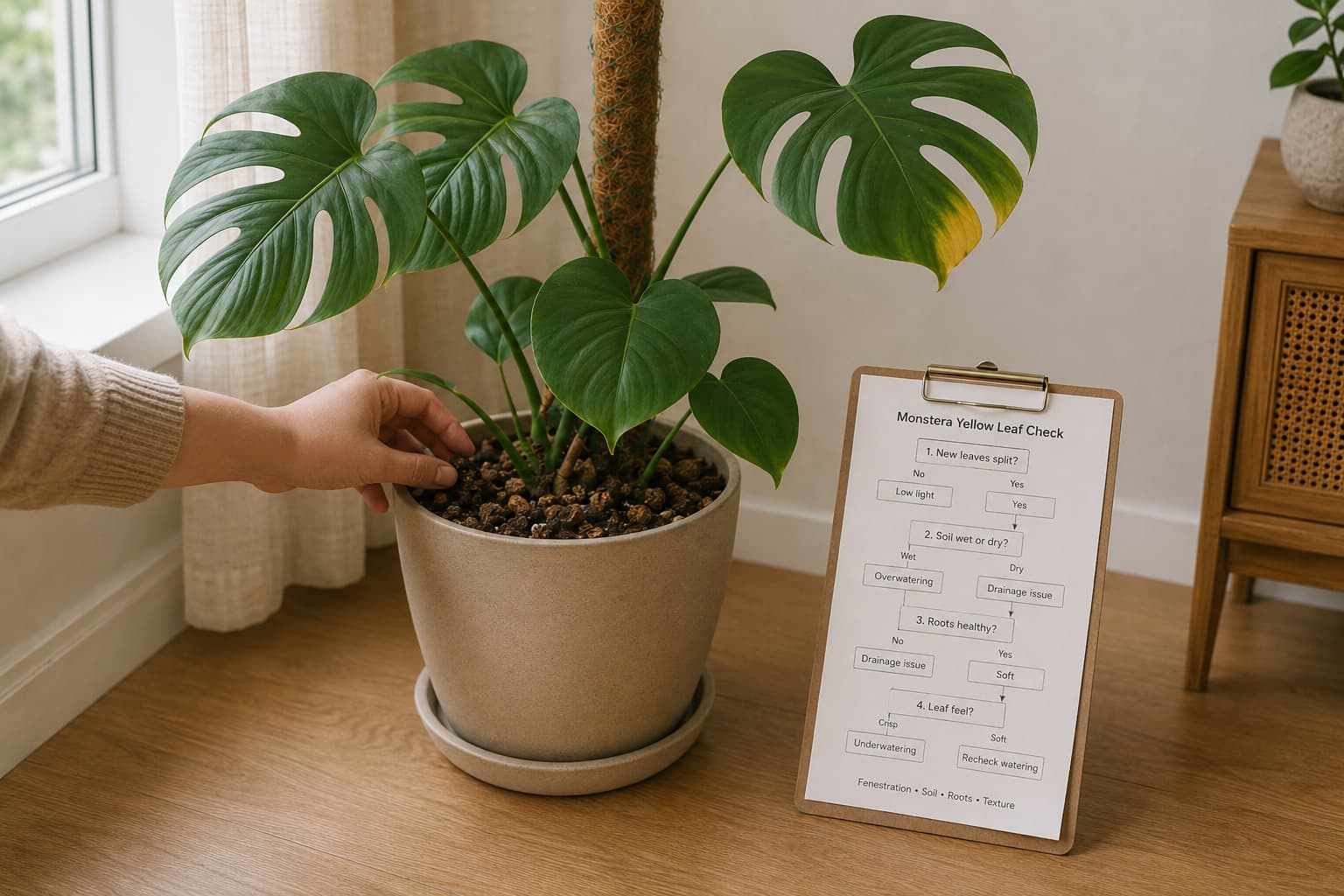
A soil moisture meter is one helpful tool, but it should not replace other checks - lifting the pot to feel its weight, pushing a finger or bamboo skewer into the mix, inspecting the roots, and considering pot size and drainage all matter too. Meters can read differently depending on soil composition and how deep they are pushed, so use them as one signal among several. (Disclosure: as an Amazon Associate I earn from qualifying purchases.)
8 Common Causes of Yellow Monstera Leaves
1. Overwatering (The #1 Culprit)
Overwatering is the most common cause of yellow Monstera leaves by a wide margin. The pattern is distinctive: the lowest (oldest) leaves turn pale yellow and feel soft or limp, the soil stays wet for days, and the stem may look slightly translucent at the base. If you slip the plant out of its pot, the roots should be firm and white or pale tan. Roots that are brown, black, soft, or foul-smelling indicate root rot.
Monstera deliciosa is an epiphytic vine native to the tropical forests of southern Mexico and Central America. In nature it climbs trees, with its roots exposed to air and anchored into bark and leaf litter. It is built to dry out between waterings. When the soil stays wet, the roots suffocate, die, and start to rot. The plant then can't take up water, which is why overwatered Monsteras often look wilted even though the soil is wet.
Fix: Stop watering and inspect the roots before doing anything else. Slip the plant out of the pot and remove only tissue that is soft, hollow, dark, or foul-smelling - healthy roots are firm and white or pale tan. Repot only when the existing mix is saturated, compacted, contaminated, or no longer draining properly; if the mix is still in good condition and only slightly wet, let it dry in shade before returning the plant to the pot. A container with proper drainage holes and a well-draining aroid mix make recurrence less likely, but they will not undo damage that has already occurred. For severe root loss, see the rescue plan below.
Personal note: My first Monstera almost died in 2022 from overwatering. I was watering every Sunday on a schedule, regardless of what the soil actually felt like. Once I switched to the finger test - water only when the top 2-3 inches are dry - the plant recovered and has been thriving since.
2. Underwatering
Less common than overwatering but increasingly frequent in summer or when people travel. Monstera underwatering shows up differently than in smaller houseplants because the large leaves lose water faster than the roots can pull it up. Symptoms: leaves curl downward first (a Monstera stress response), then leaf tips and edges turn crispy yellow or brown, and the lowest leaves yellow completely and drop. The soil will be bone dry and may have pulled away from the pot edges.
Fix: Water deeply until water runs out the drainage holes. If the soil has become hydrophobic (water runs straight through without absorbing), bottom-water by setting the pot in a bowl of water for 30-60 minutes, then drain. Resume a regular watering schedule based on soil moisture, not the calendar. Monstera in average home conditions typically needs water every 7-10 days in summer, every 10-14 days in winter, but always check the soil first.
3. Low Light (And Why Monstera Leaves Won't Split)
This is the cause most Monstera owners miss - because the yellowing is slow and the more obvious symptom is the missing fenestrations. In sustained low light, the plant cannot photosynthesize enough to support all its leaves, so it sacrifices the oldest ones first. The result is a slow, even yellowing of lower leaves while the vine stretches toward any light source. But the more telling signal is the new growth: if new leaves are smaller than the previous ones, lack the iconic splits and holes, or are solid rather than fenestrated, the plant is light-starved.
The exact reason Monstera develops fenestrations is still debated among botanists - leading theories include wind passage through the canopy, light penetration to lower leaves, and rain drainage. What is clear is that fenestrations only develop when the plant has enough light to make the larger leaves worthwhile. So if your Monstera's new leaves are coming in solid, treat it as an early warning of yellowing to come, even before any leaves turn yellow.
Fix: Move to a brighter location - ideally an east or south-facing window with 4-6 hours of bright indirect light. Direct sun will scorch the leaves (see Cause #5), so filter with a sheer curtain if needed. In rooms with no suitable window, a full-spectrum LED grow light on a 12-hour timer is the answer. For a deeper dive into lighting options, see our guide to the best grow lights for indoor plants.
Personal note: That first Monstera I mentioned - the one in my north-facing window - took me six months to figure out. Once I moved it to a brighter east window, the next leaf came in with full splits within five weeks. The lesson: if your Monstera isn't fenestrating, it's telling you it doesn't have enough light, and yellowing will follow.
4. Nutrient Deficiency
If your Monstera has been in the same pot for more than a year without fertilizer, yellow leaves may be a sign of nutrient depletion. The pattern matters, but treat patterns as clues rather than definitive diagnoses - a soil test or recent fertilizing history helps confirm. Yellow new leaves with green veins can indicate iron chlorosis, often related to pH imbalance or old potting mix. Uniform yellowing of the oldest leaves may suggest nitrogen depletion. Yellowing between the veins on older leaves can indicate magnesium deficiency, which Monsteras are particularly prone to because of their large leaf surface area.
Fix: Use a balanced houseplant fertilizer only during active growth (typically March-September in the northern hemisphere) and follow the product label for rate and frequency. Espoma Indoor Plant Food is one commonly used option. Do not fertilize until watering, light, and root problems have been ruled out - feeding a stressed plant can make the situation worse. Any fertilizer, including organic ones, can cause salt buildup or root injury if over-applied, so measure carefully and flush the soil with plain water every few months.
5. Temperature and Humidity Stress
Monstera prefers 65-85°F (18-29°C) and moderate to high humidity (50% or higher). Temperatures below 50°F (10°C) cause cold damage that shows up as dark, water-soaked yellow patches on leaves - Monstera is more cold-sensitive than Pothos. Above 90°F (32°C), heat stress causes leaves to yellow and drop, especially in direct sun. Sudden temperature swings - like being near an exterior door, heating vent, or air conditioning duct - produce mottled yellowing and leaf drop.
Humidity below 40% (common in winter with central heating or in summer with air conditioning) causes leaf tips to turn yellow-brown and crispy, even when watering is correct. See our guide on houseplant heat stress for a deep dive on summer temperature issues, and consider a cool-mist humidifier if indoor air is consistently dry.
6. Root Bound (Needs Repotting)
Monstera grows faster than most houseplants, and a young plant can outgrow its pot every 1-2 years. When the roots fill the container, they increasingly displace the potting mix, which makes it harder for the plant to take up water and nutrients. Water may run straight through the pot without being fully absorbed, the plant can't take up nutrients, and leaves yellow despite your best watering efforts. You'll often see roots growing out of the drainage holes or circling visibly at the soil surface.
Fix: Repot into a pot one size larger (2 inches wider in diameter). Gently tease apart the roots if they're tightly circled, and use fresh aroid-friendly potting mix. The best time to repot is early spring, but if the plant is severely root-bound and yellowing, do it now - just be gentle and avoid fertilizing for 6 weeks after. If your Monstera is also showing similar issues to a philodendron that's struggling indoors, root-bound stress is likely the cause for both.
7. Pests and Disease
Less common than environmental causes but worth checking - and Monstera's large leaves make pest infestations easier to spot than on smaller houseplants. Spider mites cause fine yellow stippling on leaves (look closely for tiny webbing in leaf joints and along the midrib). Thrips - which seem to prefer Monstera over almost any other houseplant - cause silvery-yellow patches and tiny black dots of frass. Mealybugs cluster in leaf joints and along stems. Fungal leaf spot produces yellow halos around brown lesions, usually from overhead watering. Scale insects look like small brown bumps on stems and the undersides of leaves.
Fix: First, isolate the affected plant from other houseplants for 2-3 weeks to prevent spread. Then identify the specific pest before treating, because different pests respond to different controls:
- Mealybugs: Touch each cluster with a cotton swab dipped in 70% rubbing alcohol - test on one leaf first and wait 24 hours to check for tissue damage before treating the whole plant. Follow with insecticidal soap per the product label.
- Spider mites: These live mostly on leaf undersides and along the midrib. Rinse the plant thoroughly with lukewarm water to dislodge mites, then treat undersides specifically with insecticidal soap or horticultural oil. Repeat at the interval recommended on the label, and check weekly with a magnifying glass - mite eggs can hatch after treatment.
- Thrips: Remove heavily infested leaves (they won't recover), then treat with spinosad or insecticidal soap. Yellow sticky traps near the plant catch adult thrips. Monitor for 3-4 weeks since thrips have multiple life stages. Note: spinosad is toxic to bees - use indoors only and avoid applying to flowering plants outdoors.
- Scale insects: Gently scrape off with a fingernail or toothpick, then treat with horticultural oil. Adult scale have a protective coating that soap alone may not penetrate.
- Fungal leaf spot: Remove affected leaves, improve air circulation, and avoid wetting foliage when watering. Severe cases may require a copper-based fungicide.
Our guide on how to make neem oil spray covers one organic option, but no single treatment works for every pest - match the treatment to the specific problem and always follow label directions.
8. Aerial Root Stress and Missing Support
This is the cause most Monstera guides skip entirely, and it's the one most likely to affect mature plants. Monstera is a climbing vine. In its native jungle, it scales trees using aerial roots that anchor into bark and absorb moisture from the air. When you grow Monstera indoors without a climbing support, those aerial roots have nowhere to go - they dangle, dry out, or root into the carpet. The plant interprets this as "I've hit the top of my support tree and there's nowhere to go," and it starts to shut down. Lower leaves yellow and drop, new leaves get smaller, and the plant loses its characteristic split-leaf shape.
Symptoms to look for: aerial roots that are shriveled, brown, or mushy; stems that lean or fall over without support; lower leaves yellowing even when watering and light are correct; new leaves coming in smaller than previous ones.
Fix: Provide a climbing support - ideally a moss pole or a wooden plank the aerial roots can grip. Gently guide the aerial roots toward the support, and mist the pole occasionally to encourage root attachment. Don't cut healthy aerial roots off - they're the plant's way of climbing, and removing them removes the plant's ability to support itself. For a full walkthrough, see the Moss Pole Connection section below.
Monstera Variety Differences (Why Identification Matters)
Different Monstera varieties show yellowing differently, and misreading the signs can lead to the wrong fix. Here's what to know about the most common varieties:
- Monstera deliciosa (the classic): Large leaves with splits and holes. Yellowing is easiest to spot because the leaf surface is large and the contrast with healthy green is sharp. Mature leaves can be 18+ inches across.
- Monstera adansonii (Swiss cheese vine): Smaller leaves with oval holes rather than splits. Yellowing is harder to identify because the leaves are naturally mostly hole. Look for leaves losing their firm texture or developing a translucent look.
- Monstera albo variegata: Cream or white variegation on green leaves. The white sections naturally brown with age - this is normal, not a sign of problems. Yellowing on the green sections is the diagnostic signal.
- Monstera Thai Constellation: Cream-yellow speckling throughout the leaf. The variegation is stable and looks similar to early yellowing - check leaf texture and growth rate to distinguish.
- Monstera peru (M. karstenianum): puckered, dark green leaves with no fenestrations. Yellowing shows as a deepening to yellow-green and softening of the leaf texture.
- "Mini Monstera" (Rhaphidophora tetrasperma): Not actually a Monstera despite the nickname. Smaller leaves with splits. Yellowing patterns are similar to true Monstera but the plant is more forgiving of low light.
General rule: On heavily variegated varieties (Albo, Thai Constellation), check leaf texture and growth rate rather than color alone. On solid or lightly variegated varieties (Deliciosa, Adansonii, Peru), color changes are more reliable diagnostic signals.
The Moss Pole Connection
If your Monstera is more than 2-3 feet tall and doesn't have a climbing support, this is likely the missing piece. Moss poles - cylindrical supports filled with sphagnum moss - mimic the bark of a jungle tree and give Monstera's aerial roots something to grip. A Monstera with proper support will grow larger leaves with more fenestrations, and is less likely to develop the aerial-root-stress yellowing described in Cause #8 - though a moss pole will not prevent yellowing from overwatering, low light, or other unrelated causes.
Here's what happens when a Monstera has support vs. when it doesn't:
| Trait | With moss pole | Without support |
|---|---|---|
| Leaf size | Increases with each new leaf | Stays small or shrinks over time |
| Fenestration | Splits and holes develop on mature leaves | Often solid leaves only |
| Lower leaves | Stay healthy longer | Yellow and drop more frequently |
| Aerial roots | Anchor into the pole, stay firm | Dangle, dry out, or shrivel |
| Overall growth rate | Faster, larger leaves | Slower, smaller leaves |
Installing a moss pole is straightforward: choose a pole taller than the current plant, push it into the soil near the stem (being careful not to damage roots), and use soft plant ties to attach the stem to the pole. Mist the moss pole weekly to keep it damp - this encourages aerial roots to attach and provides humidity. A pre-made moss pole works well, or you can make your own with sphagnum moss and PVC pipe or a wooden stake.
Personal note: I added a moss pole to a Monstera that had been stalled for about a year - small leaves, frequent yellowing, aerial roots going everywhere. Within two months of installing the pole and keeping it damp, the plant pushed out a new leaf that was twice the size of the previous ones, with full fenestration. The aerial roots gripped the pole within weeks. It's the single highest-impact change I've made to any houseplant.
The Monstera Yellow Leaf Diagnostic Flowchart
If the table above wasn't enough, here's a simple text-based decision tree to walk through:
- Are the new leaves splitting?
- No, smaller than before -> Low light (Cause #3) - move to brighter spot
- Yes, splits are normal -> Light is adequate - go to step 2
- Is the soil wet or dry?
- If wet for several days -> Check roots -> Brown/soft? -> Overwatering / root rot (Cause #1)
- If wet but roots are healthy -> Too big a pot or poor drainage -> Repot with better mix (Cause #1 prevention)
- If dry -> Go to step 3
- Are the yellow leaves crispy or soft?
- Crisp tips, dry edges -> Underwatering (Cause #2) or low humidity (Cause #5)
- Soft and limp -> Go to step 4
- Are leaves yellowing evenly or with green veins?
- Green veins, yellow between -> Possible iron deficiency - check pH (Cause #4)
- Even yellowing, oldest leaves first -> Possible nitrogen or magnesium deficiency (Cause #4)
- Are there spots, webbing, or bumps?
- Yes -> Pests or disease (Cause #7)
- No -> Go to step 6
- Are aerial roots shriveled, and is the plant leaning or unsupported?
- Yes -> Missing climbing support (Cause #8) - install a moss pole
- No -> Consider temperature swings or seasonal changes (Cause #5)
How to Save a Severely Yellowed Monstera (Step-by-Step)
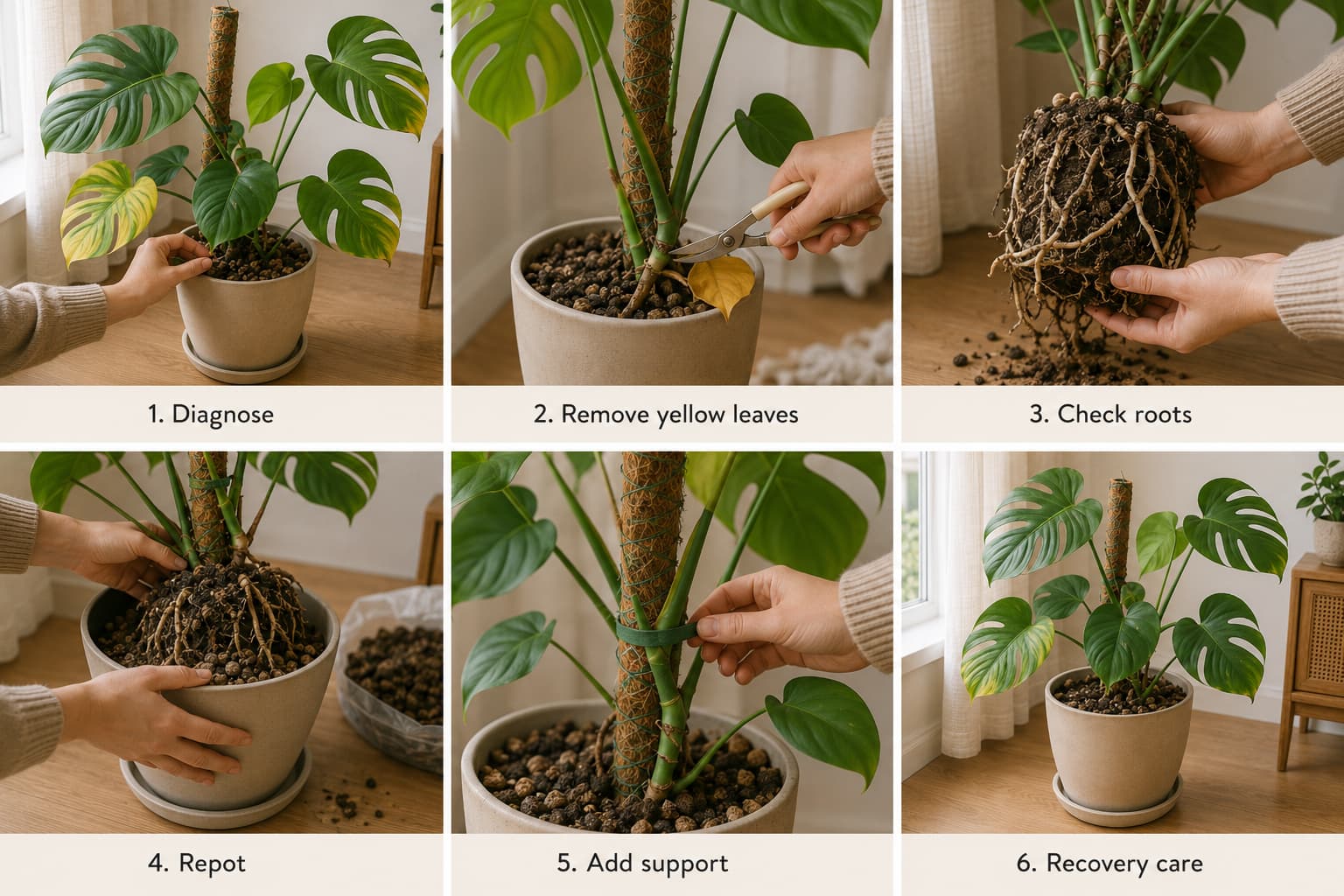
If your Monstera has lost more than half its leaves to yellowing, here's a rescue plan that works for most cases:
- Diagnose the cause using the flowchart above. Don't skip this - the fix depends on the cause.
- Trim yellow leaves with clean, sharp bypass pruning shears. Yellow leaves won't recover their green color, and they drain the plant's energy. Cut at the base of the leaf stem, just above the main stem.
- Check the roots by slipping the plant out of its pot. Remove only tissue that is soft, hollow, dark, or foul-smelling - healthy roots are firm and white or pale tan.
- Repot if necessary - only if the existing mix is saturated, compacted, contaminated, or no longer draining properly. Use a clean pot with drainage holes, and go one size smaller than the previous pot only if you removed significant roots.
- Provide climbing support - install a moss pole or sturdy stake if the plant doesn't already have one. This is especially important for mature Monsteras that have lost lower leaves.
- Adjust the environment: bright indirect light (with fenestration as your signal that it's enough), 65-85°F (18-29°C), 50%+ humidity. Don't fertilize for 6 weeks - let the plant recover first.
- Wait. Monstera recover slowly. New growth should appear within 4-8 weeks. If no new growth after 12 weeks and the plant continues to yellow, see the next section.
Seasonal Yellowing Patterns (What Most Guides Miss)
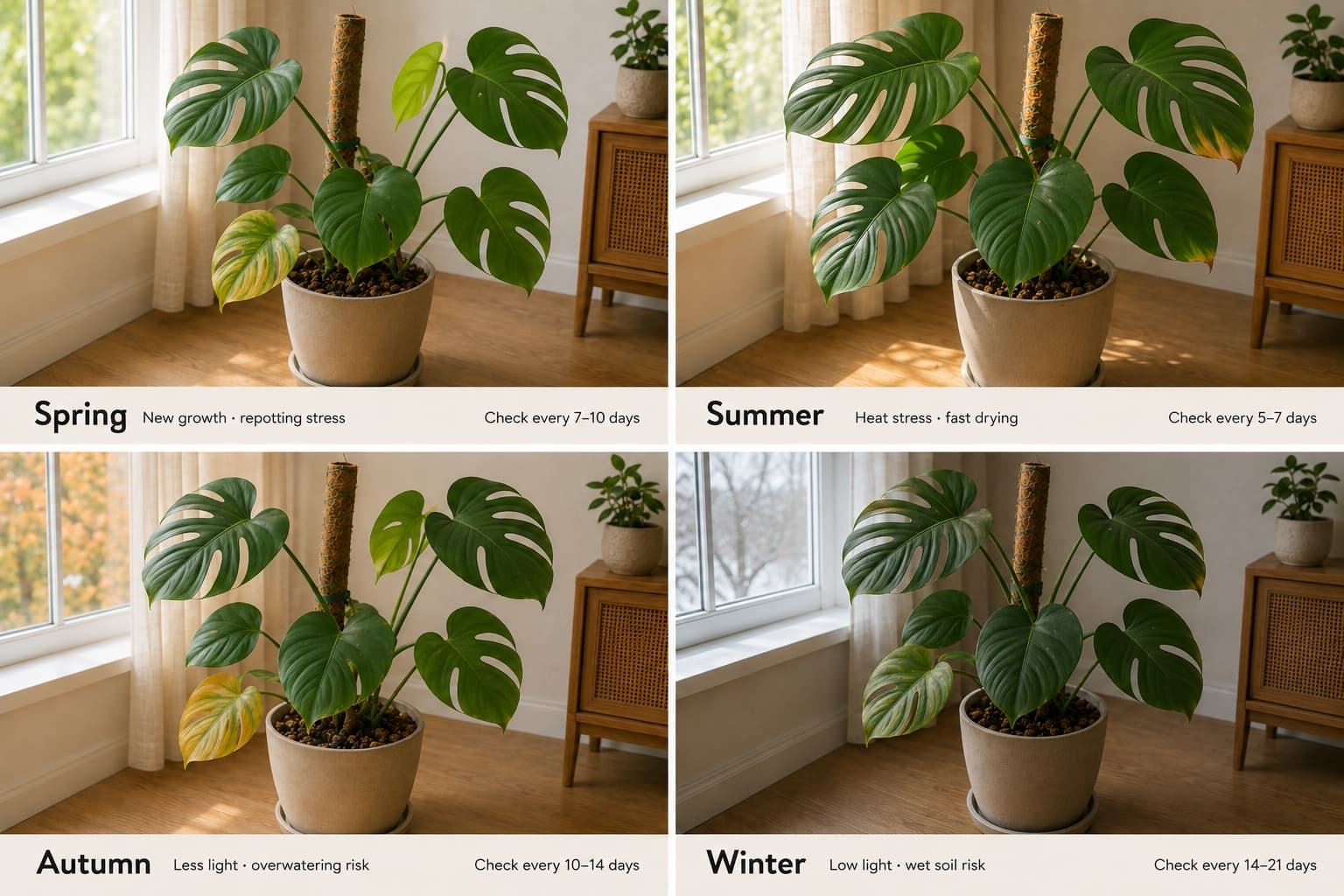
The cause of yellow leaves changes with the season. Here's what to expect and how to prevent each:
Spring (March-May)
Most yellowing in spring comes from repotting stress or fertilizer burn. If you repotted recently and the plant is yellowing, it's transplant shock - keep it in stable conditions and resist the urge to fertilize. Spring is also when scale insects become active - check stems and leaf joints.
Summer (June-August)
Summer is high season for Monstera yellowing, and it comes from multiple directions. Heat stress is the main culprit, especially in south or west-facing windows where direct sun can scorch leaves. Air conditioning ducts blowing directly on plants cause mottled yellowing and leaf drop. Spider mites and thrips thrive in the dry air of air-conditioned rooms. And paradoxically, summer is when people overwater most - warm temperatures make soil dry faster at the surface, but the lower root zone may still be wet. Always check soil moisture at 2-3 inches deep, not just the surface.
For plants struggling in summer heat, see our houseplant heat stress guide and our list of heat-tolerant houseplants for summer windows.
Autumn (September-November)
As light levels drop, plants enter semi-dormancy and need less water. Many people keep their summer watering schedule and accidentally overwater in autumn. Reduce watering frequency by about 30% as daylight hours shorten. Autumn is also when indoor humidity starts to drop as heating kicks on - a humidifier becomes more important from October onward.
Winter (December-February)
This is the most common season for yellow leaves, and frequently from overwatering combined with low humidity - though cold drafts, sudden temperature swings, and pest flare-ups are also common in winter and should be checked before assuming watering is the only issue. Central heating dries the air to 20-30% humidity, which stresses the plant, but the soil also dries slower in cool winter light. The result: people water on a schedule, the soil stays wet, roots rot. Solution: water based on soil moisture, not the calendar, and run a humidifier near your plants.
Personal note: I lost a beautiful mature Monstera two winters ago to exactly this - I kept watering weekly because that's what had worked all summer, and the soil stayed wet for 10+ days at a time in the cool winter light. By the time I noticed the yellowing, root rot had already spread. Now I check soil moisture every 4-5 days in winter and water only when the top 2-3 inches are dry, which often means 2-3 weeks between waterings for mature plants.
When to Give Up on a Yellow Monstera
Sometimes a Monstera is too far gone to save. If most leaves are yellow, the stems are mushy at soil level, and there are no healthy firm roots left, the plant is unlikely to recover - but inspect carefully before concluding this, because the exact threshold depends on the plant's overall vigor, the season, and how quickly the decline happened. Even then, before throwing the plant out, take tip cuttings from any still-healthy vines and root them in water - Monstera propagate easily, and you can have a new plant established within 2-3 months. The process is similar to propagating succulents from leaves in that patience and clean tools matter more than anything fancy.
For a parallel perspective on yellow leaves in another common houseplant, see our guide on pothos leaves turning yellow - many of the diagnostic principles overlap.
How to Prevent Yellow Leaves Going Forward
- Water by soil moisture, not the calendar. Use the finger test or a moisture meter. Most Monstera problems come from watering on a schedule.
- Provide bright indirect light. An east or south window is ideal. Let fenestration be your signal - if new leaves aren't splitting, the plant needs more light.
- Install a moss pole early. Don't wait for the plant to start leaning. A pole installed when the plant is 2-3 feet tall prevents most aerial root and support issues.
- Repot every 1-2 years for young plants, every 2-3 years for mature ones, going up one pot size. Don't jump to a much larger pot - extra soil holds extra water.
- Fertilize monthly in growing season (March-September) with a balanced fertilizer following label directions.
- Inspect monthly for pests, especially under leaves and along the midrib. Catch infestations early.
- Keep away from drafts - heating vents, AC ducts, exterior doors, and cold windows all cause stress.
Quick Fix Cheat Sheet
Short on time? Use this cheat sheet to identify the most likely cause and the immediate action to take:
| Symptom | Most likely cause | Immediate action |
|---|---|---|
| Soil staying wet for several days, leaves soft and limp | Likely overwatering / possible root rot | Stop watering, check roots, repot if mix is degraded |
| Soil bone dry, leaves crispy and curled | Underwatering | Bottom-water for 30-60 min, resume regular schedule |
| Lower leaves yellow, new leaves small and unsplit | Low light | Move to brighter spot or add grow light |
| New leaves yellow with green veins | Possible iron chlorosis | Check soil pH, consider chelated iron if confirmed |
| Yellowing between veins on older leaves | Possible magnesium deficiency | Use a fertilizer containing micronutrients |
| Roots circling pot, water runs straight through | Likely root bound (confirm by inspecting root ball) | Repot in pot 2 inches wider with fresh mix |
| Fine webbing under leaves, stippled yellow | Spider mites | Isolate, rinse thoroughly, treat undersides with insecticidal soap |
| Silvery-yellow patches, tiny black dots | Thrips | Isolate, remove heavily infested leaves, treat with spinosad |
| Yellow halo around brown spots on leaves | Fungal leaf spot | Remove affected leaves, improve airflow, stop overhead watering |
| Aerial roots shriveled, plant leaning, lower leaves yellow | Missing climbing support | Install a moss pole and guide aerial roots to it |
| Yellow leaves near AC vent or exterior door | Temperature stress | Move to stable temperature location |
Frequently Asked Questions
1.Should I cut yellow leaves off my Monstera?
Yes. Yellow leaves won't turn green again, and they drain energy the plant could use for new growth. Cut them at the base of the leaf stem with clean pruning shears, just above the main stem. This also improves airflow and reduces the risk of fungal issues.
2.Can a yellow Monstera leaf turn green again?
No. Once a leaf has turned yellow, the chlorophyll is gone and won't come back. The leaf will eventually drop on its own, but cutting it off is cleaner and prevents the plant from continuing to invest energy in a dying leaf.
3.How often should I water my Monstera?
In average home conditions, every 7-10 days in summer and every 10-14 days in winter. But always check the soil first - water only when the top 2-3 inches are dry. Larger pots dry slower than smaller ones, and Monstera in brighter light need more water than those in low light. Mature plants in big pots may go 2-3 weeks between waterings in winter.
4.Are yellow Monstera leaves a sign of overwatering or underwatering?
Both can cause yellow leaves, but the pattern differs. Overwatering produces soft, limp yellow leaves, usually starting from the bottom, with wet soil. Underwatering produces crisp, dry yellow leaf tips and edges, with dry soil that may have pulled away from the pot. Check the soil moisture first - it tells you which one.
5.Why are my Monstera leaves turning yellow with brown spots?
Usually one of three causes: (1) fungal leaf spot from overhead watering - yellow halo around a brown lesion; (2) pest damage from spider mites or thrips - fine stippling with yellow and brown; (3) cold damage - dark, water-soaked spots that turn yellow-brown. Inspect closely with a magnifying glass to distinguish.
6.Why are my Monstera leaves not splitting?
The most common reason is insufficient light. Monstera develops fenestrations (splits and holes) only when it has enough light to make the larger leaves worthwhile. Other factors include the plant's age (very young plants don't fenestrate), lack of climbing support, and inconsistent watering. Moving the plant to a brighter location and providing a moss pole usually resolve this within a few months.
7.Why is my Monstera turning yellow after repotting?
Transplant shock. The plant's roots were disturbed and need time to re-establish. Keep the plant in stable conditions (bright indirect light, consistent temperature), don't fertilize for 6 weeks, and only water when the top 2-3 inches of soil are dry. Most Monstera recover within 2-4 weeks.
8.Can too much light cause Monstera leaves to turn yellow?
Yes. Direct sun, especially in summer through south or west windows, will scorch Monstera leaves. The yellow appears as pale patches, often on the side facing the light, and may progress to brown crispy areas. Move the plant back from the window or filter the light with a sheer curtain. Recently moved plants are especially vulnerable - acclimate them gradually over 1-2 weeks.
9.How do I know if my Monstera has root rot?
Signs include persistently wet soil, yellow lower leaves that drop easily, soft or mushy stems at soil level, and a sour or rotten smell. To confirm, slip the plant out of its pot and inspect the roots - healthy roots are firm and white or pale tan, rotten roots are brown, black, or soft and may fall apart when touched.
10.Should I fertilize my Monstera when it has yellow leaves?
Only if the cause is a confirmed nutrient deficiency. Fertilizing a plant that's yellowing from overwatering, low light, or pests will make the problem worse. Diagnose first, fertilize only if needed, and always follow the product label - any fertilizer can cause root injury if over-applied.
Final Thoughts
Yellow leaves on a Monstera are almost never a death sentence - they're a signal. The plant is telling you something is off, and once you figure out what, the fix is usually straightforward. The eight causes above account for the vast majority of cases, and the diagnostic method will identify the cause in under five minutes.
If you're building a houseplant collection, Monstera pairs well with philodendrons (same Araceae family, similar care) and the more forgiving golden pothos. For parallel troubleshooting on yellowing pothos, see our guide on pothos leaves turning yellow. And for summer-specific care, our houseplant heat stress guide covers temperature management in detail.
Patience is the secret. A recovering Monstera won't look better overnight, but with the right care, new fenestrated growth will appear within 4-8 weeks. The yellow leaves you have now won't recover - but the new ones will be healthy.
Have a Monstera question I didn't cover? Drop it in the comments or reach out through the contact page. For authoritative reference, the ASPCA toxic plant database covers pet safety for Monstera deliciosa, the University of Florida IFAS Monstera production guide covers commercial and home growing standards, and the Clemson University Cooperative Extension indoor plant watering factsheet covers watering and root health fundamentals.