Golden Pothos Care: Light, Watering, Yellow Leaves & Pet Safety
Golden pothos care is straightforward once you understand the plant’s light, watering, drainage, and safety needs. This guide covers yellow leaves, propagation, variegation, popular varieties, and practical pet precautions.
Quick Summary
Golden Pothos ( Epipremnum aureum ) is arguably the most forgiving houseplant on earth — it tolerates low light, irregular watering, and the kind of neglect that would kill most plants within weeks. But "forgiving" doesn't mean "unkillable." The #1 cause of pothos death is overwatering — roots rotting in soggy soil. The #1 safety concern is calcium oxalate crystals , which make every part of the plant toxic to cats and dogs. And the plant's most famous claim — that it purifies indoor air — is based on a NASA study that's been widely misinterpreted. This guide covers the honest reality of growing pothos: what it can and can't do, how to keep it alive for decades, and the one mistake even experienced plant owners make.
In This Guide
- What Is Golden Pothos? (Devil's Ivy and the Gibberellin Mystery)
- Golden Pothos Care at a Glance
- Is Golden Pothos Toxic to Cats and Dogs?
- Golden Pothos Care: Light, Water, Soil, and Fertilizer
- Why Are My Pothos Leaves Turning Yellow?
- How to Propagate Golden Pothos
- Does Golden Pothos Really Purify Indoor Air?
- Popular Pothos Varieties
- Frequently Asked Questions
What Is Golden Pothos? (Devil's Ivy and the Gibberellin Mystery)
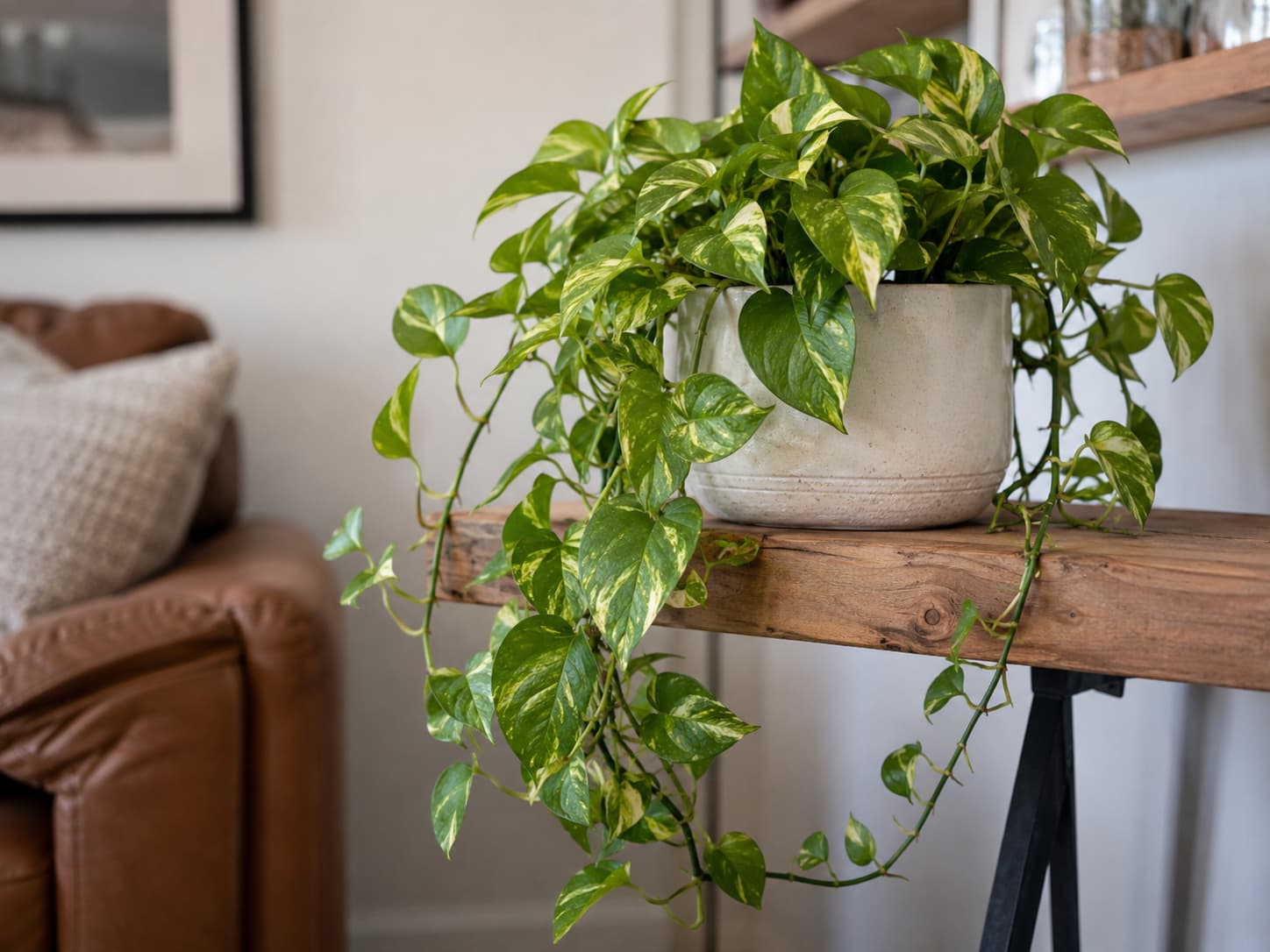
To begin with, Golden Pothos ( Epipremnum aureum ) is a tropical climbing vine in the arum family ( Araceae ), native to the Society Islands of French Polynesia. It's one of the most popular houseplants in the world — and also one of the most botanically interesting.
For example, its common name "Devil's Ivy" comes from its reputation for toughness: it stays green in near-darkness and is extraordinarily difficult to kill. In fact, the genus name Epipremnum means "upon the trunk" — a reference to its natural climbing habit. Similarly, the species name aureum means "golden," describing the yellow variegation on its leaves.
More importantly, there is a botanical curiosity: golden pothos almost never flowers. For context, the last recorded spontaneous flowering in cultivation was in 1964. The plant has a genetic mutation that disrupts the production of gibberellins — plant hormones required for flower bud initiation. Therefore, without enough gibberellin signaling, the plant rarely transitions from vegetative to reproductive growth. Nevertheless, scientists have induced flowering experimentally by spraying plants with gibberellic acid, but this doesn't happen naturally. As a result, the plant typically directs its visible growth into leaves and vines rather than flowers.
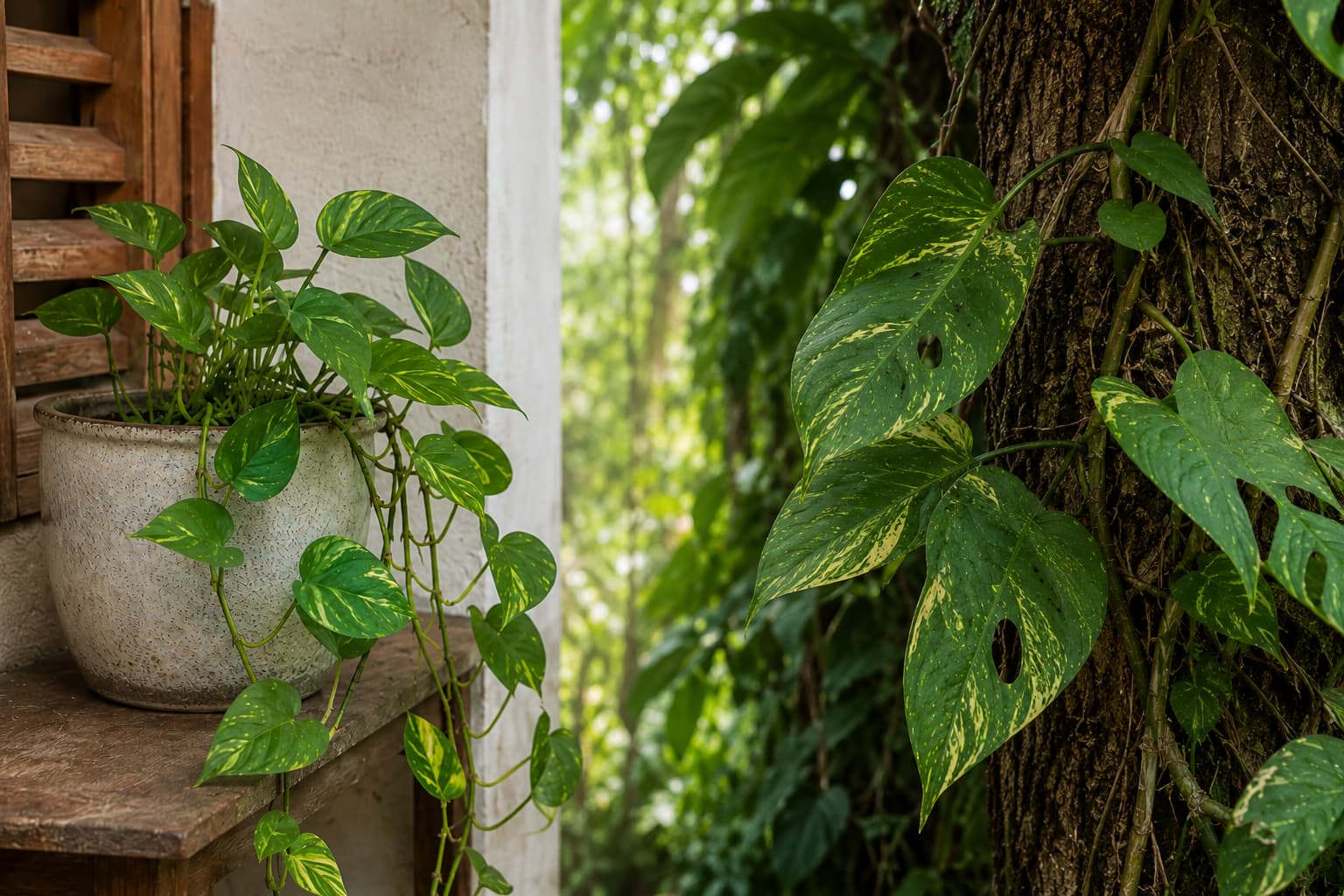
Meanwhile, pothos looks very different when it grows outdoors in tropical conditions. For example, given a tree to climb in its native rainforest habitat, it produces enormous leaves up to 2–3 feet long that develop fenestrations (splits and holes) similar to Monstera. By comparison, the juvenile form we know as a houseplant — small, heart-shaped leaves on trailing vines — is essentially a perpetual adolescent. It never gets big enough, bright enough light, or tall enough support indoors to trigger the mature form.
Golden Pothos Care at a Glance
| Feature | Details |
|---|---|
| Common Name | Golden Pothos, Devil's Ivy, Money Plant (in parts of Asia) |
| Scientific Name | Epipremnum aureum (formerly Scindapsus aureus , Pothos aureus ) |
| Plant Type | Evergreen tropical climbing vine |
| USDA Zones | 10–12 outdoors; grown as a houseplant worldwide |
| Mature Size | Indoors: vines 6–10 ft (can reach 30+ ft); outdoors: vines to 60+ ft, leaves to 3 ft |
| Light Needs | Bright indirect to low light; tolerates near-darkness |
| Watering | Let top 1–2 inches of soil dry between waterings |
| Soil | Well-draining standard potting mix |
| Flowering | Extremely rare — gibberellin deficiency prevents blooming |
| Toxicity | Toxic to cats and dogs — contains calcium oxalate crystals |
Is Golden Pothos Toxic to Cats and Dogs?
Before discussing routine care, this safety point matters most for homes with pets or small children. Specifically, every part of golden pothos contains calcium oxalate crystals — microscopic, needle-shaped crystals called raphides that embed themselves in the soft tissues of the mouth, throat, and digestive tract when chewed or swallowed.
What Calcium Oxalate Does
Pothos Is Toxic to Cats and Dogs
Symptoms of ingestion: Immediate oral pain and burning, excessive drooling, pawing at the mouth, difficulty swallowing, vomiting, and in severe cases, swelling of the throat that can obstruct breathing. Consequently, the reaction is immediate and painful, and many animals will spit out the plant after one bite, but the crystals have already done damage. If you suspect your pet has eaten pothos, contact your veterinarian immediately. ASPCA Animal Poison Control: (888) 426-4435.
Safety Precautions
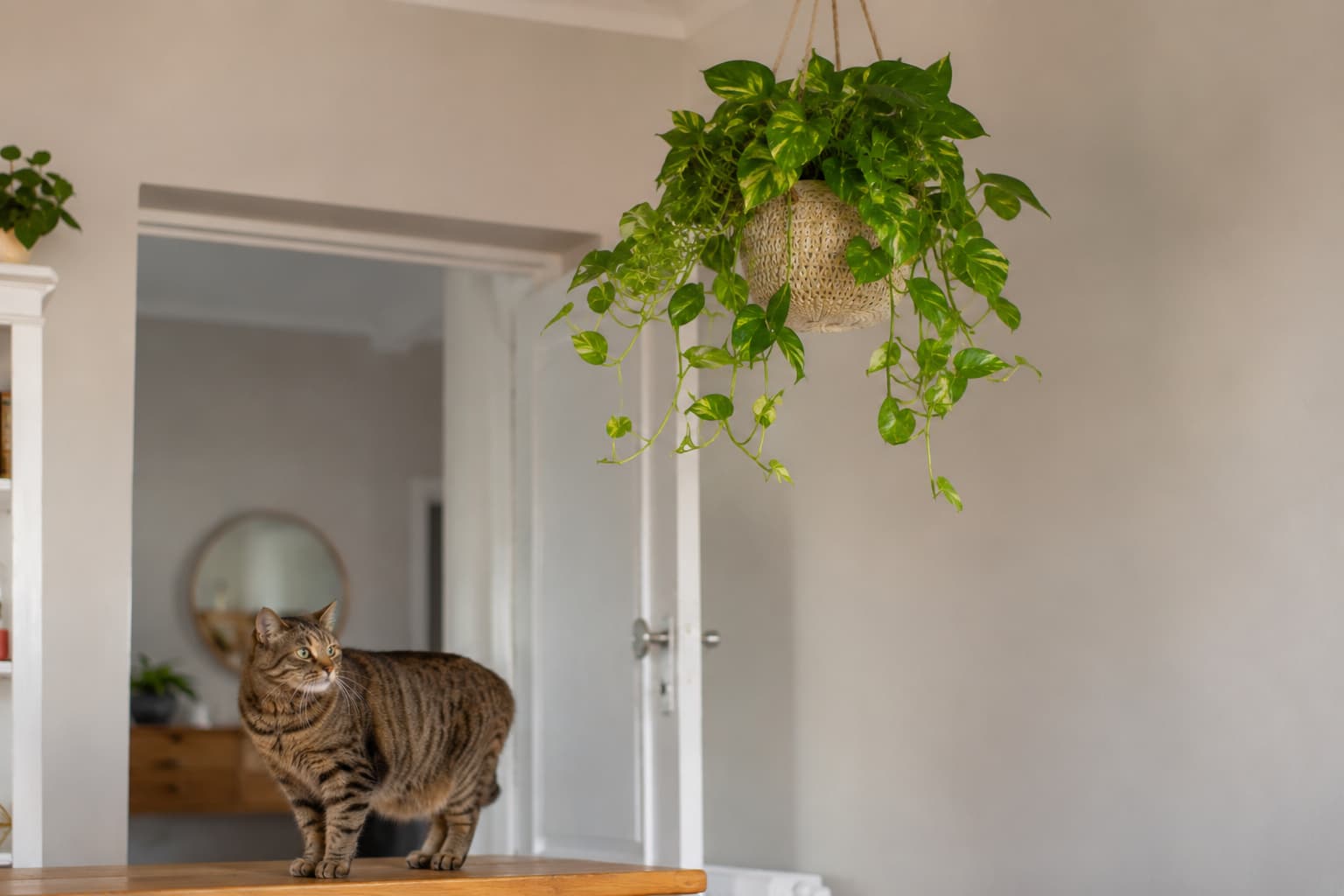
- Keep pothos out of reach of pets. For example, hanging baskets and high shelves are ideal — cats especially are attracted to trailing vines and will bat at and chew them.
- Keep away from small children. Likewise, the same calcium oxalate crystals that harm pets cause oral pain, burning, and swelling in humans. Toddlers who put things in their mouths are at risk.
- Wear gloves when pruning. In addition, the sap can cause skin irritation in sensitive individuals. Afterward, wash your hands after handling.
- Don't propagate in water in accessible locations. For example, cats may drink water from propagation vessels, and pothos in water leaches calcium oxalate into the water over time. Keep propagation jars on high shelves or in rooms pets can't access.
Safer Trailing Plants for Pet Owners
If calcium oxalate toxicity is a deal-breaker: Spider plant ( Chlorophytum comosum — non-toxic, similar trailing habit, equally indestructible), Peperomia (non-toxic, many trailing varieties), Hoya (non-toxic, waxy trailing vines), or Boston fern (non-toxic, lush cascading fronds). All tolerate similar light conditions and are safe for pets.
Golden Pothos Care: Light, Water, Soil, and Fertilizer
Light
Pothos tolerates a wide range of indoor light conditions. However, tolerates doesn't mean thrives. In bright indirect light, growth is vigorous, and leaves are larger with stronger golden variegation. By contrast, low light slows growth, reduces variegation, and increases the spacing between leaves. A windowless bathroom with only occasional artificial light may keep pothos alive for a time, but it is unlikely to support strong growth.
For best results: choose bright indirect light near an east- or north-facing window. For instance, In addition, a few hours of gentle morning sun can be beneficial after the plant is acclimated. However, avoid harsh direct afternoon sun because it can scorch leaves. Therefore, fading variegation can be a sign that the plant needs brighter indirect light.
Watering — The #1 Cause of Death
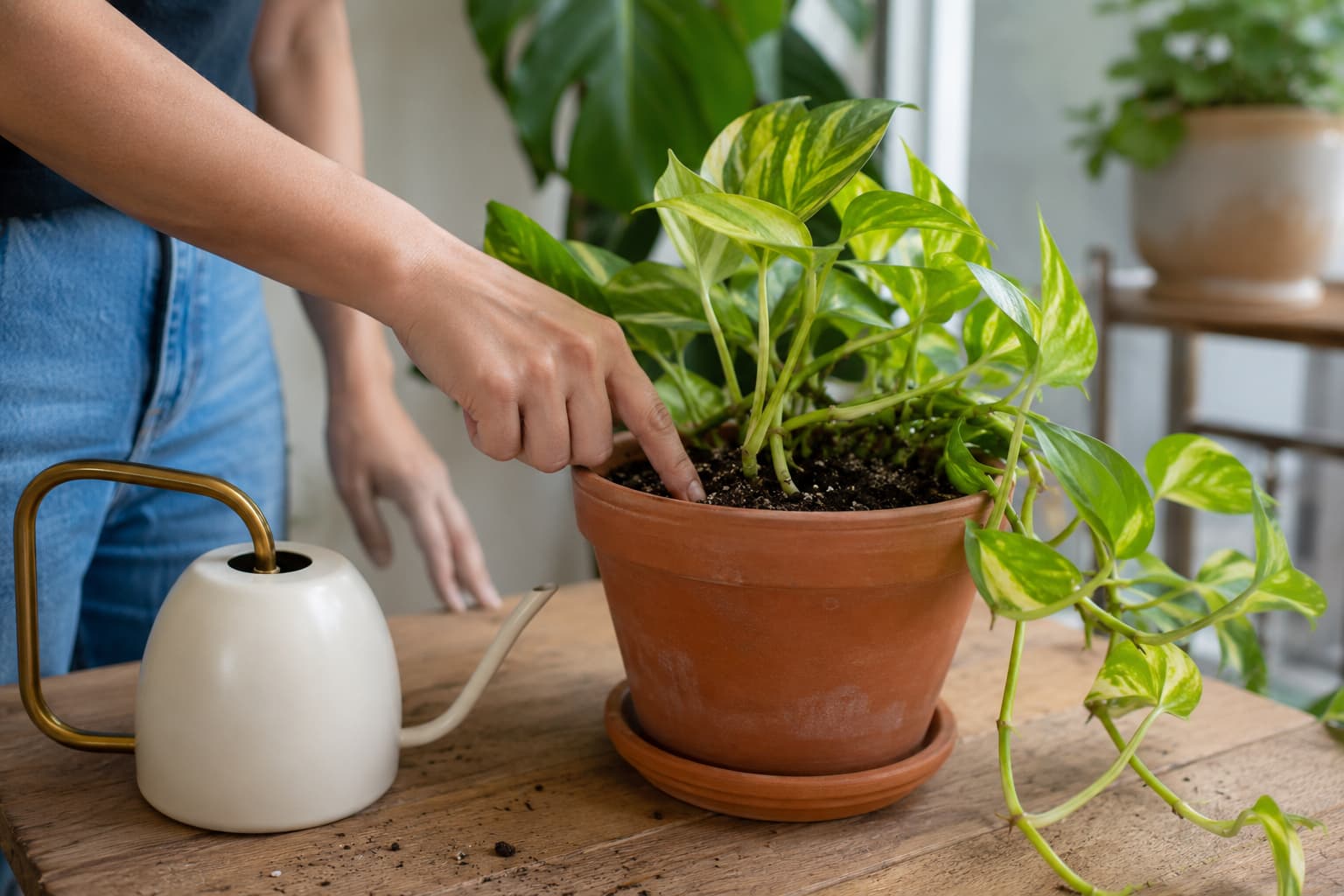
Let the top 1–2 inches of soil dry out completely between waterings. Pothos roots need oxygen as much as water. As a result, soil that stays constantly wet can lead to root decline and rot. In practice, chronically wet soil is one of the most common reasons pothos roots decline.
- Summer (growing season): Water every 7–10 days, when the top 1–2 inches of soil feel dry.
- Winter (slow growth): Water every 2–3 weeks. The plant uses far less water when growth slows.
- Signs of overwatering: Yellow leaves (starting from the bottom), soft brown spots on leaves, soil smells sour, stems feel mushy at the base.
- Signs of underwatering: Leaves wilt and curl inward, leaf edges turn brown and crispy. The plant recovers quickly from underwatering — water thoroughly and it perks up within hours.
The Wilting Confusion
First, a pothos wilting from underwatering often perks up after a thorough watering. A pothos wilting from overwatering (root rot) stays wilted after watering because the roots are dead and can't absorb water. On the other hand, if a wilted pothos stays limp after watering, inspect the roots before adding more water — unpot immediately and check the roots.
Soil
For soil, a standard well-draining potting mix is a good starting point. Pothos is not fussy about soil the way rosemary or cacti are. For example, adding 20–30% perlite can improve drainage and reduce the chance that the mix stays wet too long. By contrast, avoid dense garden soil in containers because it can compact and reduce root-zone aeration.
Fertilizing
During active growth, feed periodically with a balanced liquid houseplant fertilizer at half strength . However, reduce or pause feeding when growth naturally slows. Otherwise, excessive fertilizer can contribute to salt buildup in the soil, which appears as brown leaf tips and edges. As a result, if you see salt-related tip burn, flush the pot thoroughly with plain water and pause feeding until growth stabilizes.
Humidity and Temperature
In addition, pothos is comfortable at typical indoor temperatures. It tolerates low humidity but thrives with higher humidity — brown leaf edges are a sign the air is too dry. Instead of relying on misting alone, focus first on stable room conditions and adequate watering. Keep away from cold drafts and heating vents. Consequently, prolonged exposure to temperatures near or below 50°F (10°C) can cause cold stress.
Why Are My Pothos Leaves Turning Yellow?
If yellowing is the main problem you are trying to solve, use our dedicated Pothos yellow leaves troubleshooting guide for a step-by-step diagnosis of watering, drainage, light, root stress, and natural leaf aging.
Not surprisingly, yellow leaves are one of the most common pothos complaints. Therefore, start with the pattern of yellowing, the moisture level in the pot, and any recent changes in light or care.
Match the Yellowing Pattern to the Cause
| Symptom | Likely Cause | Fix |
|---|---|---|
| Multiple lower leaves yellowing, soil is damp | Overwatering — the #1 cause | Stop watering. Let soil dry completely. If severe, unpot and check for root rot |
| Leaves yellow with brown crispy edges, soil is bone-dry | Underwatering | Water thoroughly. Plant should recover within hours |
| Occasional single yellow leaf at the base | Natural aging — oldest leaves die off | Normal. Remove the leaf. No action needed |
| New growth is pale yellow with green veins | Nutrient deficiency (usually nitrogen) | Begin monthly fertilizing at half strength during growing season |
| Yellow patches on leaves exposed to sun | Sunburn — too much direct light | Move away from direct sun. Scorched leaves won't recover; new growth will be normal |
| Whole plant pale, slow growth | Rootbound — needs repotting | Repot into a container 1–2 inches larger. Loosen circling roots |
How to Propagate Golden Pothos
Fortunately, pothos is one of the easiest houseplants to propagate. With regular pruning, a single healthy plant can provide many useful cuttings over time.
Water Propagation (Most Reliable)
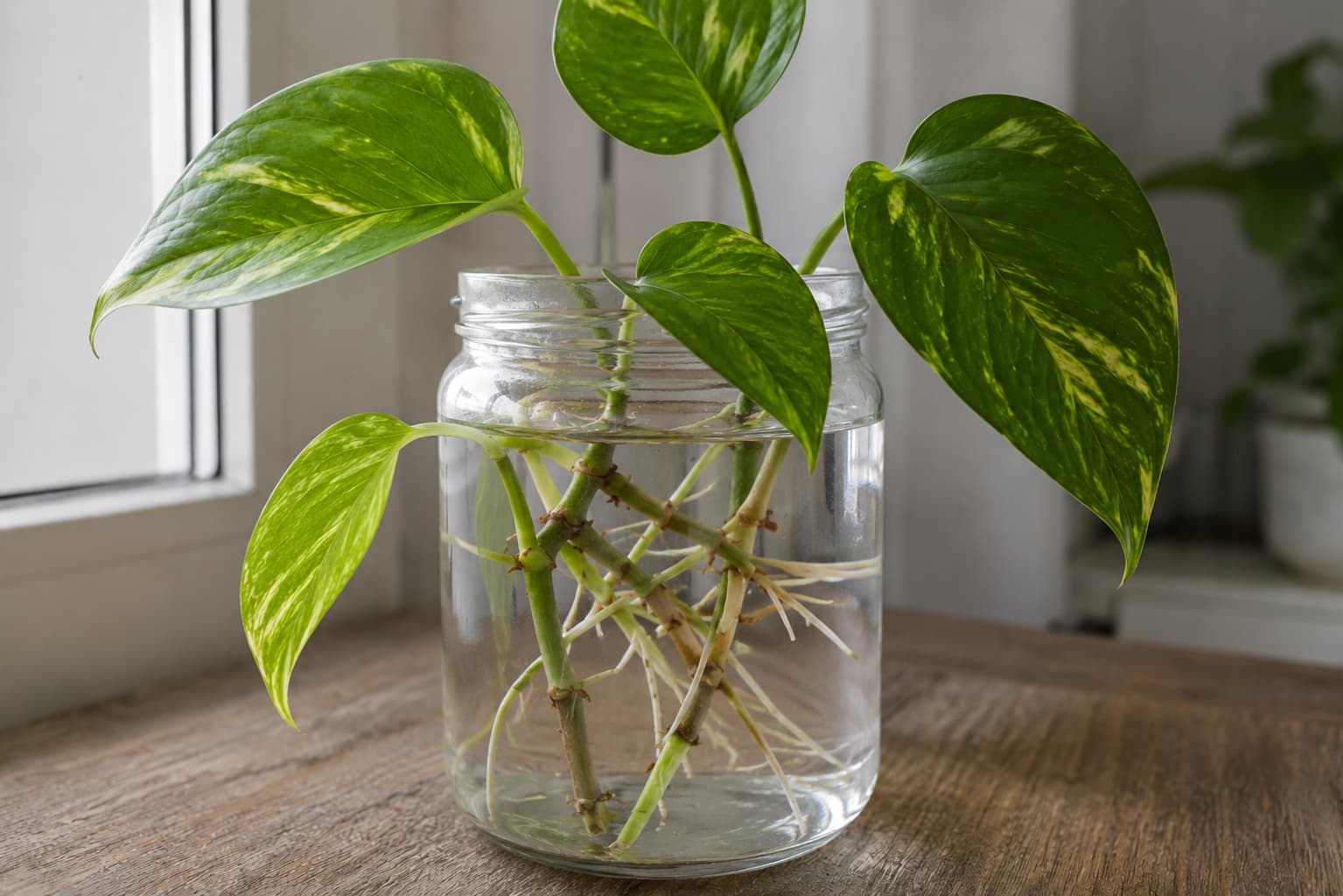
- First, cut a vine just below a node (the small brown bump where leaves emerge). Ideally, each cutting should have a few healthy leaves and at least one viable node.
- Next, remove the bottom leaf or two so bare nodes can sit below the water line.
- Then, place the cutting in a clean glass or jar of room-temperature water. Importantly, only the nodes should be submerged, not the leaves.
- Afterward, keep the cutting in bright indirect light and refresh the water when it becomes cloudy or depleted.
- Roots appear in 1–2 weeks . Once roots are well established, transplant the cutting into potting mix.
- After transplanting, keep the mix slightly more evenly moist at first while the water roots adapt to soil.
Soil Propagation (Skip the Water Step)
- Alternatively, cut as above and dip the cut end in rooting hormone (optional but speeds rooting).
- Next, insert the cutting into moist potting mix, burying 1–2 nodes.
- Keep in bright indirect light and maintain consistent soil moisture for the first 2–3 weeks.
- Eventually, new roots should develop. Gently tug the cutting — resistance means roots have formed.
The Pothos Propagation Hack
Pothos cuttings release natural rooting hormones into the water. If you're propagating other, slower-rooting plants (like Monstera or Philodendron), add a pothos cutting to the same jar. The hormones it releases will speed up rooting for all the cuttings in the water. This is one of the best-kept secrets among houseplant enthusiasts.
Does Golden Pothos Really Purify Indoor Air?
Another common claim is that pothos acts as an indoor air purifier, largely because of NASA's 1989 Clean Air Study. Here's what the study actually found — and what it didn't.
In that study, NASA researchers placed plants in sealed chambers and exposed them to volatile organic compounds (VOCs) — formaldehyde, benzene, trichloroethylene — and measured how much was removed over 24 hours. Under those test conditions, pothos did remove some of these compounds. But the study conditions bear almost no resemblance to a real home. However, the chambers were small (about the size of a microwave), completely sealed, and contained high concentrations of VOCs. In contrast, a real room exchanges air constantly through doors, windows, and ventilation systems.
By comparison, a 2019 review published in the Journal of Exposure Science & Environmental Epidemiology calculated that you would need between 10 and 1,000 plants per square meter of floor space to achieve the same VOC removal rate as the NASA study — meaning you'd need 100–1,000 pothos plants in a single room to match what happened in the sealed chamber.
Pothos Is Not an Air Purifier
Even so, pothos contributes to a pleasant indoor environment and may remove trace amounts of VOCs in its immediate vicinity. But it will not meaningfully improve your indoor air quality in a typical home. If you want cleaner indoor air: open windows, use HEPA filters, and eliminate sources of VOCs (scented candles, air fresheners, some furniture and paint). A pothos on your desk does more for your mood than your air quality — and that's a perfectly good reason to have one.
Popular Pothos Varieties
| Variety | Leaf Appearance | Light Needs | Notes |
|---|---|---|---|
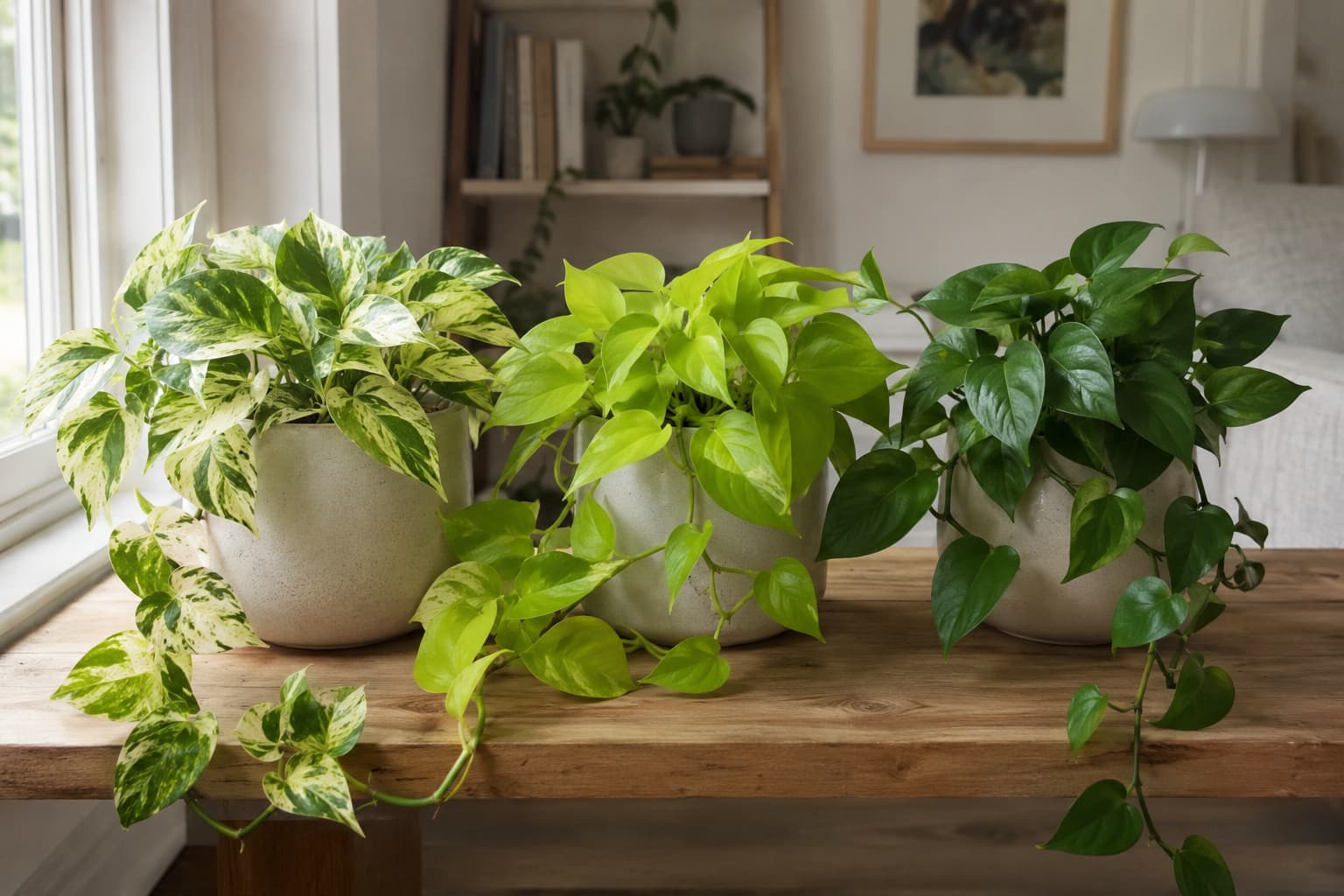
| Golden Pothos | Green with yellow-gold variegation | Low to bright indirect | Overall, the classic form is vigorous. Variegation intensifies with more light. |
| Marble Queen | White and green marbled pattern | Bright indirect required | Slower growing. Needs more light than golden — low light causes reversion to solid green. |
| Neon | Solid bright chartreuse-yellow | Bright indirect | No variegation — color is uniform. Darkens in low light. Striking contrast plant. |
| Jade | Solid deep green, no variegation | Low to bright indirect | Best for very low light. Grows faster than variegated types (more chlorophyll = more energy). |
| Pearls and Jade | Green with white and silver patches | Bright indirect | Smaller leaves. Compact habit. Slower growing. More sensitive to overwatering. |
| Cebu Blue | Silvery blue-green, elongated leaves | Bright indirect | Different species ( E. pinnatum ). Distinctive blue-silver sheen. Can develop fenestrations with maturity and climbing support. |
Frequently Asked Questions
Yellow Leaves, Safety & Variegation
Why are my pothos leaves turning yellow?
The most common cause is overwatering — multiple lower leaves yellowing while the soil stays damp. Stop watering and let the soil dry out completely. If the soil is bone-dry and leaves are yellow with brown crispy edges, it's underwatering. An occasional single yellow leaf at the base is natural aging. See the yellow leaves diagnostic table above for the full breakdown.
Is pothos toxic to cats and dogs?
Yes — all parts contain calcium oxalate crystals. Ingestion causes immediate oral pain, burning, drooling, difficulty swallowing, and vomiting. Keep pothos in hanging baskets or on high shelves out of reach. Therefore, if ingestion is suspected, contact a veterinarian immediately. See the toxicity section above for safer trailing plant alternatives.
Why doesn't my pothos have variegation?
Not enough light. Variegation is a light-dependent trait — in low light, the plant produces more chlorophyll (green) to maximize energy capture, and the golden or white variegation fades. As a result, moving the plant to brighter indirect light can help new growth show stronger variegation. Existing all-green leaves won't change. If your plant was variegated and has reverted to solid green, it's a light issue, not a disease.
Water Growing, Air Quality & Growth
Can pothos grow in water permanently?
Yes. In addition, pothos can remain in water long-term, which is why it's so popular for hydroponics and decorative vases. However, water-grown pothos grows more slowly than soil-grown and needs more attention: change the water every 1–2 weeks to prevent bacterial growth and replenish oxygen, add a few drops of liquid fertilizer to the water monthly during the growing season, and watch for algae growth in clear containers (opaque containers prevent this).
Does pothos really purify air?
In practice, not in any meaningful way in a typical home. The NASA Clean Air Study that popularized this claim was conducted in sealed, small chambers at high VOC concentrations. In a real room with normal air exchange, you'd need hundreds of plants to achieve a measurable effect. Pothos contributes to a pleasant indoor environment, but it's not an air purifier. Instead, ventilation and appropriate air filtration are far more effective for indoor air quality. See the NASA study section above for details.
Why is my pothos not growing?
Usually, the most common causes are: not enough light (pothos survives in low light but grows extremely slowly — move to brighter indirect light), rootbound (check if roots are circling the pot or emerging from drainage holes — repot 1–2 inches larger), underfeeding (start monthly fertilizing at half strength during growing season), or it's winter (pothos naturally slows or stops growing from October through February — this is normal, don't force it with extra water or fertilizer).
Outdoor Summer Care & Longevity
Can I put my pothos outside in summer?
Yes, but with precautions. For example, Pothos can spend the summer outdoors in Zones 10–12. In cooler zones, it can go outside once nighttime temperatures stay above 55°F (13°C). Place in full shade or dappled light — direct outdoor sun will scorch the leaves within hours. Bring back inside before nighttime temperatures drop below 50°F (10°C). Inspect thoroughly for pests before bringing inside. Finally, expect some leaf drop as the plant readapts to indoor conditions.
How long do pothos plants live?
Indefinitely, with proper care. Over time, individual vines may die back, but the plant continuously produces new growth. Moreover, well-maintained pothos can remain in cultivation for many years through pruning and propagation. The key to longevity: repot every 2–3 years, prune regularly to encourage new growth, and propagate cuttings to start new plants as insurance. Even if the original plant declines, its cuttings carry on the lineage.
Sources & Further Reading:
- Royal Horticultural Society — Epipremnum Growing Guide
- Missouri Botanical Garden — Epipremnum aureum Plant Finder
- ASPCA — Devil's Ivy (Pothos) Toxicity Information
- NASA — Interior Landscape Plants for Indoor Air Pollution Abatement (1989)
- Journal of Exposure Science — Potted Plants Do Not Improve Indoor Air Quality: A Review (2019)
- NIH — Gibberellin and Flowering in Epipremnum aureum
Final Thoughts
Golden Pothos is forgiving and adaptable, which explains why it remains such a popular beginner houseplant. Even so, tolerance is not the same as ideal care. Missed watering or a dim room may slow the plant down rather than kill it immediately, while better light and a well-timed watering routine encourage fuller growth.
In short, the key to a long, healthy pothos life is simple: don't overwater it, keep it out of reach of pets, and give it enough light to maintain its variegation. After that, fertilizer, humidity, and repotting are refinements rather than the foundation of care. Get those three things right and your pothos will outlive your furniture.
Golden Pothos Care Checklist
Finally, here are the main points to remember:
- Let soil dry between waterings. Overwatering kills more pothos than everything else combined.
- Toxic to cats and dogs — calcium oxalate crystals. Hang high or choose a pet-safe alternative.
- More light = more variegation. Solid green leaves mean the plant needs brighter conditions.
- Propagates in water in 1–2 weeks. The easiest plant to multiply. Add a cutting to other propagation jars to speed rooting.
- Does not meaningfully purify air. NASA study was in a sealed chamber. Open a window instead.
- Almost never flowers. Gibberellin deficiency. It's not you — it's genetics.
If you found this guide helpful, you might also enjoy our guide on How to Grow Rosemary — for when you're ready to move from houseplants to herbs.