Why Your Pothos Leaves Are Turning Yellow (And How to Fix It)
Quick Summary
If you see pothos leaves turning yellow, start with soil moisture, root condition, light, and leaf texture before changing the care routine. This guide walks you through a 5-minute diagnostic method, 7 common causes, a step-by-step rescue plan, and seasonal patterns that can change what the symptoms mean.
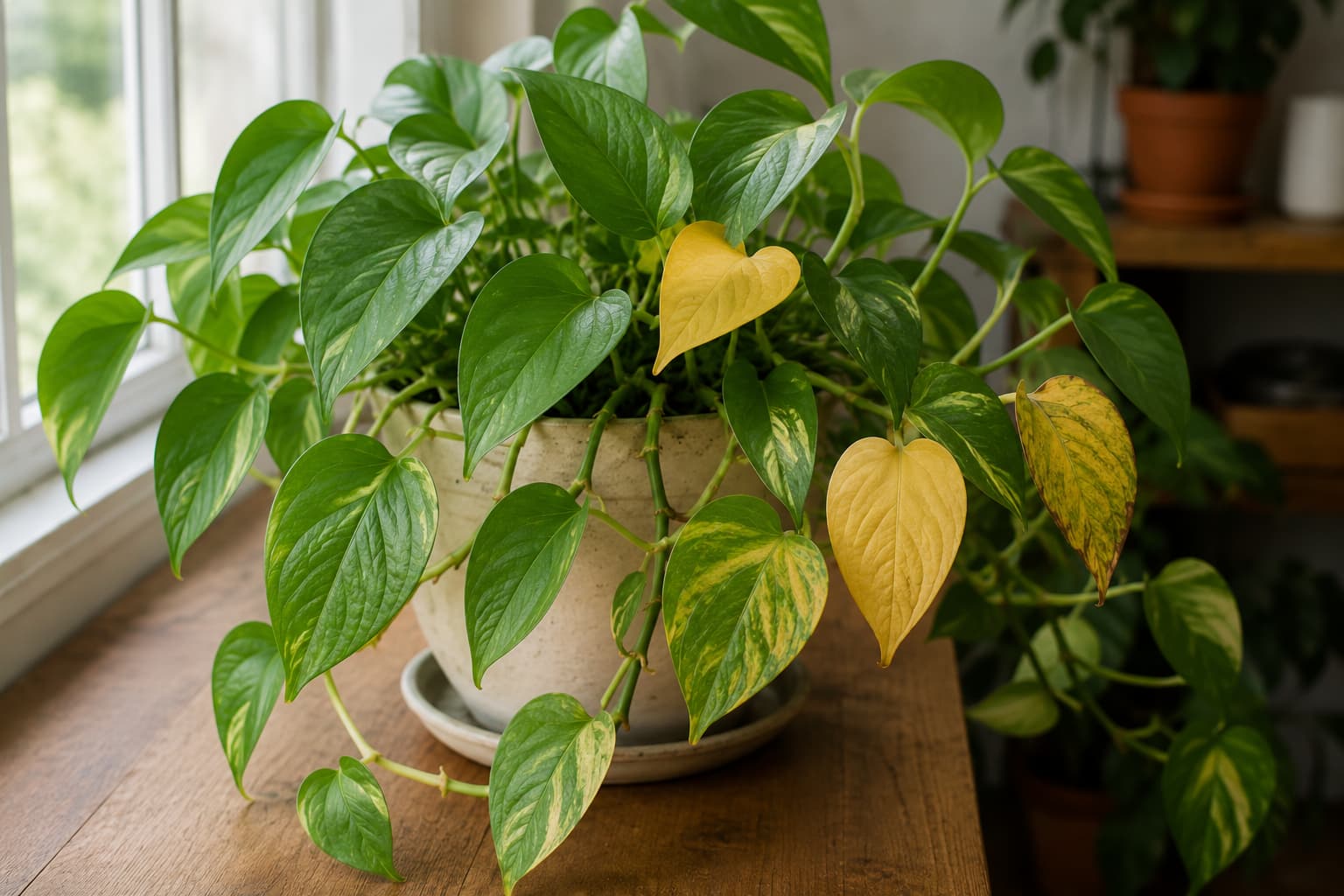
If you notice pothos leaves turning yellow, you're not alone. The color change is a symptom rather than a diagnosis, and the cause is often easier to narrow down when you check soil moisture, roots, light, and leaf texture together. In many cases, those clues point to a fixable care problem.
The bad news is that there's no single answer. Overwatering is the most common culprit, but underwatering, low light, nutrient deficiencies, temperature swings, root-bound pots, and pests can all produce yellow leaves that look almost identical to a beginner. This guide gives you a diagnostic method, walks through each cause with specific symptoms, and finishes with a step-by-step rescue plan for severely yellowed plants.
I've killed my share of pothos over the years - my first one died from overwatering within three weeks of bringing it home. The lessons below come from those mistakes and from answering the same questions from readers and forum members. If you want the complete growing guide (not just the troubleshooting), see our golden pothos care guide.
Pothos Leaves Turning Yellow? Start With the 5-Minute Diagnostic
Before you do anything, run through these four checks. They will narrow down the cause in under five minutes and save you from making the wrong fix.
| Check | What to look for | Likely cause |
|---|---|---|
| 1. Leaf position | Yellowing on bottom (oldest) leaves | Overwatering or natural aging |
| Yellowing on top (newest) leaves | Nutrient deficiency or light issue | |
| 2. Leaf texture | Soft, mushy, or limp | Possible excess moisture or root damage |
| Crisp, dry, papery | Underwatering or low humidity | |
| 3. Soil moisture | Still saturated unusually long after watering | Possible excess moisture, dense mix, oversized pot, or poor drainage |
| Very dry, lightweight pot; mix may pull from the edges | Possible insufficient or uneven watering | |
| 4. Roots | White, firm, smells earthy | Healthy - look elsewhere |
| Soft, hollow, dark, or foul-smelling roots | Root damage; identify drainage and moisture cause |
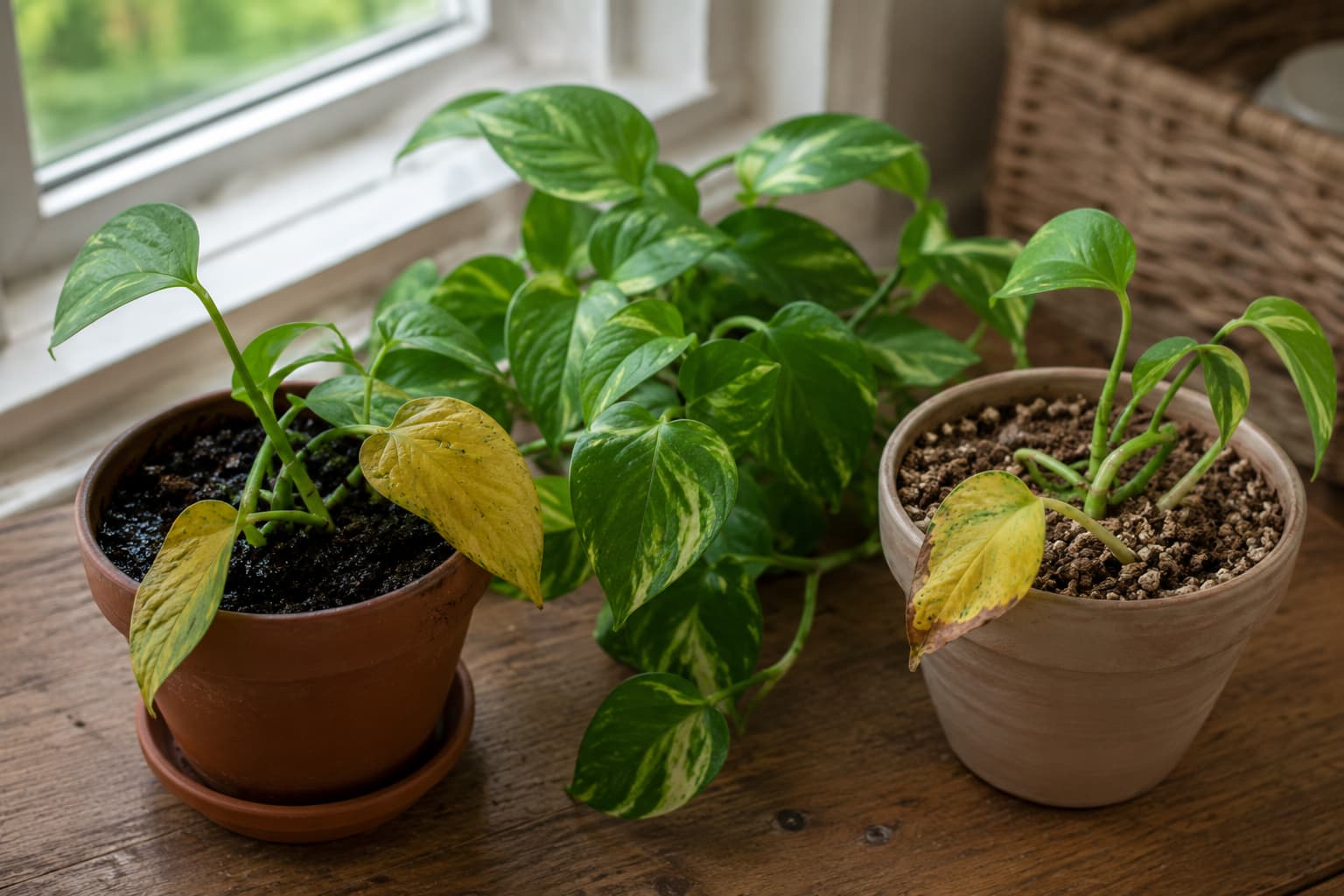
A soil moisture meter can provide one extra data point in a deep pot, but it should not replace checking the mix with a finger or wooden skewer, lifting the pot to compare its weight, and inspecting drainage and roots when symptoms persist. Readings can vary with soil composition, fertilizer salts, and probe placement.
7 Causes of Pothos Leaves Turning Yellow
1. Overwatering and Poor Drainage
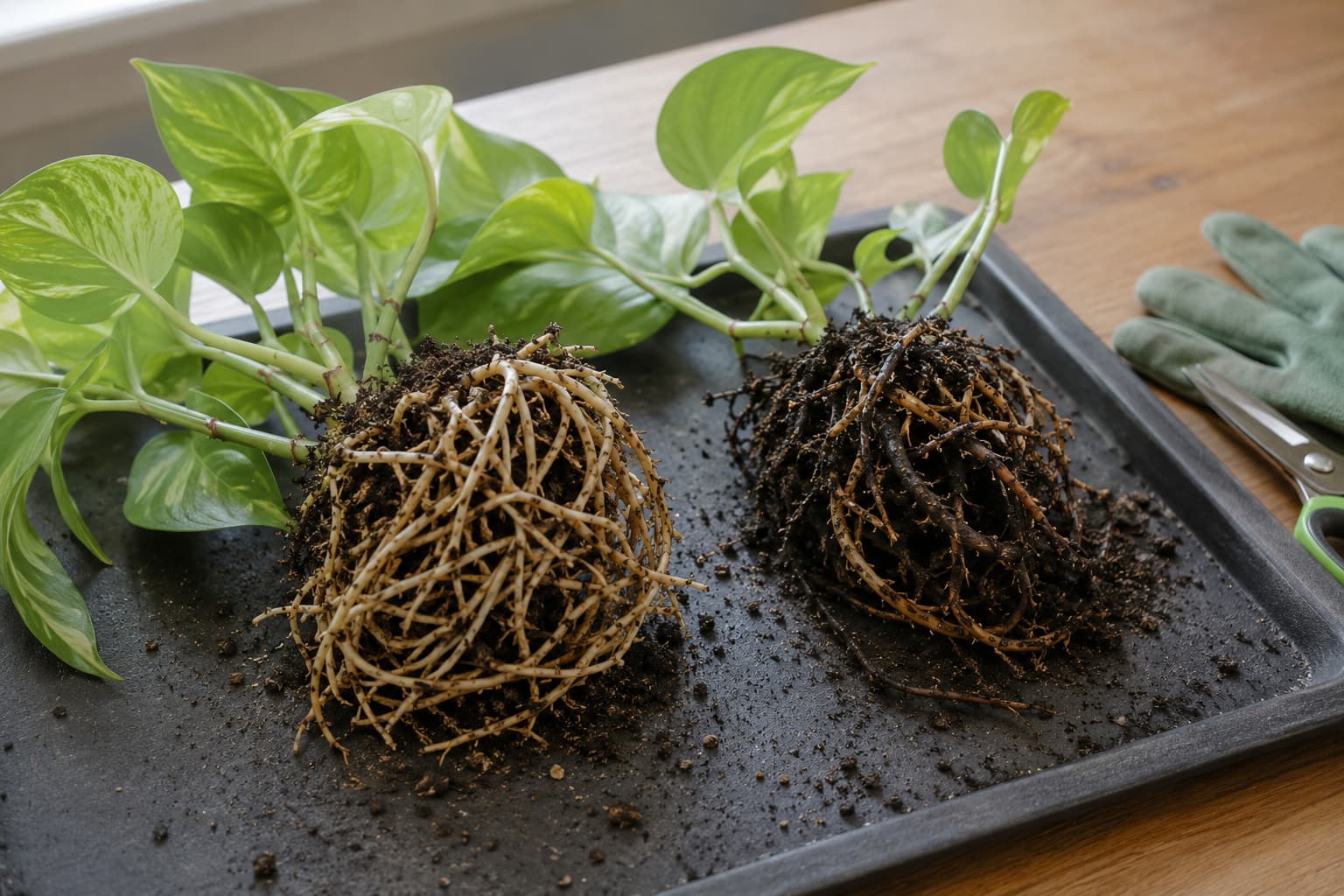
When you see pothos leaves turning yellow while the potting mix stays wet for an unusually long time, excess moisture is one of the first conditions to check. Yellowing alone does not confirm overwatering, so also look for soft lower leaves, loss of root firmness, a sour smell, or dark tissue at the base of the vine. Healthy roots are usually firm and pale to tan; damaged roots may be soft, hollow, dark, or easily stripped.
Pothos roots need both moisture and oxygen. Dense mix, a pot without drainage, standing water in a cachepot, cool low-light conditions, or a container that is too large can keep the root zone saturated. When roots lose oxygen for too long, they decline and become more vulnerable to rot.
Fix: Inspect the roots before making a major change. Remove only tissue that is soft, hollow, dark, or foul-smelling with clean scissors. Repot when the current mix is saturated, compacted, contaminated, or no longer draining well. Use fresh, lightly moist potting mix and a clean container with drainage holes that is proportionate to the remaining root system. Do not fertilize until the plant is stable and producing healthy growth.
Personal note: My first pothos declined because I watered on a weekly routine without checking the pot. I now combine the finger test with pot weight and wait until the upper mix has dried before watering again.
2. Underwatering
Less common but increasingly frequent as people travel or forget routines. Symptoms: leaves curl inward first (a pothos stress response), then the leaf tips and edges turn crispy yellow or brown, then the lowest leaves yellow completely and drop. The soil will be bone dry and may have pulled away from the edges of the pot.
Fix: Water slowly and thoroughly until excess drains. If very dry mix initially repels water, rehydrate it in stages or bottom-water briefly, then let the pot drain completely. Check the mix and pot weight before watering again rather than returning to a fixed weekly schedule.
3. Low Light Stress
Pothos leaves turning yellow in sustained low light often appear first on older lower growth while the vines stretch toward the nearest light source and new leaves become smaller or paler. This can resemble a watering problem, so compare the light level with how quickly the potting mix dries before deciding on a fix.
Fix: Move to a brighter location - ideally an east or north-facing window with 4-6 hours of indirect light. Avoid direct sun, which will scorch leaves. In winter or in rooms with no natural light, a full-spectrum LED grow light on a 12-hour timer is the answer. For a deeper dive into lighting options, see our guide to the best grow lights for indoor plants. Personal note: My own pothos grew happily in a north-facing window for three years with no issues. When I moved it to a hallway with no natural light, the bottom leaves started yellowing within six weeks. I moved it back to a bright spot and added a small grow light on a timer - new growth returned to normal within a month. The lesson: pothos tolerates low light, but doesn't thrive in it indefinitely.
4. Nutrient Deficiency
Nutrient shortage is possible in old, depleted potting mix, but yellow leaves with green veins can also result from root damage, unsuitable pH, excess salts, or impaired nutrient uptake. Uniform yellowing of older leaves may be associated with nitrogen shortage, natural aging, low light, or root stress. Do not diagnose a deficiency from color alone.
Fix: First rule out wet roots, poor light, pests, and recent fertilizer buildup. During active growth, use a balanced houseplant fertilizer only as directed on the label. Start conservatively and apply it to an already moist root zone. If symptoms persist, refresh degraded potting mix or investigate water quality and pH rather than repeatedly increasing fertilizer.
5. Temperature and Humidity Stress
Pothos prefer 65-85°F (18-29°C) and average home humidity (40-60%). Temperatures below 50°F (10°C) cause cold damage that shows up as dark, water-soaked yellow patches on leaves. Above 90°F (32°C), heat stress causes leaves to yellow and drop, especially in direct sun. Sudden temperature swings - like being near an exterior door, heating vent, or air conditioning duct - produce mottled yellowing and leaf drop.
Humidity below 30% (common in winter with central heating) causes leaf tips to turn yellow-brown and crispy, even when watering is correct. See our guide on houseplant heat stress for a deep dive on summer temperature issues, and consider a cool-mist humidifier if winter air is dry.
6. Root Congestion and Potting-Mix Breakdown
Roots circling inside a pot are not automatically harmful, and a few roots emerging from drainage holes do not prove that repotting is urgent. More useful signs include a root mass that has displaced most of the mix, repeated wilting soon after watering, water bypassing the root ball, unstable growth, or a pot that no longer holds moisture evenly.
Fix: Slide the plant out and assess the whole root ball. If roots dominate the container, move up only one modest pot size and use fresh, well-aerated mix. Loosen only dense outer circling roots and avoid aggressive disturbance. Repotting can be done when needed, but stable warm conditions and active growth usually support faster recovery.
7. Pests and Disease
Less common but worth checking. Spider mites cause fine yellow stippling on leaves (look closely for tiny webbing under leaves). Mealybugs cluster in leaf joints and cause yellowing and stunted growth. Fungal leaf spot produces yellow halos around brown lesions, usually from overhead watering. Scale insects look like small brown bumps on stems and cause overall yellowing.
Fix: Isolate the plant and identify the pest before treating. Rinse sturdy foliage and wipe both leaf surfaces. For visible mealybugs, a cotton swab lightly moistened with isopropyl alcohol can be used after spot-testing one leaf. For mites, scale crawlers, or wider infestations, use a product labeled for indoor plants and the identified pest, covering leaf undersides and repeating only at the label interval. Remove leaves with advanced fungal spotting, keep foliage dry, and improve airflow. Neem products are not a one-application cure and can injure leaves when mixed or applied incorrectly.
Pothos Variety Differences: Why Identification Matters
Different pothos varieties show yellowing differently, and misreading the signs can lead to the wrong fix. Here's what to know about the most common varieties:
- Golden Pothos (Epipremnum aureum 'Golden'): The most common variety, with green and yellow variegation. Yellowing is easiest to spot because the contrast with healthy green is sharp. Watch for leaves turning fully yellow (not just the natural variegated patches).
- Marble Queen Pothos: Heavy white and green marbling. Yellowing is harder to identify because the leaves already have so much pale area. Look for leaves losing their firm texture or developing a translucent look.
- Neon Pothos: Bright chartreuse-green leaves. Yellowing shows as a deeper, more saturated yellow or pale washed-out color. Easy to overdiagnose - the natural color is already yellow-green.
- Jessenia Pothos: Similar to Marble Queen but with more yellow-green tones. Yellowing shows as a uniform deepening of color and softening of leaves.
- Manjula Pothos: Cream, white, green, and yellow variegation. White sections naturally yellow and brown with age - this is normal, not a sign of problems.
- Snow Queen Pothos: Mostly white with green streaks. White sections are prone to browning at the tips regardless of care - don't mistake this for a watering problem.
General rule: On heavily variegated varieties (Marble Queen, Manjula, Snow Queen), check leaf texture and soil moisture rather than color alone. On solid or lightly variegated varieties (Golden, Neon, Jade), color changes are more reliable diagnostic signals.
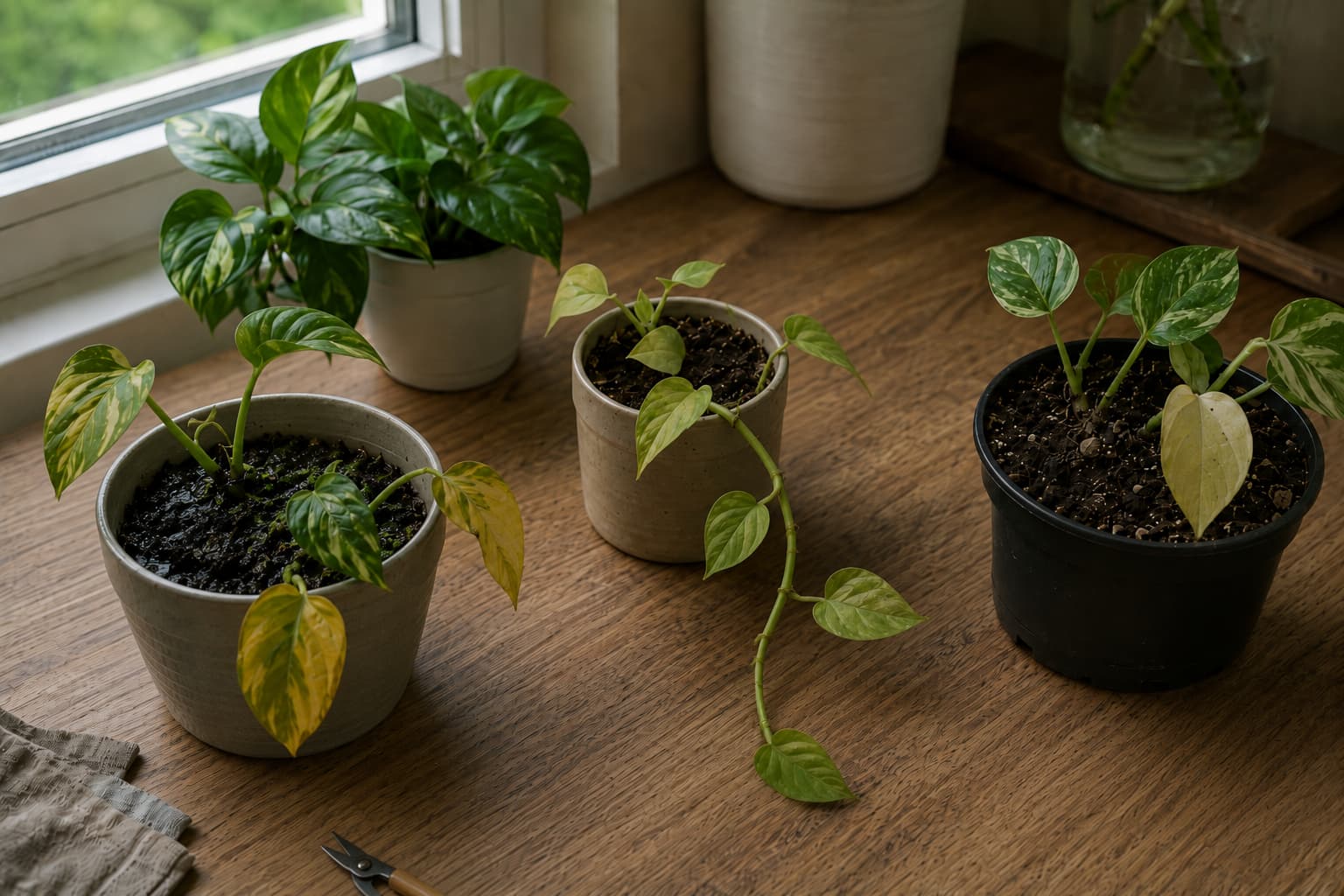
The Pothos Yellow Leaf Diagnostic Flowchart
If the table above wasn't enough, here's a simple text-based decision tree to walk through:
- Is the mix unusually wet or very dry?
- If it remains saturated much longer than normal, inspect drainage, pot size, roots, and light.
- If it is very dry and the pot feels light, rehydrate gradually and check whether water is bypassing the root ball.
- How do the leaves feel?
- Soft, translucent, or limp tissue with wet mix supports a root-zone moisture problem.
- Crisp edges with very dry mix support drought, salt buildup, heat, or dry-air stress.
- Where is the yellowing?
- Older lower leaves can reflect natural aging, low light, root stress, or nutrient shortage.
- Pale new leaves between greener veins can reflect pH, roots, salts, water quality, or nutrient availability.
- Are there pests, lesions, or distorted growth?
- Inspect leaf undersides and nodes with bright light before choosing a treatment.
- Isolate the plant if insects or an infectious leaf-spot problem are suspected.
- Is the root ball functioning normally?
- Repot only when roots dominate the pot, mix has broken down, or drainage and moisture use are clearly impaired.
- If roots are healthy, review seasonal light, temperature, airflow, and recent care changes.
How to Save a Severely Yellowed Pothos (Step-by-Step)
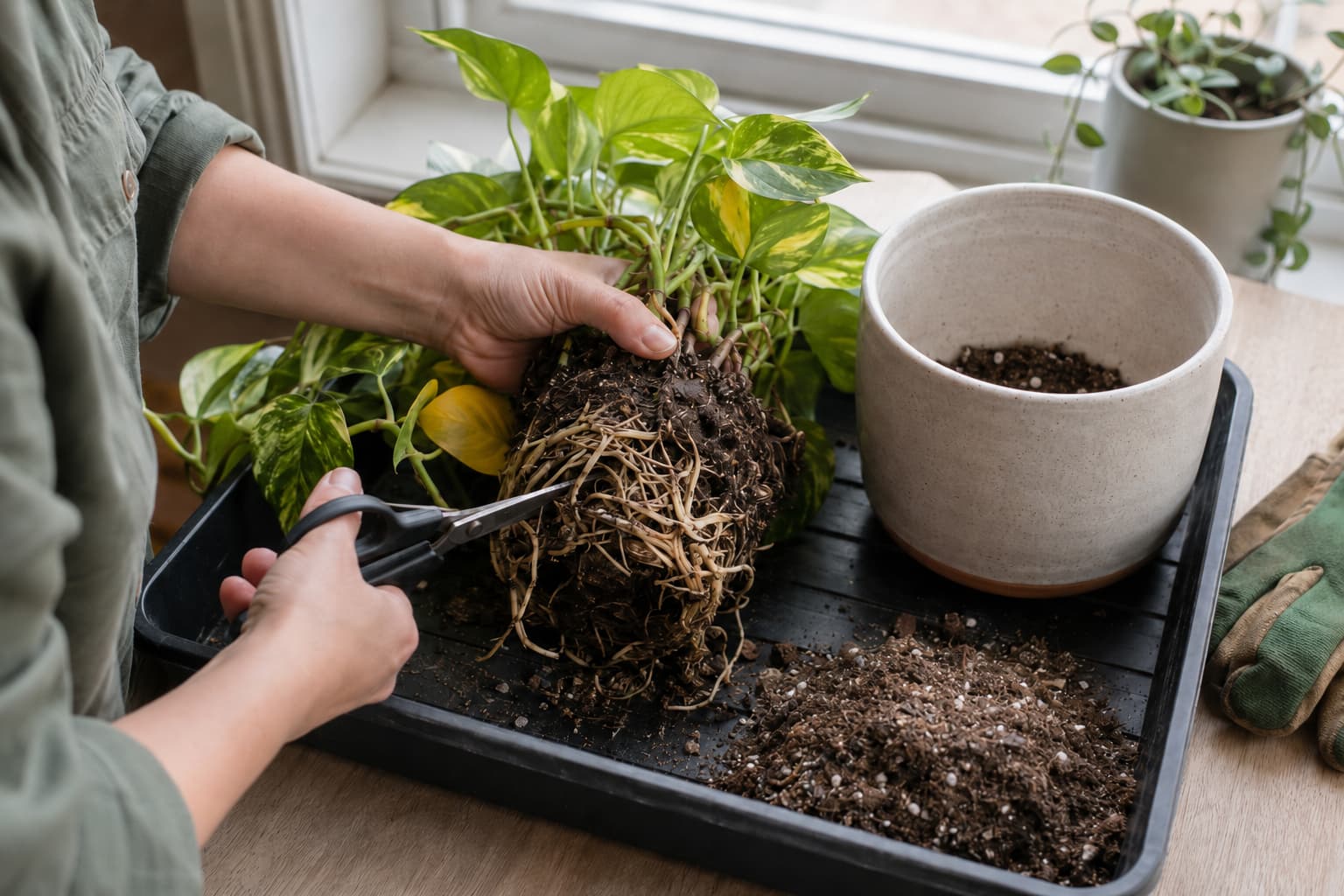
If you have pothos leaves turning yellow across several vines, use the following sequence. The goal is to preserve firm stems and healthy roots, not to remove a predetermined percentage of foliage or roots.
- Diagnose before treating. Check soil moisture, pot size, drainage, light, temperature, roots, and pest signs. Avoid stacking several remedies at once.
- Remove only fully damaged leaves. Use clean scissors for leaves that are completely yellow, soft, or badly spotted. Partly pale leaves can remain while you monitor the correction.
- Inspect the roots. Firm pale-to-tan roots are generally healthy. Trim only roots that are soft, hollow, dark, or foul-smelling.
- Repot only when needed. Replace mix that is saturated, compacted, contaminated, or poorly draining. Match the pot to the remaining root mass and ensure drainage holes are open.
- Stabilize the environment. Provide bright indirect light, steady indoor temperatures, and watering based on actual mix dryness. Pause fertilizer until healthy growth resumes.
- Monitor over several weeks. Look for firm stems, stable moisture use, and healthy new growth. Continued decline means the diagnosis or root condition needs another review.
Seasonal Patterns Behind Pothos Leaves Turning Yellow
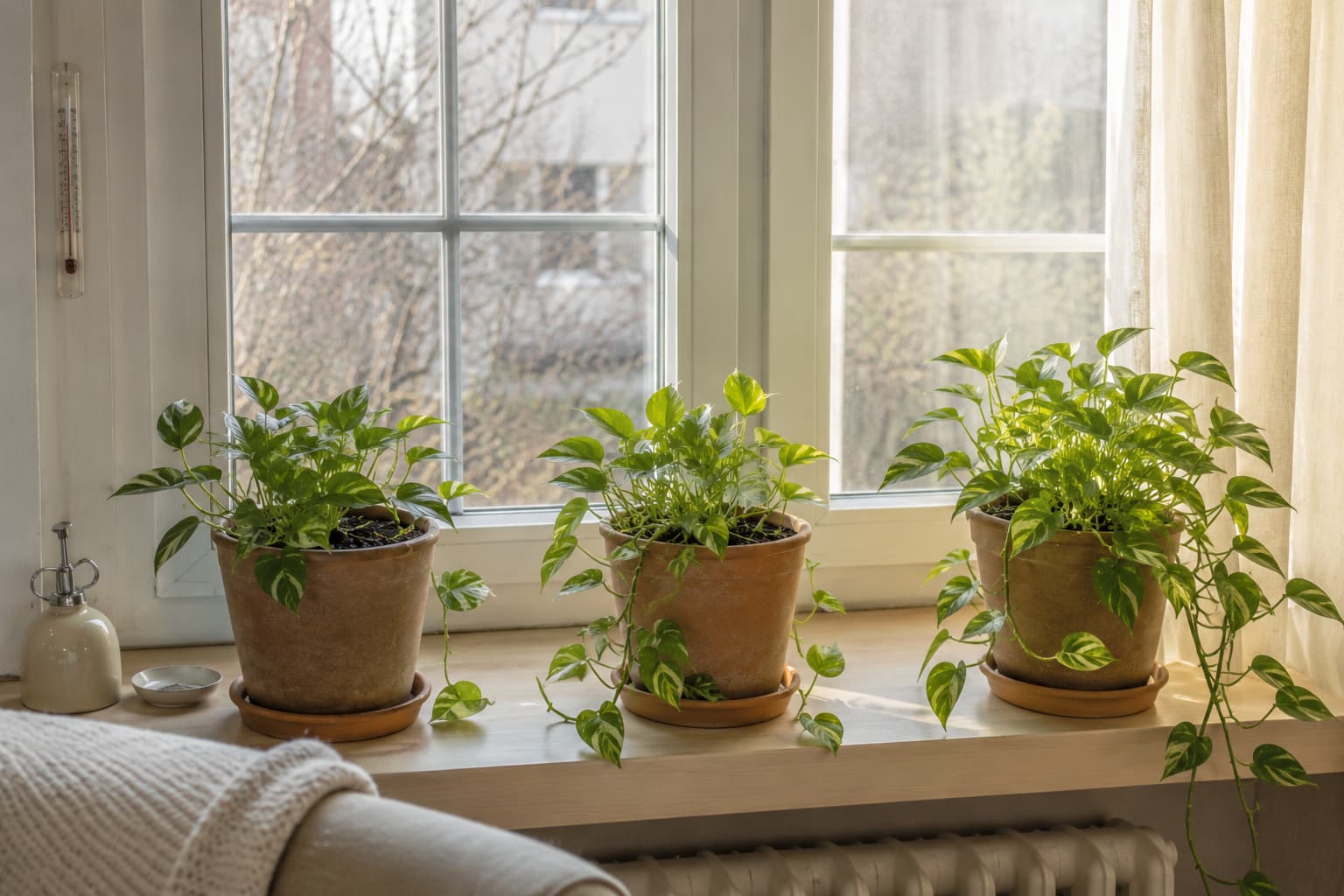
The cause of yellow leaves changes with the season. Here's what to expect and how to prevent each:
Spring (March-May)
Most yellowing in spring comes from repotting stress or fertilizer burn. If you repotted recently and the plant is yellowing, it's transplant shock - keep it in stable conditions and resist the urge to fertilize. Spring is also when scale insects become active - check stems and leaf joints.
Summer (June-August)
Heat stress is the summer culprit, especially in south or west-facing windows. Leaves directly touching hot glass can scorch and turn yellow within hours. Air conditioning ducts blowing directly on plants cause mottled yellowing. For plants struggling in summer heat, see our list of heat-tolerant houseplants for summer windows - or just move your pothos back from the glass by 12 inches.
Autumn (September-November)
As light levels drop, plants enter semi-dormancy and need less water. Many people keep their summer watering schedule and accidentally overwater in autumn. Recheck the soil more slowly as daylight shortens; many indoor pots take longer to dry in autumn.
Winter (December-February)
Winter combines several stresses: lower light, slower potting-mix drying, heating vents, cold glass, and dry indoor air. Yellowing may come from wet roots, temperature swings, pests, natural aging, or more than one factor at once. Check soil moisture and exposure before increasing either watering or humidity. In my own home, a pot that dries quickly in summer may take much longer in winter, which is why I now check the plant rather than keeping a weekly schedule.
When to Give Up on a Yellow Pothos
Recovery becomes unlikely when no firm roots or healthy stem sections remain and decay continues after damaged tissue is removed. Leaf percentage alone is not a good cutoff. Before discarding the plant, take clean tip cuttings from any firm, healthy vines and propagate those separately. Pothos cuttings often root readily when kept clean, warm, and evenly moist.
For a complete reference on growing pothos from scratch, see our golden pothos care guide - it covers light, watering, soil, propagation, and pet safety in detail.
How to Prevent Pothos Leaves Turning Yellow Again
- Water by actual mix dryness. Check below the surface and lift the pot to compare its weight before and after watering.
- Provide bright indirect light. Increase exposure gradually and protect foliage from intense hot-window sun.
- Repot when the root ball or mix shows a need. Choose only a modestly larger draining pot; excess unused mix can remain wet too long.
- Fertilize only during healthy active growth. Follow the label and do not use fertilizer as a first response to unexplained yellowing.
- Inspect regularly for pests. Check leaf undersides, nodes, stems, and nearby plants so small infestations are easier to manage.
- Avoid temperature extremes. Keep the plant away from cold glass, exterior-door drafts, heaters, and direct air-conditioning flow.
Quick Fix Cheat Sheet
Short on time? Use this cheat sheet to identify the most likely cause and the immediate action to take:
| Symptom | Most likely cause | Immediate action |
|---|---|---|
| Mix remains wet unusually long and leaves feel soft | Possible excess moisture or root damage | Pause watering, inspect roots and drainage, repot only if needed |
| Very dry mix, lightweight pot, crisp or curled leaves | Possible insufficient or uneven watering | Rehydrate gradually, drain fully, then reassess drying |
| Lower leaves yellow, soil dry, vines stretching | Low light | Move to brighter spot or add grow light |
| New leaves pale between greener veins | Possible nutrient-uptake, root, pH, or salt issue | Check roots, recent fertilizer, water quality, and pH before treating |
| Dense root ball, rapid wilting, or water bypassing the mix | Possible root congestion or degraded mix | Inspect first; move up one modest pot size if roots dominate |
| Fine stippling, mites, or webbing on leaf undersides | Possible spider mites | Isolate, rinse, confirm the pest, and use a labeled treatment |
| Brown lesions with yellow margins or expanding spotting | Possible leaf-spot disease or physical damage | Remove badly affected leaves, keep foliage dry, improve airflow |
| Yellow leaves near AC vent or exterior door | Temperature stress | Move to stable temperature location |
| Crisp tips during winter or near heating | Possible dry air, salts, uneven watering, or heat | Check watering and salts; move from heat and add humidity if measured air is very dry |
Frequently Asked Questions
01Should I cut yellow leaves off my pothos?
Fully yellow leaves usually do not recover. Remove them with clean scissors when they are soft, damaged, or unsightly, cutting the petiole close to the vine without injuring the stem. A partly pale but firm leaf can remain while you correct the underlying cause.
02Can a yellow pothos leaf turn green again?
A fully yellow leaf usually does not regain normal color. A partly chlorotic leaf may improve when the underlying light, root, water, or nutrient problem is corrected, so diagnose before removing every pale leaf.
03How often should I water my pothos to prevent yellow leaves?
Water when the upper potting mix has dried and the pot feels noticeably lighter. Drying time varies with pot size, mix, light, temperature, airflow, and season, so a fixed weekly schedule is unreliable.
04Are yellow pothos leaves a sign of overwatering or underwatering?
Both can contribute, but neither can be diagnosed from color alone. Wet mix plus soft leaves and damaged roots supports excess moisture; very dry mix plus crisp or curled leaves supports insufficient or uneven watering.
05What does an overwatered pothos look like?
Look for a combination of slow-drying mix, soft lower leaves, stem-base decline, and roots that are soft, hollow, dark, or foul-smelling. Confirm root condition before repotting or trimming.
06Why are my pothos leaves turning yellow after repotting?
Recent root disturbance, a much larger pot, compacted mix, or changed watering can all trigger yellowing after repotting. Keep conditions stable, avoid unnecessary fertilizer, and water only after checking the new mix.
07Can too much light cause pothos leaves to turn yellow?
Yes. Abrupt exposure to strong direct sun can bleach or scorch the exposed side of a leaf, later producing crisp brown tissue. Move the plant back gradually or filter intense light with a sheer curtain.
08How do I know if my pothos has root rot?
Yellow leaves alone do not confirm root rot. Inspect the root system: healthy roots are firm, while damaged roots may be soft, hollow, dark, easily stripped, or foul-smelling. Also check drainage, pot size, and how long the mix remains saturated.
09Why are my pothos leaves turning yellow with brown spots?
Possible causes include leaf-spot disease, mites or thrips, cold injury, sun scorch, mechanical damage, or chemical residue. Note the pattern, inspect leaf undersides, and review recent exposure before treating.
10Should I fertilize my pothos when it has yellow leaves?
Not until watering, roots, light, temperature, pests, and fertilizer-salt buildup have been reviewed. Fertilize only when nutrient depletion is plausible and the plant is otherwise healthy and actively growing, following the product label.
Final Thoughts
Pothos leaves turning yellow are a signal that something in the plant's environment or root zone needs attention, not a diagnosis by themselves. Start with soil moisture, root condition, light, and leaf texture; those checks resolve many cases without guesswork.
If you're building a houseplant collection, pothos pairs well with philodendrons (similar care, different look) and is more forgiving than fiddle leaf figs or calatheas. For summer care specifically, our houseplant heat stress guide covers temperature management in detail. And if you're just starting out, our complete golden pothos care guide walks through everything from choosing a plant to long-term maintenance.
Patience is the secret. A recovering pothos will not look better overnight. Improvement may take several weeks, and fully yellow leaves usually decline while healthy new growth reflects whether the correction is working.
References and Safety
- Penn State Extension — Pothos as a Houseplant
- University of Minnesota Extension — Managing Insects on Indoor Plants
- Penn State Extension — Pest and Disease Problems of Indoor Plants
- ASPCA — Golden Pothos Toxicity for Dogs and Cats
Have a pothos question not covered here? Share the leaf pattern, potting-mix condition, light exposure, and a clear root photo through the contact page.