Flowers That Bloom at Night: 4 Evening Garden Favorites
To begin with, flowers that bloom at night can change how a garden feels after sunset. In addition, some open toward dusk, some release stronger fragrance in the evening, and many become especially noticeable when pale petals contrast with darker foliage.
Quick Answer
For an easy starting point, consider moonflower, four o’clock, evening primrose, and night-blooming jasmine. However, they are not interchangeable: light, climate, toxicity, growth habit, and invasive potential vary widely. Therefore, choose the plant that fits your site first, then design around its real needs.
Why Evening Bloomers Are Special
When daylight fades, a different set of cues becomes important. For example, pale petals remain easier to see in low light, while fragrance can become more noticeable as the air cools and human activity slows down.
At the same time, some night-opening flowers are adapted to visitors such as moths. That does not mean every “night garden” plant supports the same pollinators, so it is better to think in terms of flower shape, scent, local wildlife, and local suitability rather than one universal formula.
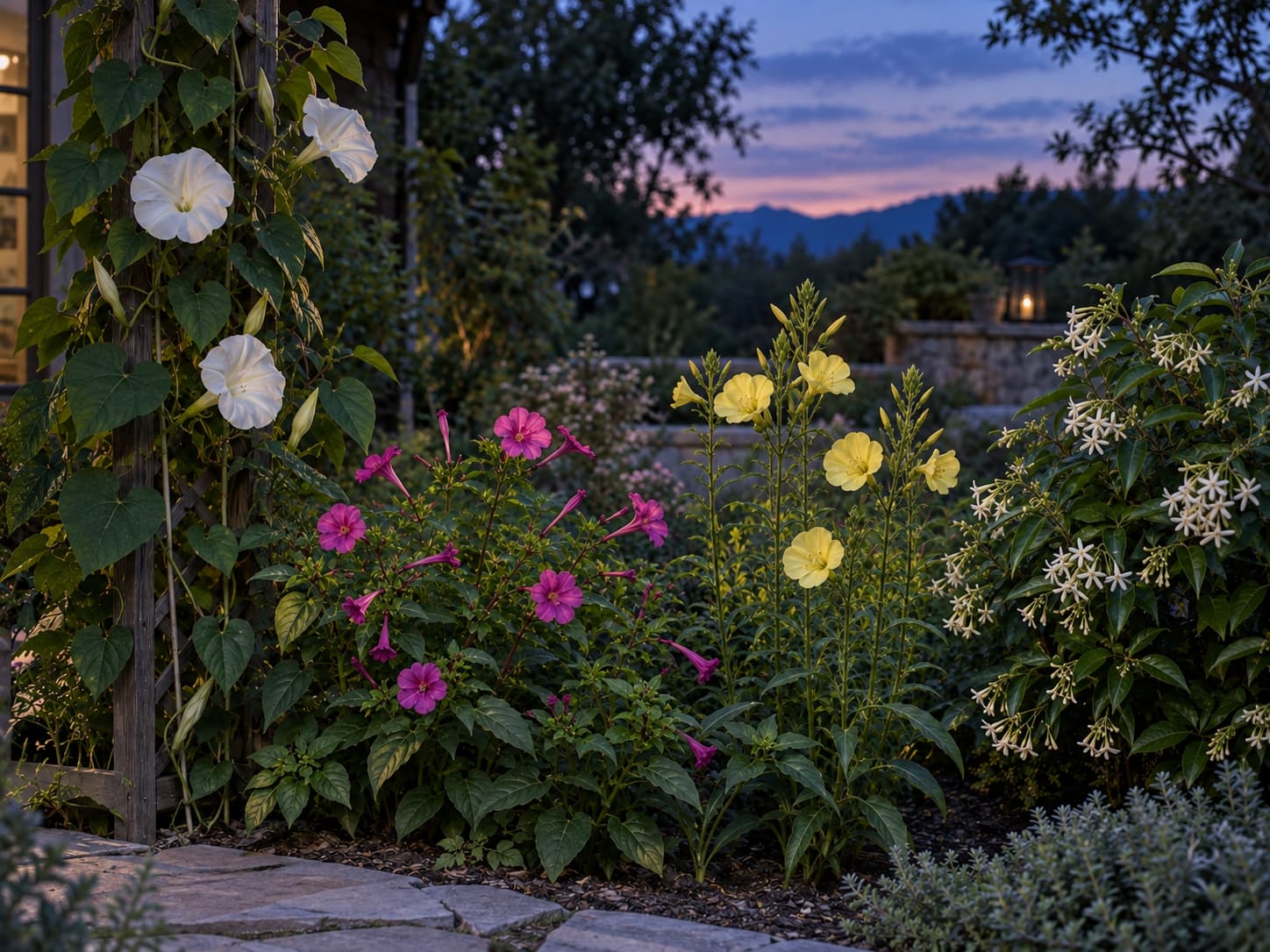
4 Flowers That Bloom at Night
| Plant | Habit | Evening feature | Best use | Important note |
|---|---|---|---|---|
| Moonflower Ipomoea alba | Fast twining vine | Large white flowers open toward evening | Trellis, fence, arch | Seeds can be harmful if eaten |
| Four o’clock Mirabilis jalapa | Bushy flowering plant | Trumpet flowers often open late in the day | Borders, containers | Can self-seed; check local behavior |
| Evening primrose Oenothera biennis | Upright biennial | Yellow flowers open toward evening | Naturalistic beds | Can reseed freely |
| Night-blooming jasmine Cestrum nocturnum | Large woody shrub | Very strong fragrance after dusk | Warm-climate gardens, large containers | Toxic if ingested; invasive in some warm regions |
1. Moonflower (Ipomoea alba)
First, moonflower is the dramatic vertical option. As a result, its large pale flowers stand out clearly against dark foliage after sunset. Because it is a vigorous vine, give it a secure trellis or fence and enough room to climb.
For more detail, see our Moonflower growing guide.
2. Four o’clock (Mirabilis jalapa)
Next, four o’clock flowers often open late in the day and continue into evening. In addition, they are useful where you want a lower, bushier plant rather than a vine. Because of that, growth habit and winter survival depend on climate, and the plant can self-seed in favorable conditions.
For a deeper look at timing, care, and garden use, see our Four O’Clock flower guide.
3. Evening primrose (Oenothera biennis)
Meanwhile, common evening primrose produces yellow flowers that open toward evening and can attract moth visitors. However, it fits best in a looser, naturalistic garden because it may reseed readily and can look less formal than the other plants on this list.
4. Night-blooming jasmine (Cestrum nocturnum)
Finally, night-blooming jasmine can perfume a large garden after dusk, but its strong scent, toxicity, and invasive potential make placement especially important. In fact, it is not a true jasmine; botanically, it belongs to a different plant family.
See our night-blooming jasmine care guide for light, watering, pruning, winter care, toxicity, fragrance, and invasive-growth precautions.
Do not treat night-blooming jasmine like a default patio plant
In warm climates, check local invasive-species guidance before planting Cestrum nocturnum. In homes with young children or chewing pets, its toxicity also makes placement especially important.
Moonlight Pollinators: What Actually Visits at Night?
In general, night-opening flowers can support night-flying insects, especially moths, but the exact visitor depends on region, flower structure, and season. For example, long-tongued moths are well suited to deep tubular flowers such as moonflower.
Moths are the clearest night-garden connection
For instance, sphinx moths and related species are important visitors to many pale, fragrant, tubular flowers. Therefore, a garden with suitable nectar plants and darker nighttime conditions can be more useful than one lit primarily for appearance.
Do not assume every flower attracts bats
By comparison, bat pollination is important mainly in certain ecosystems, especially in tropical and warm regions. However, it is too broad to say that common patio night bloomers automatically attract bats everywhere. So, local ecology matters.
Be careful with nighttime lighting
Importantly, artificial light can disrupt night-flying insects. As a result, protecting dark areas may be just as important as choosing fragrant flowers.
Greenmuse 3-Step Moon-Garden Design
1. Choose one evening focal point
First, start with the place you actually use after sunset: a chair, path, porch, or balcony door. Then, position the strongest flowers where you can experience them without crowding the space.
2. Layer height, pale color, and fragrance
Next, use one climber or tall plant, one middle layer, and one lower edge plant. For example, moonflower can climb vertically while a lower evening flower sits closer to the path.
3. Preserve darkness
Finally, do not illuminate the entire planting bed. Instead, light only the steps, seating edge, or route that needs visibility. Dark foliage and shadow create contrast, while also leaving habitat less disturbed.
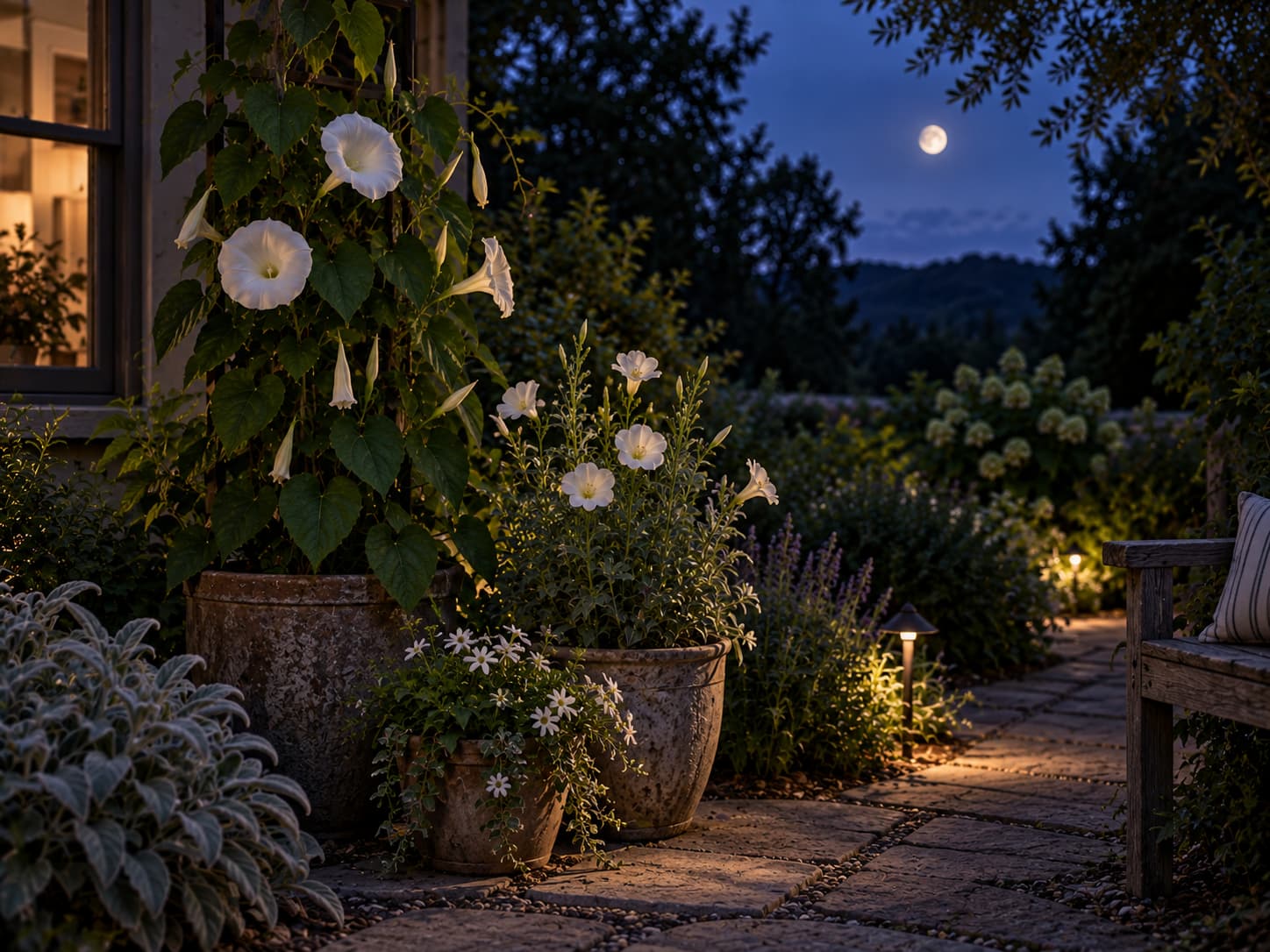
Lighting: Less Is Better
Traditionally, moon-garden advice often encouraged decorative lanterns and strings of fairy lights throughout the planting. For wildlife-friendly design, however, more light is not automatically better.
- Use the lowest practical brightness.
- Shield fixtures and point them downward.
- Choose warmer light rather than blue-white light.
- Use timers or motion controls when possible.
- Preserve part of the garden as a genuinely dark zone.
In short, light the place where a person needs to walk, not the flower simply because it looks attractive.
Evening Bloom Time-Lapse Video
For a visual example, the original Greenmuse short showing flowers opening around twilight is still useful as a companion to this guide.
Moon Garden Planner
Likewise, if you prefer to sketch the layout before planting, the existing Greenmuse Moon Garden Planner can help organize flower position, light, and bloom timing.
Frequently Asked Questions
1. What are good container plants for an evening garden?
Four o’clock and some compact evening flowers can work well in containers. Moonflower can also grow in a large pot with a secure trellis. Night-blooming jasmine is possible in a large container, but its toxicity, strong fragrance, mature size, and local invasive status should be considered first.
2. Does moonflower bloom only once?
No. Instead, a healthy moonflower vine can produce many flowers across its flowering season. Individual blooms are short-lived, but new buds continue developing when light, warmth, water, and plant health are suitable.
3. What pollinates flowers that bloom at night?
For example, moths are among the best-known visitors to many night-opening flowers. Other night-flying insects may also visit depending on region and plant species. Bat pollination is important in some ecosystems, but it should not be assumed for every home garden.
4. Can I grow evening flowers in partial shade?
Yes, in some cases. However, flowering still depends on the individual species and the actual amount of usable light. Check each plant separately rather than treating “night-blooming” as a shared light requirement.
5. Is night-blooming jasmine safe around pets?
No. For safety, Cestrum nocturnum should be treated as toxic if ingested. If pets chew plants, choose a safer alternative or place the shrub where access can be reliably prevented.
6. Should a moon garden use lots of decorative lighting?
No. Instead, restrained, shielded lighting is better for preserving the nighttime atmosphere and reducing disturbance to night-flying insects. Use artificial light mainly where people need it for safe movement.
Greenmuse editorial note: Evening gardens work best when plant choice, local ecology, and human comfort are considered together. A beautiful plant is not automatically the right plant for every climate or household.
Which flower opens first in your garden after sunset? Share your climate zone and whether you garden in beds, containers, or on a balcony.