Moonflower Guide: How to Grow Ipomoea alba from Seed to Night Bloom
Learn how to germinate moonflower seeds, encourage fragrant evening blooms, avoid the Datura mix-up, and grow this fast-climbing vine with confidence.
Quick Summary
Moonflowers (Ipomoea alba) are one of the most magical plants you can grow — a fast-climbing vine that unfurls luminous white, saucer-sized blooms at dusk and fills the evening air with a soft, sweet fragrance. But they're also one of the most misunderstood. Gardeners struggle with seeds that won't sprout, vines that produce leaves but no flowers, and — most critically — confusion with the highly toxic Datura plant, which is also called "moonflower." This guide sorts through the confusion, gives you the exact steps for reliable germination and blooming, and shows you how to build an evening garden around this twilight star.
In This Guide
- What Is a Moonflower? (And What It's Not)
- Moonflower vs. Datura: The Safety Warning Every Gardener Needs
- Plant Profile at a Glance
- How to Grow Moonflowers from Seed (The Right Way)
- Ongoing Care: Light, Water, Feeding, and Support
- Why Won't My Moonflower Bloom? (5 Common Causes)
- Growing Moonflowers in Cold Climates (Zones 3–5)
- Building a Moon Garden Around Your Moonflower
- Frequently Asked Questions
What Is a Moonflower? (And What It's Not)
Moonflower (Ipomoea alba) is a tender perennial vine in the morning glory family (Convolvulaceae), native to tropical and subtropical regions of the Americas. It's a close relative of the common morning glory (Ipomoea purpurea) and sweet potato vine (Ipomoea batatas) — and like its relatives, it's a fast, twining climber that can cover a trellis, fence, or arch in a single growing season.
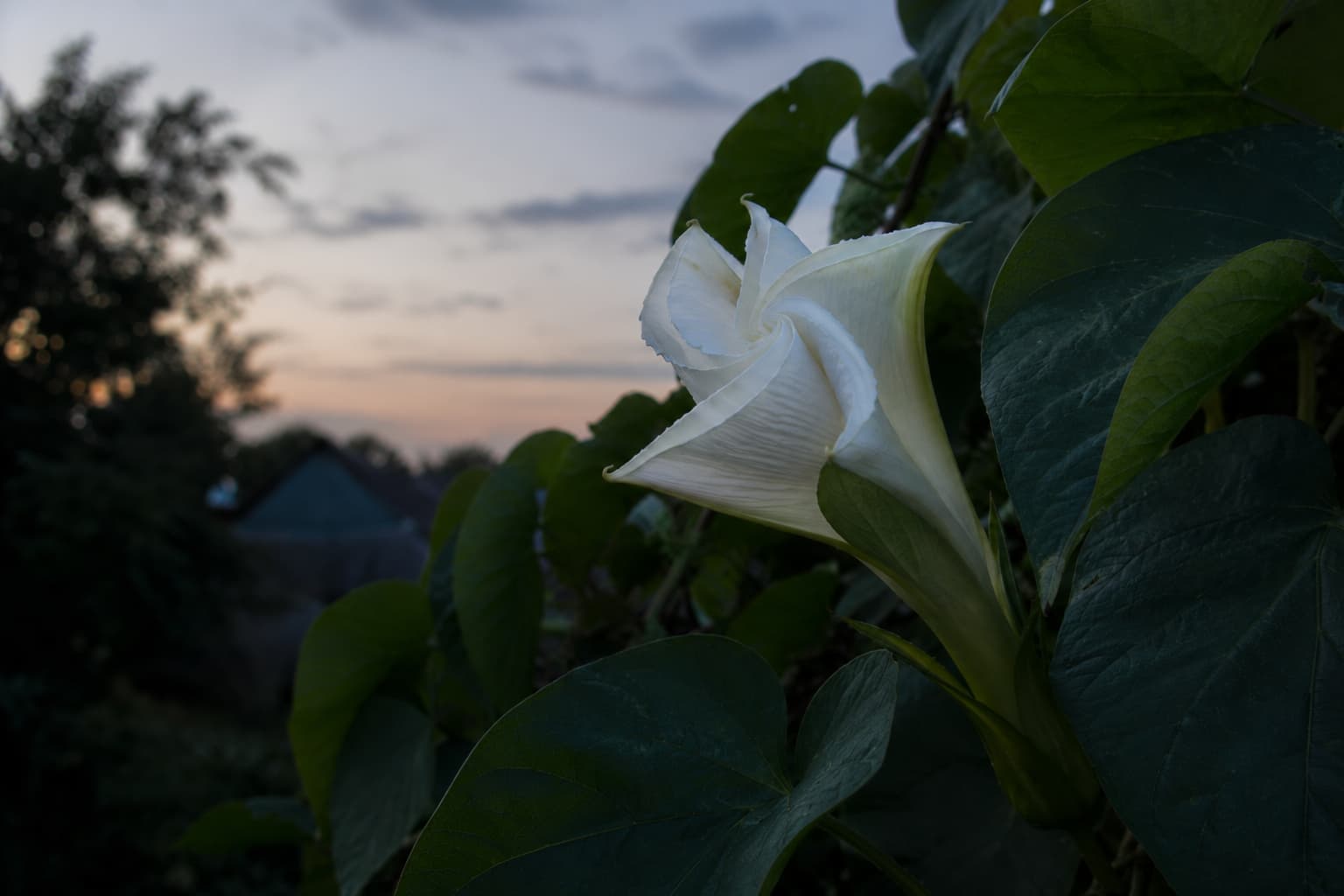
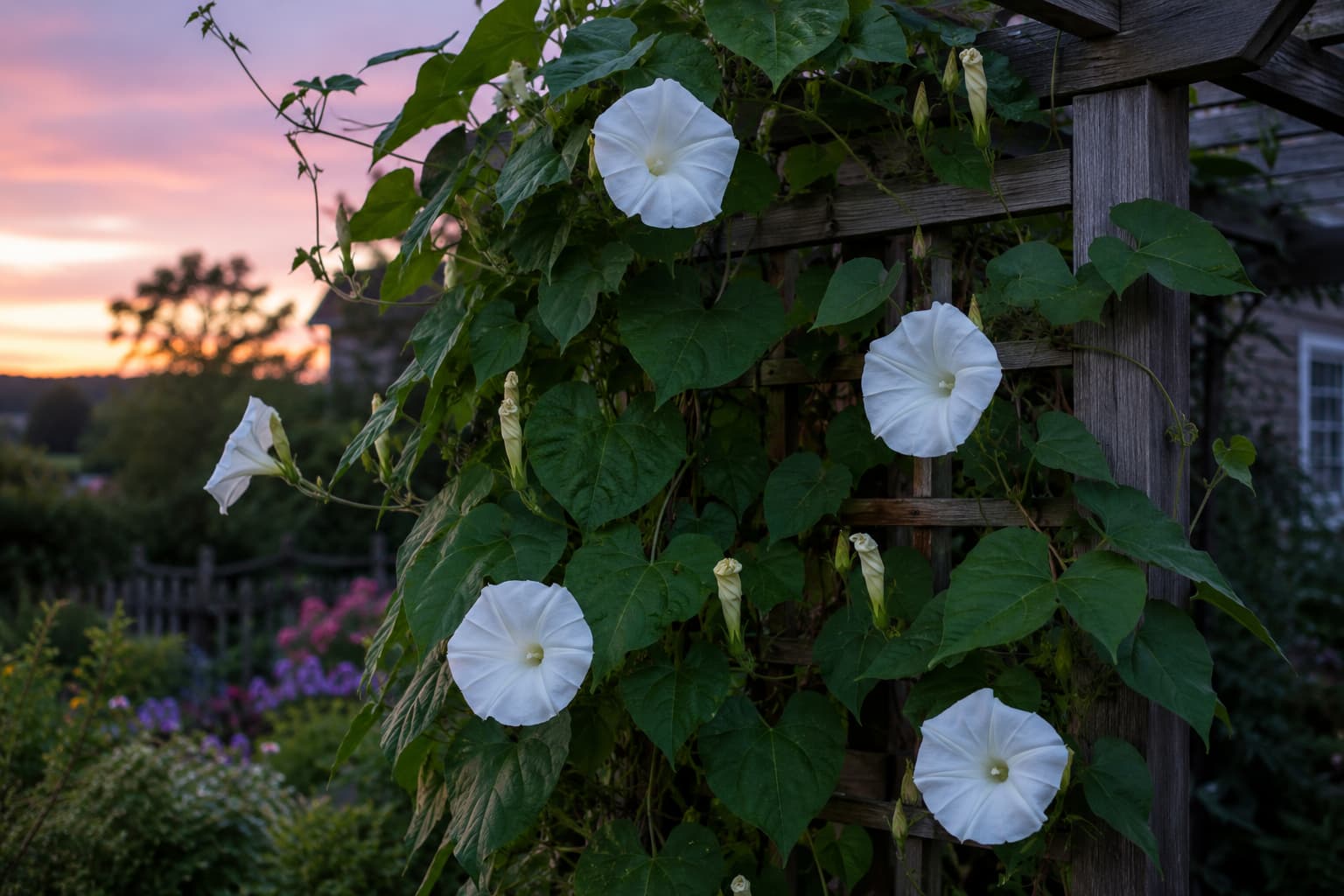
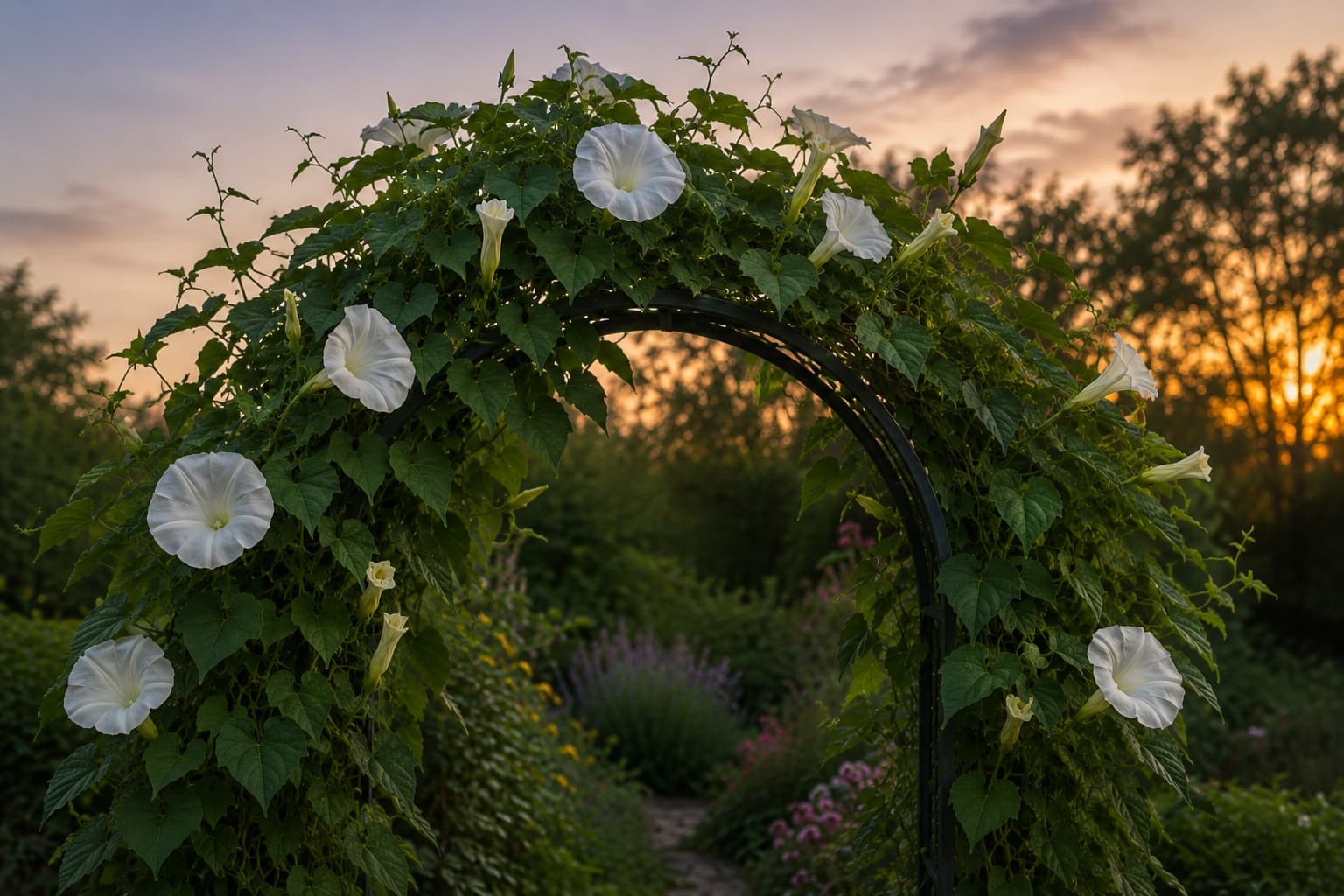
What sets moonflowers apart: their blooms are nocturnal. The large, pure white, fragrant flowers — up to 5–6 inches across — begin opening at dusk and close by mid-morning the next day. On a warm summer evening, you can actually watch them unfurl in real time, spiraling open over the course of just a few minutes. It's one of the most mesmerizing things a garden can offer.
The fragrance is light, sweet, and slightly citrusy — not heavy or cloying. It's strongest in the first few hours after opening, making moonflowers ideal for planting near patios, porches, and outdoor seating areas where you'll be in the evening.
Moonflower vs. Datura: The Safety Warning Every Gardener Needs
This is the most important thing in this entire guide, and it's not discussed nearly enough: two completely different plants are both commonly called "moonflower," and one of them is dangerously toxic.
Critical Distinction
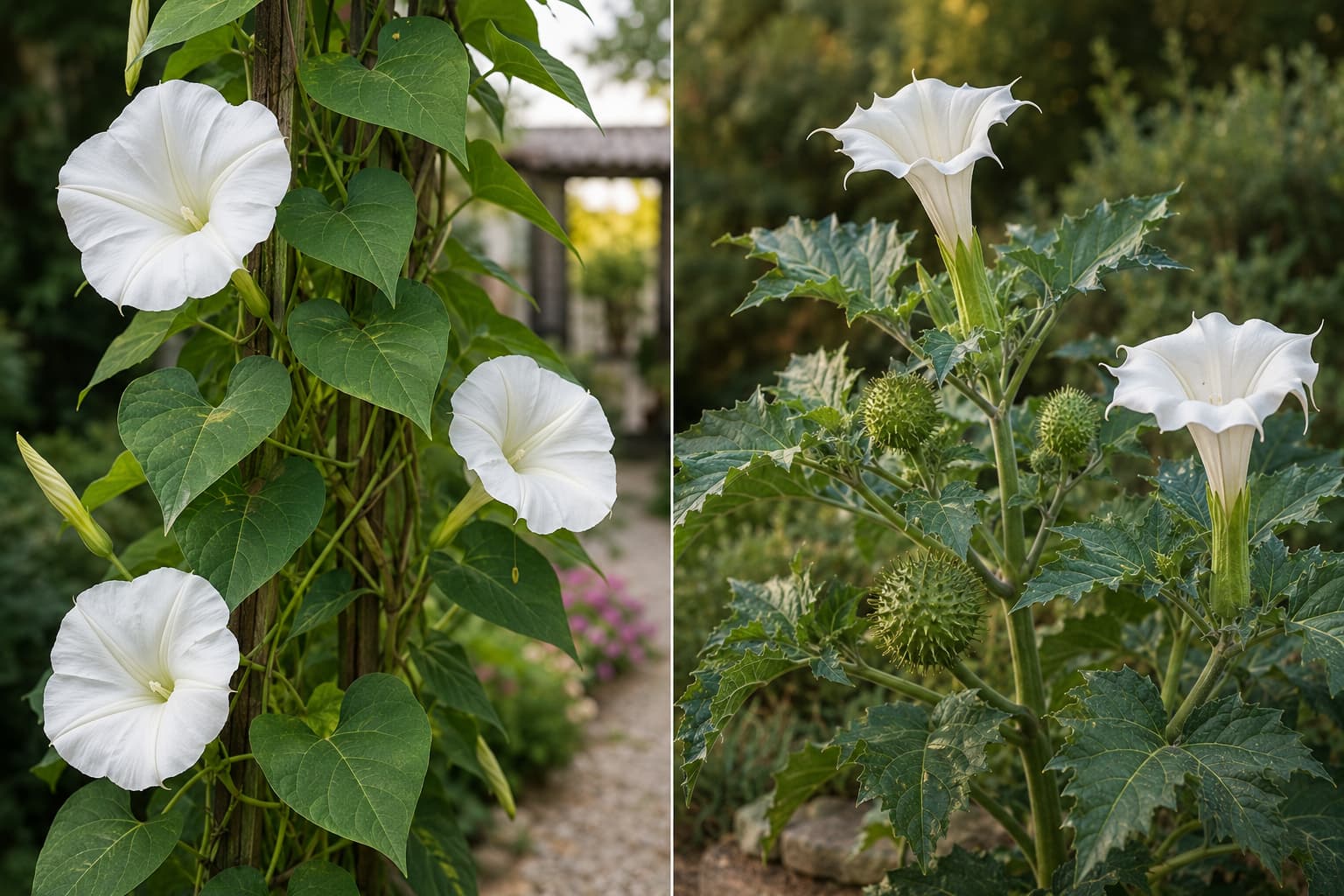
Moonflower vine (Ipomoea alba) — the subject of this guide — is a climbing vine in the morning glory family. Its seeds are mildly toxic if ingested but not deadly. Datura (Datura innoxia, Datura stramonium, and related species) — also called "moonflower" in many garden centers and seed catalogs — is a bushy, upright plant with large trumpet-shaped white flowers. All parts of Datura are extremely toxic and can be fatal if ingested. Never confuse the two.
| Characteristic | Moonflower Vine (Ipomoea alba) | Datura / Thorn Apple (Datura spp.) |
|---|---|---|
| Growth Habit | Twining vine, climbs supports | Upright, bushy shrub |
| Leaves | Heart-shaped, soft, smooth | Large, coarse, jagged-edged, often foul-smelling when crushed |
| Flowers | White, 4–6 inch trumpets, fragrant | White or purple trumpets, 4–8 inches, often fragrant |
| Seed Pods | Small, round, papery capsules | Large, spiky, walnut-sized pods |
| Toxicity | Seeds mildly toxic if ingested | All parts extremely toxic — can be fatal |
| Family | Convolvulaceae (morning glory) | Solanaceae (nightshade) |
How to Buy Safely
When buying seeds or plants, always check the botanical name on the packet. You want Ipomoea alba. If the packet says Datura anything, put it back — unless you fully understand the risks and are comfortable with a highly toxic plant in your garden. This is especially important if you have children or pets.
Plant Profile at a Glance
| Feature | Details |
|---|---|
| Common Name | Moonflower, Moonflower Vine, Tropical White Morning Glory |
| Scientific Name | Ipomoea alba |
| Plant Type | Tender perennial vine (grown as annual in most zones) |
| USDA Zones | Perennial in Zones 9–11; annual in Zones 3–8 |
| Bloom Time | Midsummer through first frost; flowers open at dusk |
| Sun Needs | Full sun — at least 6 hours of direct light per day |
| Soil | Rich, well-drained, loamy soil; tolerates average soil |
| Fragrance | Light, sweet, citrusy — strongest in early evening |
| Mature Size | 8–15 ft tall (can reach 20 ft in ideal conditions); 3–6 ft wide |
| Toxicity | Seeds mildly toxic if ingested; keep away from children and pets |
How to Grow Moonflowers from Seed (The Right Way)
Moonflower seeds have one of the hardest seed coats in the garden. Without scarification, germination can be slow and uneven. The steps below help the seed absorb water more reliably and usually shorten the waiting period.
Step 1: Scarify (Nick) the Seeds
Moonflower seeds are large, hard, and dark brown to black — they look like small pebbles. Use a nail clipper, small file, or sharp knife to nick a tiny notch in the seed coat, just deep enough to expose the lighter inner layer. Don't go deep enough to damage the embryo inside. Alternatively, rub seeds between two pieces of fine sandpaper. This is called scarification, and it's the difference between success and failure with moonflower germination.
The Nail Clipper Trick
The easiest method: use a clean nail clipper to snip off the tiniest bit of the pointed end of the seed — just enough to break through the hard outer coat. It's fast, precise, and safer than a knife for most people.
Step 2: Soak Overnight
After nicking, soak the seeds in warm (not hot) water for 12–24 hours. You'll see them swell noticeably — some may even double in size. Seeds that don't swell after 24 hours can be nicked again and re-soaked. Seeds that remain hard after soaking can be nicked very lightly a second time and soaked again.
Step 3: Sow at the Right Time
Moonflowers are heat lovers. They need warm soil to germinate and warm air to grow. Two options:
- Direct sow outdoors: After all danger of frost has passed and soil temperature is at least 65°F (18°C). For most of the U.S., this is late May to early June. Sow ½ inch deep, 6–12 inches apart near a support structure.
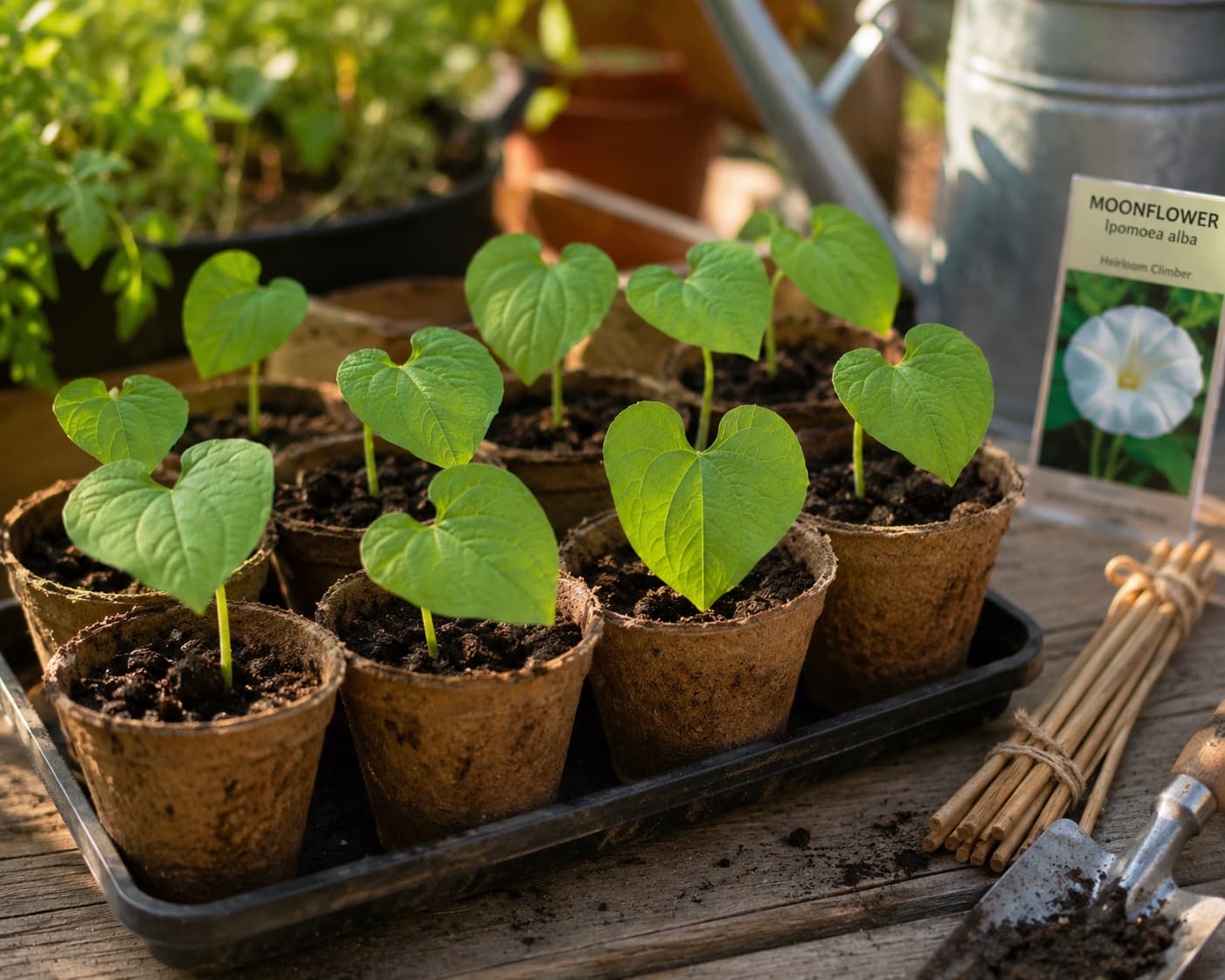
- Start indoors: 4–6 weeks before your last frost date. Use individual 3–4 inch biodegradable pots (peat or cow pots) — moonflowers dislike root disturbance. Keep at 70–75°F. Provide bright light once seedlings emerge. Harden off gradually before transplanting outdoors.
Step 4: Provide a Support Immediately
Moonflowers are born to climb — they start reaching for support within days of emerging. Install a trellis, fence, arch, or netting at planting time, not two weeks later. The vines twine counterclockwise and grow incredibly fast once established (up to a foot per week in peak summer). Trying to untangle and retrain them later is frustrating for you and stressful for the plant.
Ongoing Care: Light, Water, Feeding, and Support
Light Requirements
Moonflowers need full sun — at least 6 hours of direct light per day, and 8+ is better. Consistent direct light is important for reliable flowering. A moonflower in partial shade will grow leaves but produce few, if any, flowers. In hot climates (Zone 9+), some afternoon shade is tolerated, but morning-to-midday sun is essential.
Watering
Keep soil consistently moist but not waterlogged. Moonflowers are thirsty vines during active growth — especially in containers, which dry out faster than garden soil. Water deeply 2–3 times per week during hot, dry weather. A 2-inch layer of mulch around the base helps retain moisture and keeps roots cool.
Signs of underwatering: wilting during the day (even if they recover at night), slow growth, small leaves. Signs of overwatering: yellowing lower leaves, soft stems, mold on soil surface.
Fertilizing: The Delicate Balance
Feeding is one area where moonflower care can easily become unbalanced. Moonflowers are in the morning glory family, and like their relatives, they respond to high-nitrogen fertilizer by producing lush, green, rampant foliage — and almost no flowers. If you've ever complained that your moonflower looks like a jungle but won't bloom, excess nitrogen is a common cause.
Avoid routine high-nitrogen feeding. If the vine appears pale or weak, use a balanced or lower-nitrogen fertilizer at the label rate rather than feeding on a fixed schedule. If you've already over-fertilized with nitrogen, stop fertilizing entirely and water deeply to help flush excess nitrogen from the soil. It may take a few weeks, but the plant should redirect energy to flowering.
The Nitrogen Trap
Many general-purpose fertilizers are high in nitrogen (the first number on the label). Lawn fertilizer runoff is especially problematic. If your moonflower is near a fertilized lawn, it's probably getting a nitrogen boost you didn't intend. Switch to a bloom-focused fertilizer and keep lawn applications at least 5–6 feet away.
Support and Training
Moonflowers need something to climb. The best supports: trellises, arbors, chain-link fences, netting, or taut strings. The vines will twine around anything vertical — but they need something to grab. A single plant can cover a 6-foot-wide trellis by late summer. For dense coverage, plant every 12 inches along the base of the support.
Young vines may need a little guidance — gently wrap the growing tip around the support once or twice and it'll take over from there. Once established, moonflowers climb on their own and need no further training.
Why Won't My Moonflower Bloom? (5 Common Causes)
If you search "moonflower" on any gardening forum, the top question by a wide margin is some version of: "My vine is huge and healthy but no flowers. What's wrong?" Here are the causes, ranked from most to least common:
1. Too Much Nitrogen (Most Common)
Lush, dark green, vigorous foliage with zero blooms is the classic sign. Switch to a low-nitrogen, high-phosphorus fertilizer. Stop all fertilizing for 3–4 weeks if you suspect you've overdone it.
2. Not Enough Sun
Moonflowers in less than 6 hours of direct sun will struggle to bloom. This is especially common when they're planted on the north side of a structure or under a tree canopy that looked sparse in spring but filled in by summer.
3. Started Too Late / Short Growing Season
Moonflowers need a long, warm growing season. In Zones 3–6, seeds started outdoors in June may not have enough time to mature and bloom before frost. The fix: start seeds indoors 4–6 weeks before your last frost date. More on this in the cold climate section below.
4. Plant Is Too Young
Moonflowers grown from seed typically need 8–10 weeks of growth before they start blooming. If it's only been 6 weeks since you planted, be patient — they're still building the infrastructure to support flowers. Blooms usually begin in mid-to-late summer and continue until frost.
5. Overwatering
Constantly soggy soil stresses the roots and can delay or reduce flowering. Let the top inch of soil dry out between waterings.
Quick Diagnostic
Lots of leaves, no flowers → too much nitrogen, not enough sun, or plant too young. Few leaves, no flowers → poor soil, underwatering, or disease. Buds form but drop → inconsistent watering or extreme heat. Match your symptom to the fix.
Growing Moonflowers in Cold Climates (Zones 3–5)
Moonflowers are tropical plants that need heat and a long season. In Zones 3–5, where summers are shorter and cooler, you need a strategy. The good news: with the right approach, even northern gardeners can enjoy moonflowers before frost arrives.
Cold-Zone Action Plan
- Start seeds indoors 6–8 weeks before your last frost date — earlier than the standard 4–6 weeks. This gives you larger, more established transplants.
- Use heat mats during germination. Moonflower seeds germinate best at 70–80°F soil temperature.
- Don't transplant outside until nighttime temperatures stay reliably above 50°F (10°C). Cold nights can slow moonflower growth considerably — it's better to keep them indoors an extra week than to rush them into chilly soil.
- Plant against a south-facing wall, fence, or stone path. These structures absorb heat during the day and radiate it at night, creating a warmer microclimate.
- Use dark-colored containers or raised beds to trap additional solar heat.
- Mulch with black plastic or dark landscape fabric early in the season to warm the soil faster.
- Cover young plants with cloches or row cover on unexpectedly cold nights.
Short-Season Variety Tip
Some seed companies offer earlier-blooming moonflower strains. Look for varieties described as "early flowering" or "short season." These have been selected to bloom in 7–8 weeks instead of the standard 10–12, making a big difference in Zones 3–5.
Building a Moon Garden Around Your Moonflower
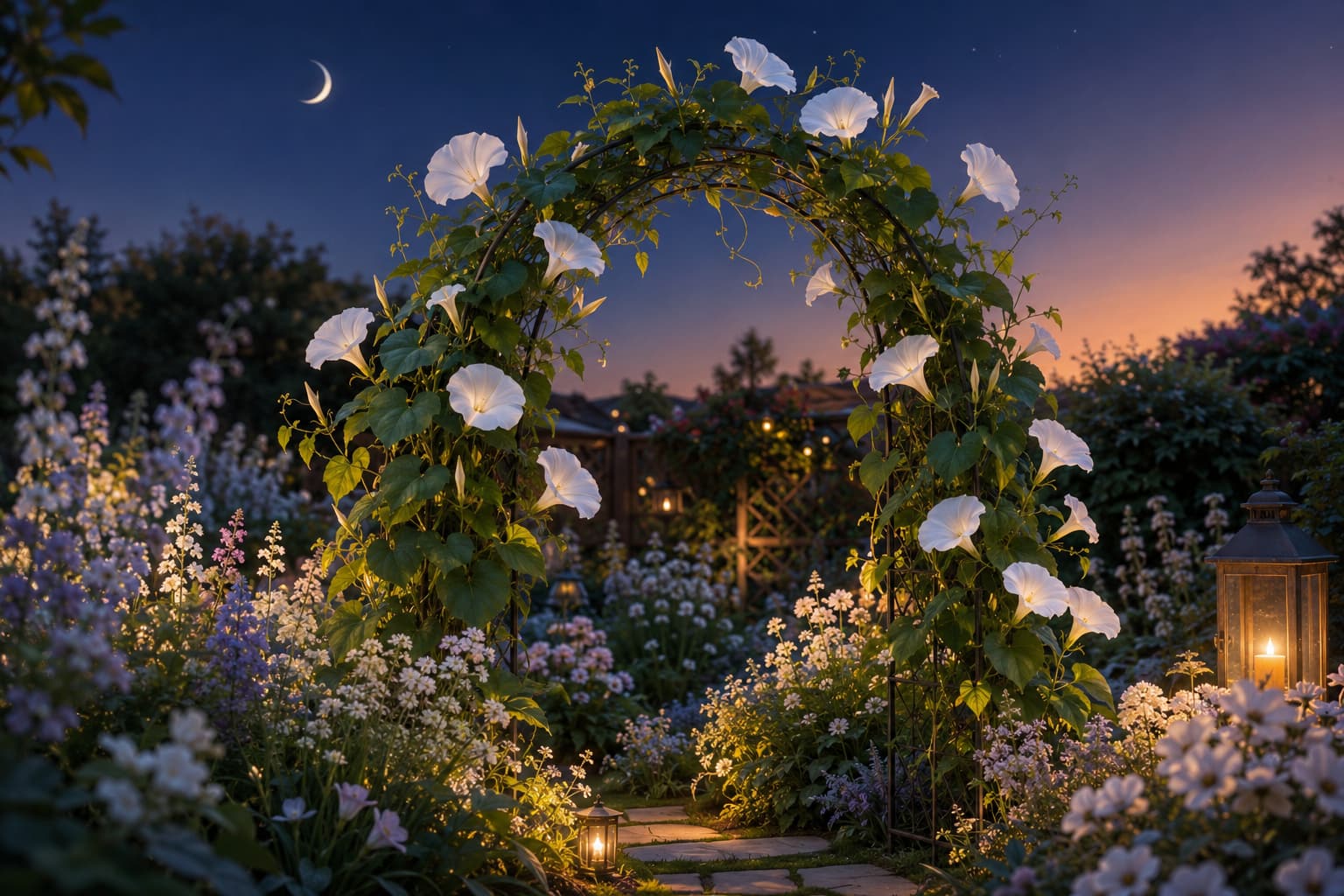
Moonflowers are spectacular on their own — but they're even better as the anchor of a moon garden: a garden designed to be enjoyed after dark, with white and pale flowers, silver foliage, and night fragrance.
Best Companion Plants for a Moon Garden
| Plant | Why It Works | Contribution |
|---|---|---|
| Four O'Clocks (Mirabilis jalapa) | Open in late afternoon; bushy, fills the middle layer | Pink/yellow/white blooms, sweet fragrance |
| Flowering Tobacco (Nicotiana alata) | Intensely fragrant at night; tubular white flowers | Vertical accent, jasmine-like scent |
| Evening Primrose (Oenothera) | Pale yellow blooms open at dusk; native option | Ground cover, soft glow in low light |
| Dusty Miller (Jacobaea maritima) | Silvery, luminous foliage that glows in moonlight | Foreground texture, drought-tolerant |
| Sweet Alyssum (Lobularia maritima) | Low-growing, honey-scented; white varieties glow at night | Carpets the ground, continuous bloom |
| Lavender (Lavandula) | Silver foliage, calming scent; attracts day pollinators | Structure, fragrance, 24-hour garden appeal |
Design Tips for Maximum Evening Impact
- Plant near where you sit in the evening. The fragrance is wasted if the plant is at the far end of the yard. Put it near a patio, deck, porch, or bedroom window.
- Use white and pale-colored flowers throughout. White, cream, pale yellow, and soft pink are most visible in low light. Dark reds and purples disappear after sunset.
- Add soft, warm lighting. Solar-powered warm-white string lights or path lights enhance the moon garden without overpowering it. Avoid harsh white or blue-toned LEDs — they can overpower the softer evening atmosphere.
- Layer heights. Moonflower and nicotiana (tall) → four o'clocks and lavender (middle) → dusty miller and alyssum (low). This creates depth and visual interest even in dim light.
- Include reflective surfaces. A light-colored gravel path, a white-painted bench, or a small mirror or gazing ball amplifies moonlight and garden lighting.
Frequently Asked Questions
1. Why aren't my moonflower seeds germinating?
Moonflower seeds have an extremely hard seed coat. Without scarification (nicking the seed coat with a nail clipper or file) and an overnight soak in warm water, germination rates are very low — often 10% or less. Properly scarified and soaked seeds should sprout within 7–14 days at 70–75°F. Also check that your seeds are fresh — moonflower seeds lose viability faster than many other flower seeds.
2. Is moonflower the same as Datura?
No — and confusing them is dangerous. Moonflower vine (Ipomoea alba) is a climbing vine in the morning glory family. Datura (Datura spp.) is an upright, bushy plant in the nightshade family, and all parts of Datura are extremely toxic and can be fatal if ingested. Always check the botanical name on seed packets and plant tags. This guide covers Ipomoea alba only.
3. Why does my moonflower have tons of leaves but no flowers?
The most common cause is excess nitrogen — often from lawn fertilizer runoff or using a high-nitrogen plant food. Switch to a low-nitrogen, high-phosphorus bloom fertilizer (like 5-10-10). Other causes: not enough sun (needs 6+ hours direct), plant too young (needs 8–10 weeks from seed), or short growing season in cold zones (start seeds indoors earlier).
4. Are moonflowers toxic to dogs, cats, or children?
The seeds of Ipomoea alba are mildly toxic if ingested — they can cause gastrointestinal upset, nausea, and vomiting. They are not as dangerous as Datura seeds, but should still be kept away from children and pets. Store seeds in labeled, childproof containers. If you have a dog that eats garden plants, plant moonflowers in a fenced area or elevated container.
5. Can moonflowers grow in containers?
Yes, but choose a large container — at least 14–18 inches wide and deep — and include a sturdy trellis or obelisk for support. Container-grown moonflowers need more frequent watering and feeding than in-ground plants. Use a loam-based potting mix with good drainage. In Zones 8 and colder, containers can be moved to a sheltered location in fall, though the plant won't survive winter indoors without supplemental lighting.
6. How do I save moonflower seeds for next year?
Wait until the flower fades and a small, round seed pod forms in its place. Let the pod dry on the vine until it turns brown and papery. Harvest before it splits open. Each pod contains 2–4 large seeds. Dry them indoors on a paper plate for a week, then store in a labeled paper envelope in a cool, dry place. Seeds remain viable for 1–2 years if stored properly.
7. Will moonflowers come back every year?
In Zones 9–11, moonflowers are perennial and will return from the roots each spring. In Zones 3–8, they're grown as annuals and killed by frost. However, they self-seed readily in many areas — if you let seed pods mature and drop, you'll often find volunteer seedlings the following spring. In warm zones, this can become aggressive; deadhead spent flowers if you don't want volunteers.
8. Can I plant moonflowers and morning glories together?
Yes — this is a classic combination. Morning glories (Ipomoea purpurea or I. tricolor) bloom during the day in blues, purples, pinks, and reds. Moonflowers take over at dusk with white, fragrant blooms. Plant them on the same trellis and you'll have 24-hour bloom coverage from midsummer through frost. Both need the same conditions: full sun, well-drained soil, and scarified seeds.
Sources & Further Reading:
Final Thoughts
There's something genuinely magical about moonflowers — and it's not just marketing. Watching a 5-inch white bloom spiral open in real time, breathing in that soft citrus fragrance as dusk settles, seeing sphinx moths appear out of the darkness to feed — it's one of those garden experiences that never gets old.
But the magic only happens if you get the fundamentals right. Scarify and soak the seeds. Give them full sun. Don't overdo the nitrogen. Start early if you're in a cold zone. And above all, know what you're planting — the difference between Ipomoea alba and Datura is not a detail; it's a safety issue.
Here's what to remember:
- Nick and soak seeds — skip this step and you'll be waiting weeks for nothing
- Full sun, consistent water, low-nitrogen fertilizer — the formula for blooms, not just leaves
- Provide support at planting time — these vines climb fast and need direction from day one
- Check the botanical name — Ipomoea alba is what you want; Datura is not
- Build a moon garden around it — moonflowers are even better with four o'clocks, nicotiana, and evening primrose
If you found this guide helpful, you might also enjoy our guides on Four O'Clock Flowers and Maple Tree Care — two more guides for gardeners who want practical, honest advice that actually works.
Have you grown moonflowers? Share your climate zone, first bloom date, and the method that helped your seeds germinate.