Balcony Vegetable Garden: 3 Steps to Your First Summer Harvest
A beginner-friendly plan for choosing container vegetables, arranging a small balcony, and managing water, feeding, heat, and harvest without overcomplicating the setup.
Published June 6, 2025 · Last updated September 2026
Quick Answer
A productive balcony vegetable garden starts with three things: choose compact crops that match your sun, give each plant enough root space and drainage, and check containers frequently because heat and wind dry them faster than garden beds. Cherry tomatoes, peppers, bush beans, compact eggplants, Malabar spinach, and lemongrass can all work well when the balcony has suitable light and the containers fit the crop.
Step 1: Choose Balcony-Friendly Vegetables
To begin with, do not choose crops only because they are easy in a backyard. Instead, balcony gardening changes the equation. Root volume, wind, reflected heat, railing shade, and limited floor space all matter more when every plant is in a pot.
Three reliable beginner crops
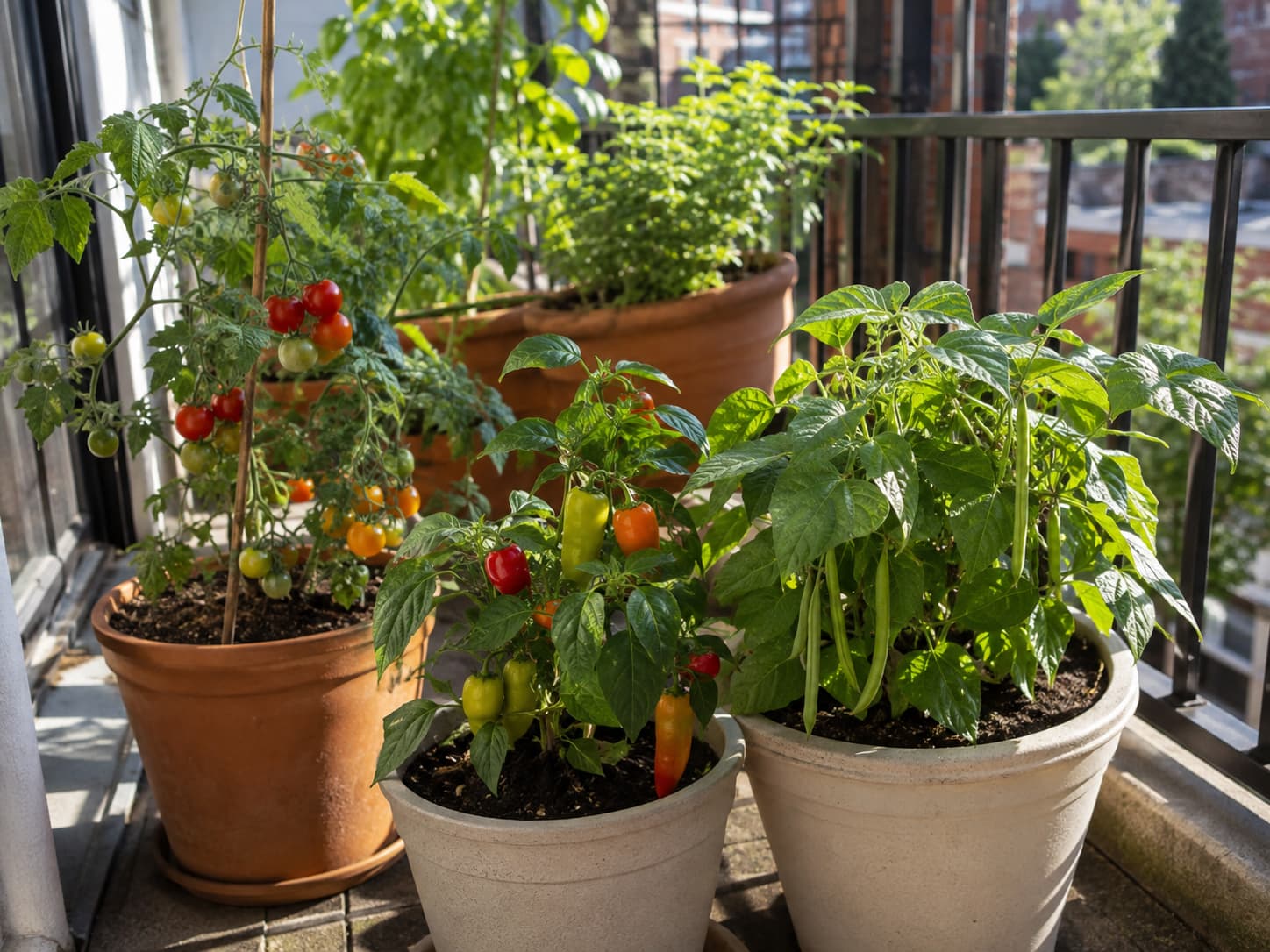
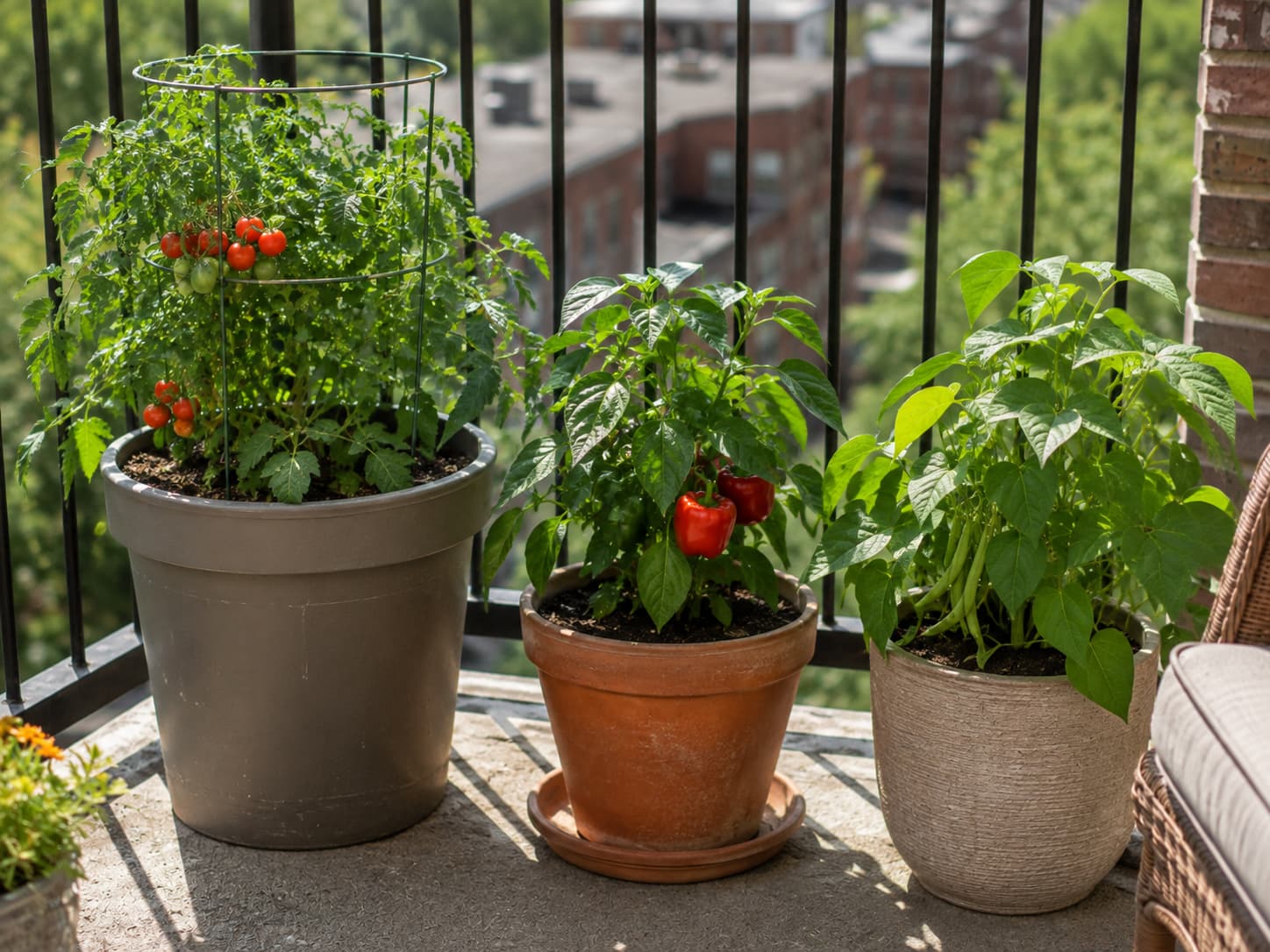
For most beginners, compact tomatoes, peppers, and bush beans are practical starting points. Meanwhile, tomatoes and peppers need the brightest part of the balcony, while bush beans can give you a useful crop without tall supports if you choose a true bush type.
| Crop | Why it works | Container approach | Support |
|---|---|---|---|
| Compact tomato | Good yield from a relatively small footprint | Use a roomy container with drainage; larger pots buffer heat and moisture swings better | Compact cage or stake as needed |
| Pepper | Warm-season crop that adapts well to containers | Give one plant enough root volume rather than crowding several into a small pot | Usually light support only |
| Bush bean | Direct-sown and relatively fast to harvest | Use a container wide enough for several plants at label spacing | Usually none or minimal support |
Determinate vs. Indeterminate Tomatoes
In a tight balcony, determinate or patio-type tomatoes are usually easier because they stay more compact. Indeterminate tomatoes can also grow in containers, but they need more root room, stronger support, and more vertical management.
Three heat-friendly extras
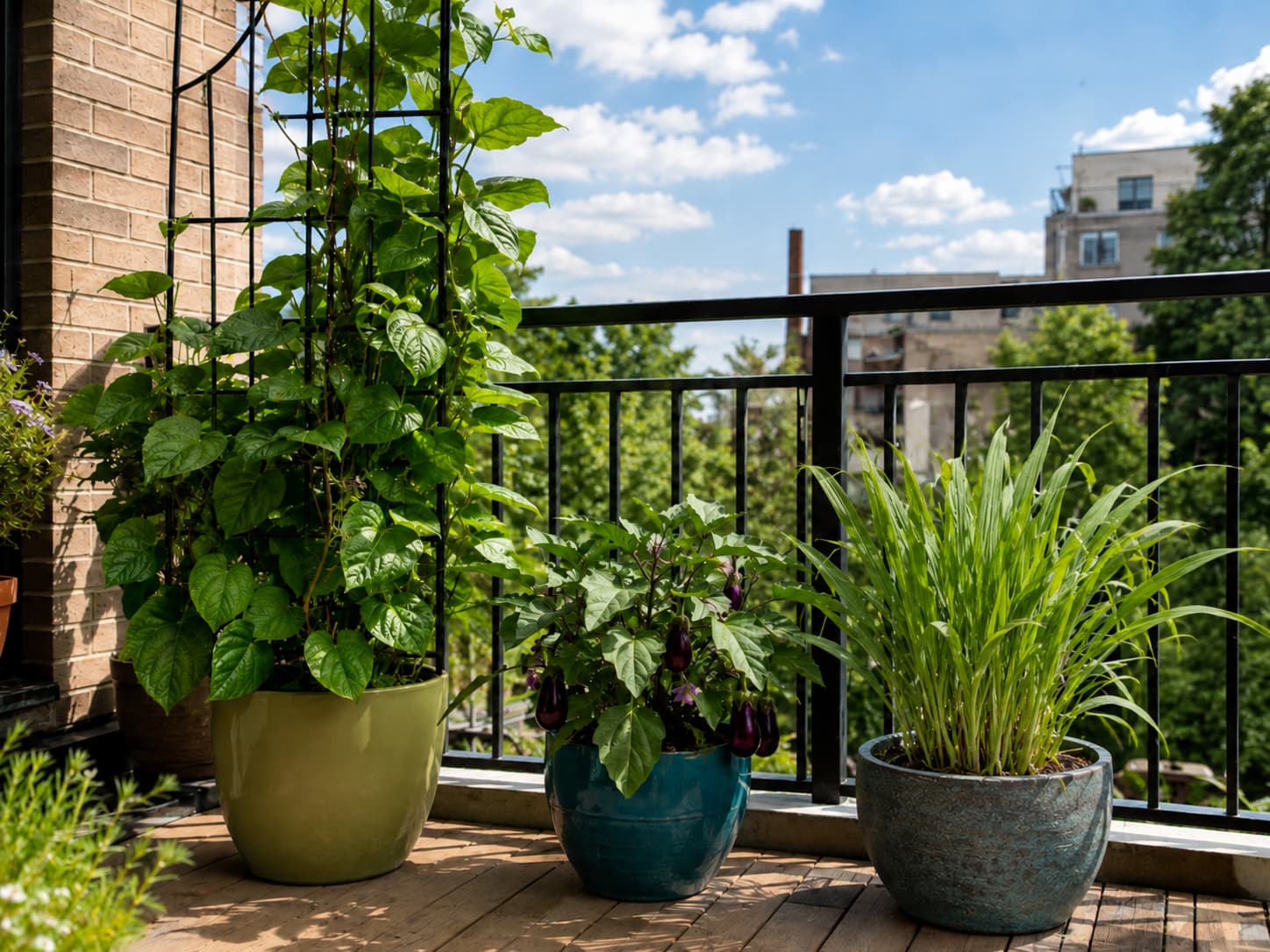
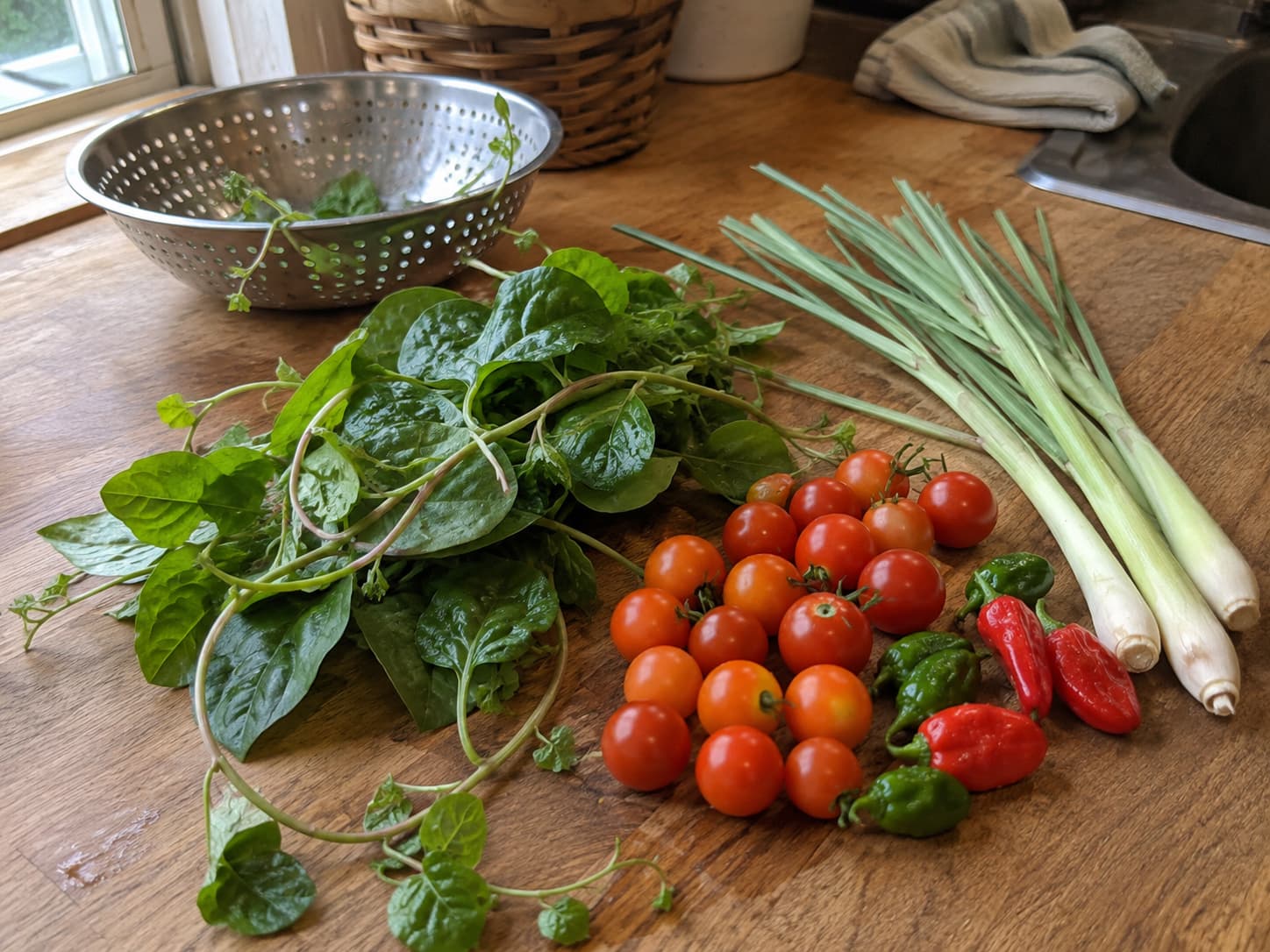
If summers are hot, Malabar spinach, compact eggplant, and lemongrass can expand the harvest without requiring a large bed. Specifically, each solves a different space problem: Malabar spinach grows upward, dwarf eggplants stay compact, and lemongrass forms a manageable clump.
Malabar spinach
Unlike true spinach, Malabar spinach (Basella alba or B. rubra) is a tropical vine that enjoys warm weather. Train it on a sturdy trellis and harvest young leaves and tender shoots for cooked dishes.
Compact eggplant
Similarly, dwarf and compact eggplant cultivars are useful where floor space is limited. Give them strong sun, warm conditions, and enough container volume to prevent rapid drying.
Lemongrass
Finally, lemongrass (Cymbopogon citratus) handles heat well and is useful in the kitchen. However, do not rely on a potted lemongrass plant as mosquito control; growing the live plant nearby is not a substitute for proven bite-prevention methods.
Step 2: Build a Safer Balcony Layout
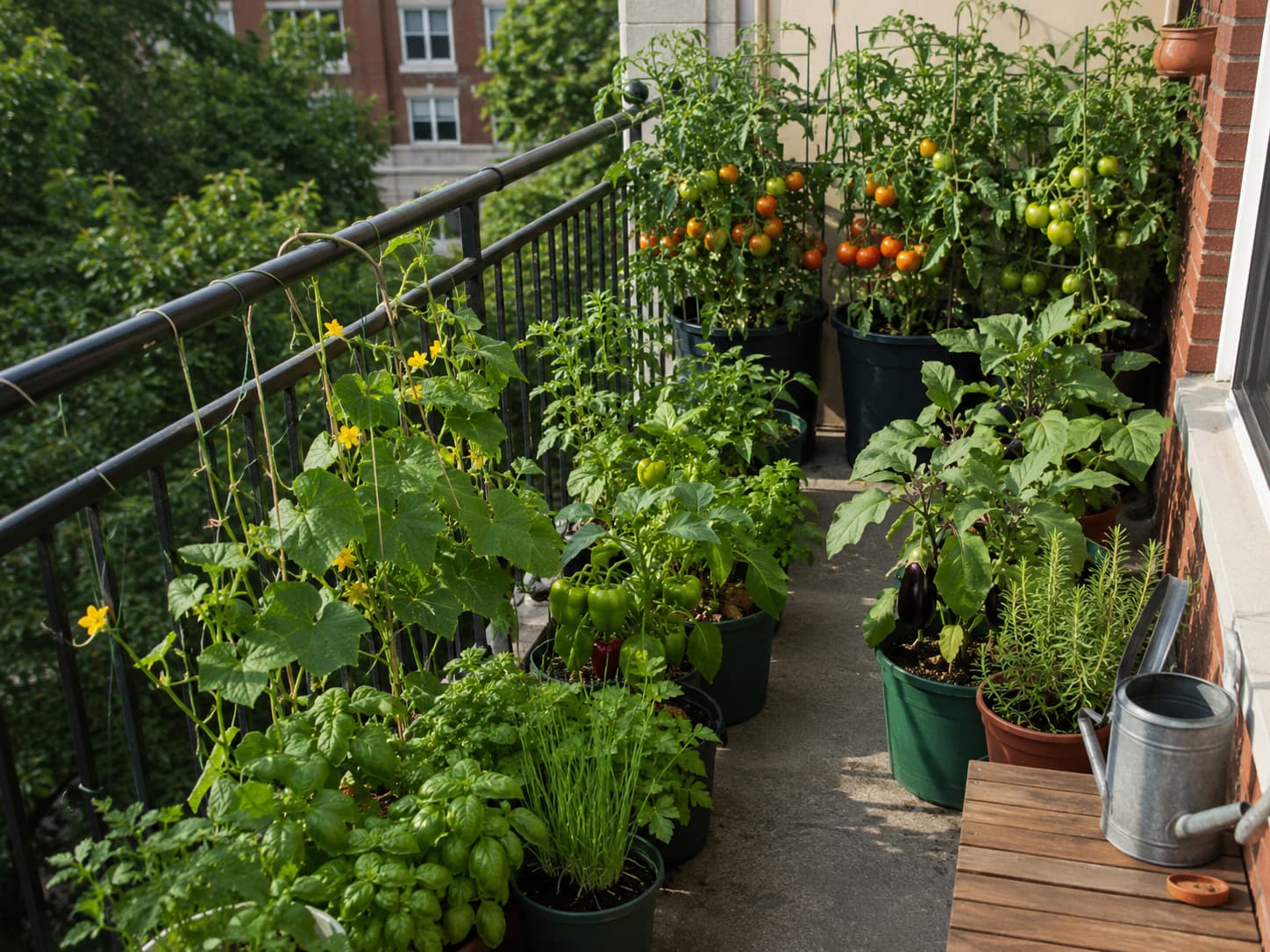
Before buying containers, observe the balcony for several days. Note where direct sun actually falls, which corners are windy, where rain reaches, and which areas stay shaded by the building or railing.
Map the sun before placing crops
- Brightest zone: tomatoes, peppers, and eggplants usually belong here.
- Moderate-light zone: beans, herbs, and some leafy crops may be more forgiving.
- Deep shade: fruiting vegetables are unlikely to perform well without substantially more light.
As a result, orientation alone does not tell the whole story. For example, nearby buildings, balcony overhangs, railings, and seasonal sun angles can change the usable light dramatically.
Check structural and building rules
Do Not Guess Balcony Load Limits
Wet potting mix, large containers, water reservoirs, and ceramic pots can become heavy. Do not assume a universal pounds-per-square-foot rating. Check your building rules, lease or strata guidance, and structural information before grouping large containers. Also keep pots secure so wind cannot tip them over or send loose objects over a railing.
Choose containers by root space, not one magic size
For containers, bigger is often easier because a larger root zone holds moisture more steadily and heats up more slowly. However, the right size depends on the crop, cultivar, climate, and pot shape.
| Crop | Practical starting point | What matters most |
|---|---|---|
| Compact tomato | Large single-plant container | Root room, drainage, and stable support |
| Pepper | Medium-to-large single-plant container | Warm soil without repeated drought stress |
| Bush beans | Wide container | Enough surface area to follow seed spacing |
| Compact eggplant | Large single-plant container | Consistent moisture and strong light |
| Malabar spinach | Deep container with trellis | Vertical support and warm conditions |
| Lemongrass | Roomy pot for one clump | Drainage and enough space for expanding stems |
For a deeper container strategy, see Containers vs. In-Ground Planting.
Step 3: Water and Feed by Plant Signals
Once the balcony is planted, the most important routine is observation. At the same time, containers dry faster than in-ground beds, but they can also stay wet if the mix is dense, the pot is oversized, or drainage is blocked.
Check moisture before watering
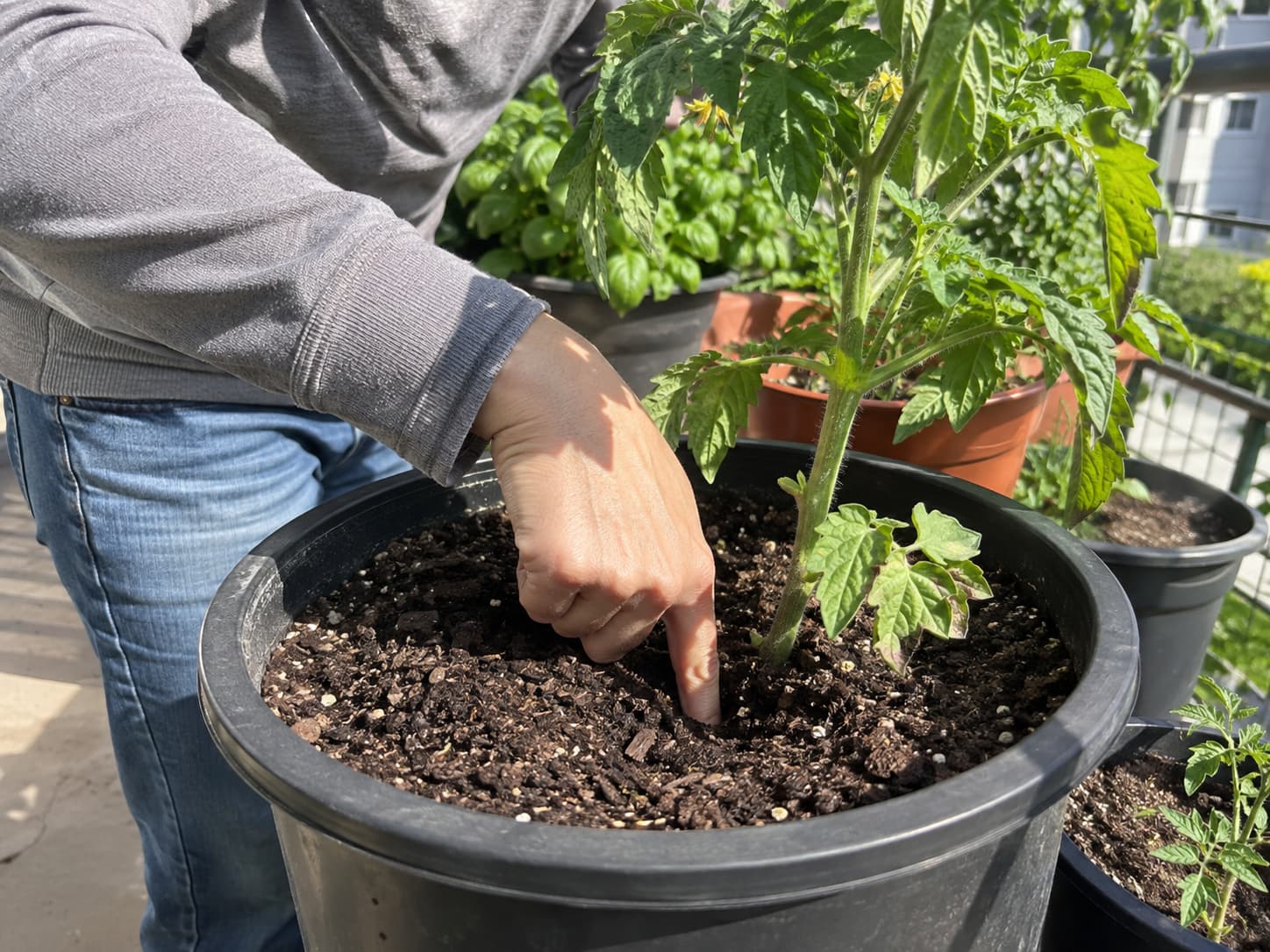
- Feel below the surface. Do not judge only by a dry crust on top.
- Water thoroughly when the root zone is becoming dry. Apply enough water to moisten the mix evenly.
- Let excess water drain. Do not leave ordinary containers standing in stagnant water unless they are designed as a reservoir system.
- Recheck more often in heat and wind. Small pots can change quickly during hot weather.
Importantly, afternoon wilting does not always mean the soil is dry. During intense heat, leaves may droop temporarily even while the root zone still contains moisture. Check the pot before adding more water. For the underlying principle, see our heat-stress guide.
Feed according to the fertilizer label
Because container crops depend on a limited volume of mix, nutrients eventually need replenishing. However, there is no universal “every 10 days” schedule that fits every potting mix and fertilizer. For instance, some mixes already contain starter fertilizer, while slow-release and liquid products have very different instructions.
- Tomatoes, peppers, and eggplants: use a fertilizer labeled for container vegetables and follow the package rate.
- Beans: avoid unnecessary high-nitrogen feeding; excessive nitrogen can favor leaves over pods.
- Leafy crops and lemongrass: feed only as needed and according to the label.
Blossom-End Rot Is Usually a Water-Management Problem
Blossom-end rot is a physiological disorder linked to inadequate calcium reaching developing fruit. In containers, uneven moisture and rapid root-zone stress are common contributors. Therefore, improve watering consistency before automatically adding calcium products.
Heat, Wind & Moisture Management
During hot weather, container roots can heat and dry quickly. For that reason, light-colored pots, larger soil volumes, a modest organic mulch layer, and protection from the harshest reflected heat can make moisture easier to manage.
At the same time, wind increases water loss and can snap unsupported stems. Grouping pots can provide some shelter, but leave enough space for air movement and access. Secure trellises and tall supports so they cannot become wind hazards.
Skip the Rock “Drainage Layer”
Do not add a layer of gravel or rocks to the bottom of an ordinary container to “improve drainage.” Use containers with drainage holes and a suitable potting mix instead. A heavy rock layer reduces usable root volume and adds unnecessary balcony weight.
Common Balcony Vegetable Pests
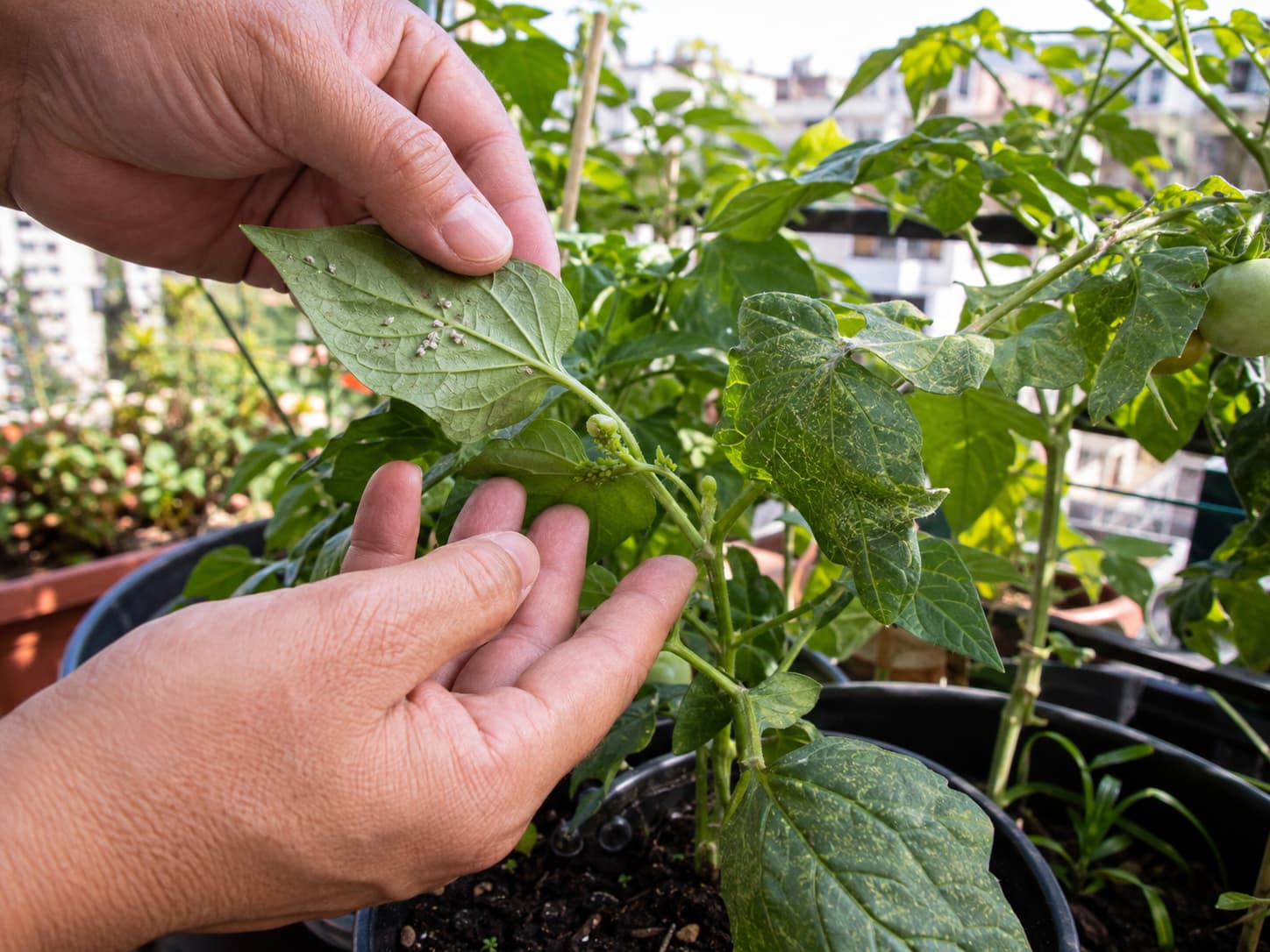
Even above ground level, aphids, whiteflies, and spider mites can still reach balcony vegetables. Therefore, the best first step is identification rather than spraying everything on a fixed schedule.
| Pest | Typical clues | First response |
|---|---|---|
| Aphids | Clusters on tender growth, curling leaves, sticky honeydew | Rinse sturdy plants, remove badly infested tips, then use a labeled treatment if needed |
| Whiteflies | Small white adults rise when foliage is disturbed; nymphs feed under leaves | Inspect undersides, use sticky cards for monitoring, and treat only when needed |
| Spider mites | Fine stippling, bronzing, and sometimes webbing in hot, dry conditions | Isolate badly affected pots, rinse foliage where appropriate, and use a product labeled for mites if pressure continues |
If you use neem, insecticidal soap, horticultural oil, or another pesticide, follow the product label for the crop, pest, concentration, interval, and harvest restrictions. Avoid homemade fixed-dose recipes.
Harvest Often and Replant the Empty Space
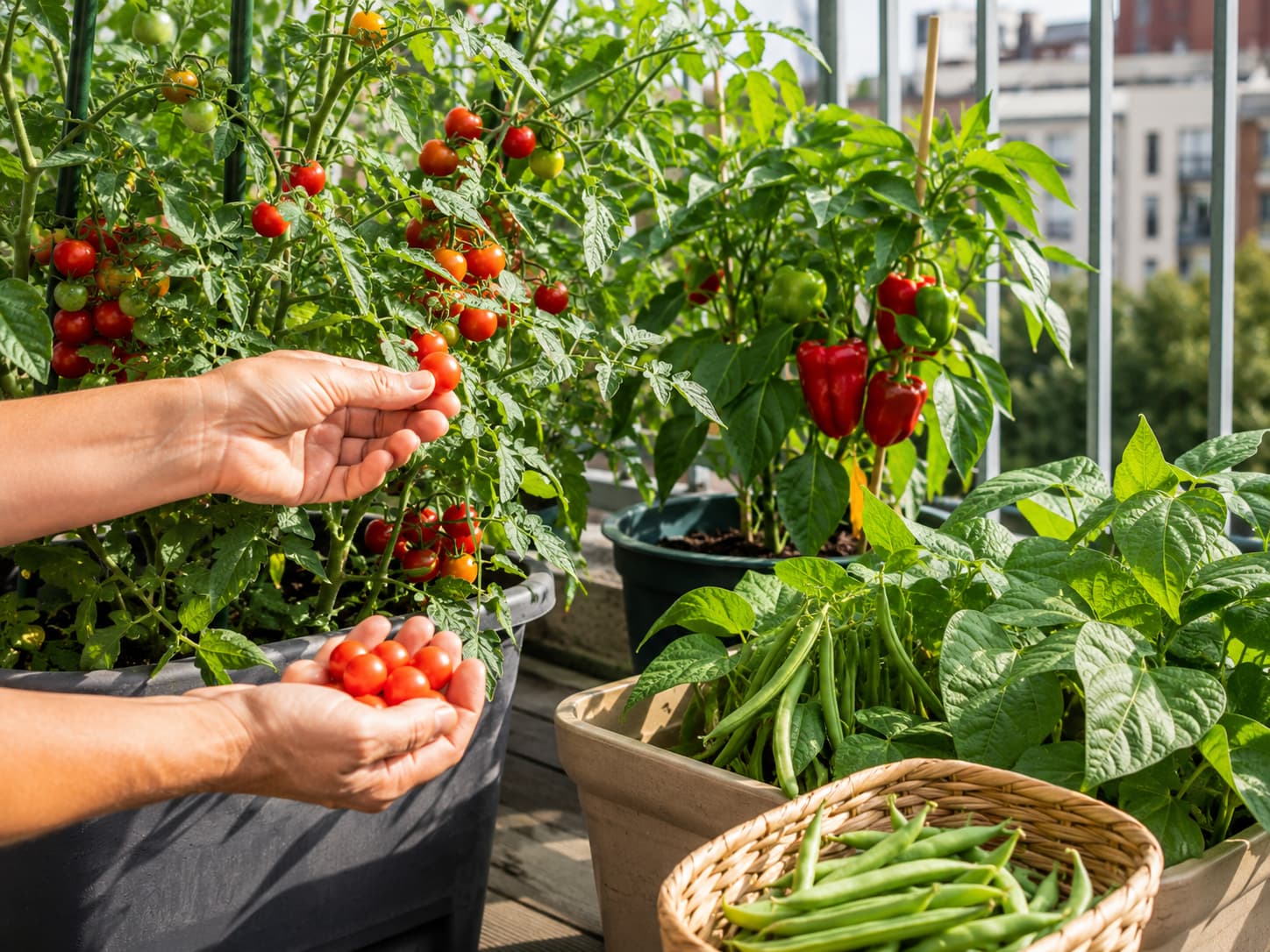
Use succession planting when a crop finishes
For example, a bush bean planting may finish well before frost. Then, if your remaining warm season is long enough, sow another quick crop. Otherwise, switch the container to a cool-season vegetable instead of leaving it empty.
When summer winds down, our Cool-Season Balcony Greens Guide can help you move from tomatoes and beans into spinach, kale, arugula, chard, or mâche.
Before Seedlings Go Outside
If you are starting from indoor seedlings, harden them off gradually rather than moving them from indoor light straight into wind and full sun. In addition, warm-season crops respond differently to cool nights, so tomatoes, peppers, and basil should not all be treated as if they have the same temperature tolerance.
For a step-by-step transition, use our guide to moving tomatoes, peppers, and basil outside.
Frequently Asked Questions
Light, Containers & Crop Choice
01Can I grow tomatoes on an east-facing balcony?
Possibly, but measure the actual direct light. Fruiting tomatoes generally perform best with strong sun. If an east-facing balcony receives only a short morning window, leafy greens and herbs may be more reliable. Buildings, overhangs, and seasonal sun angle matter more than compass direction alone.
02How big should a container be for peppers or eggplants?
Use a container large enough for one mature plant and choose the larger option when summers are hot or windy. As a result, a larger root volume buffers moisture better. Always use drainage holes and check the cultivar's mature size.
03What is the easiest balcony vegetable for a beginner?
Bush beans are a good starting choice. They can be direct-sown, do not require a tall trellis, and usually mature relatively quickly. Compact tomatoes and peppers are also beginner-friendly if your balcony has enough sun.
Water, Wind & Reuse
04Can I reuse potting mix next year?
Often, yes. Remove old roots, assess drainage and structure, and refresh depleted mix as needed. Do not automatically reuse mix from plants with serious soil-borne disease or pest problems; follow crop-specific sanitation guidance.
05What can I grow on a very windy balcony?
Start with compact crops and sturdy containers. Avoid top-heavy setups, secure supports, and use wind protection that does not completely block airflow. Because wind speeds up drying, check moisture more frequently than you would in a sheltered location.
06When should I move warm-season seedlings outside?
Wait until frost risk has passed and conditions suit the crop. Tomatoes usually tolerate the transition earlier than peppers and basil, but all indoor-grown seedlings should be hardened off gradually before permanent outdoor placement.
Sources & Further Reading
Final Thoughts
Ultimately, a balcony vegetable garden works best when you simplify the system. Start with a few compact crops, use containers that give roots enough space, and place the sun-loving plants where the light is strongest.
Then, let the plants tell you what to adjust. Check moisture instead of watering by the calendar, feed according to the fertilizer label, protect containers from dangerous wind, and switch finished summer crops into cool-season greens when the weather changes.
What are you growing on your balcony? Share your climate, sun exposure, container size, and the first crop you want to harvest.