Morning Glory Guide: How to Grow Ipomoea Without the Common Mistakes
Morning glories can cover a trellis in one summer, but the best results come from warm soil, lean feeding, early support, and careful seed-pod control.
Morning Glory: Key Facts
- Botanical group
- Ipomoea species, especially I. purpurea, I. tricolor, and I. nil
- Plant type
- Fast-growing annual twining vine in most temperate gardens
- Best light
- At least 6 hours of direct sun
- Bloom season
- Midsummer until the first hard frost
- Main care mistake
- Too much nitrogen, which produces leaves instead of flowers
- Main safety concern
- Seeds should not be eaten and should be kept away from children and pets
- Spread risk
- Some types self-seed freely; regional behavior varies
The Short Answer
Morning glories are fast annual vines that flower best in full sun, warm soil, and moderate fertility. Nick and soak the hard seeds before sowing, give the young vines support immediately, and avoid high-nitrogen fertilizer if you want flowers instead of leaves. Keep seed packets and mature pods away from children and pets, and deadhead before pods ripen if you do not want volunteers returning around the garden.
In This Guide
Morning Glory Basics: What You’re Actually Growing
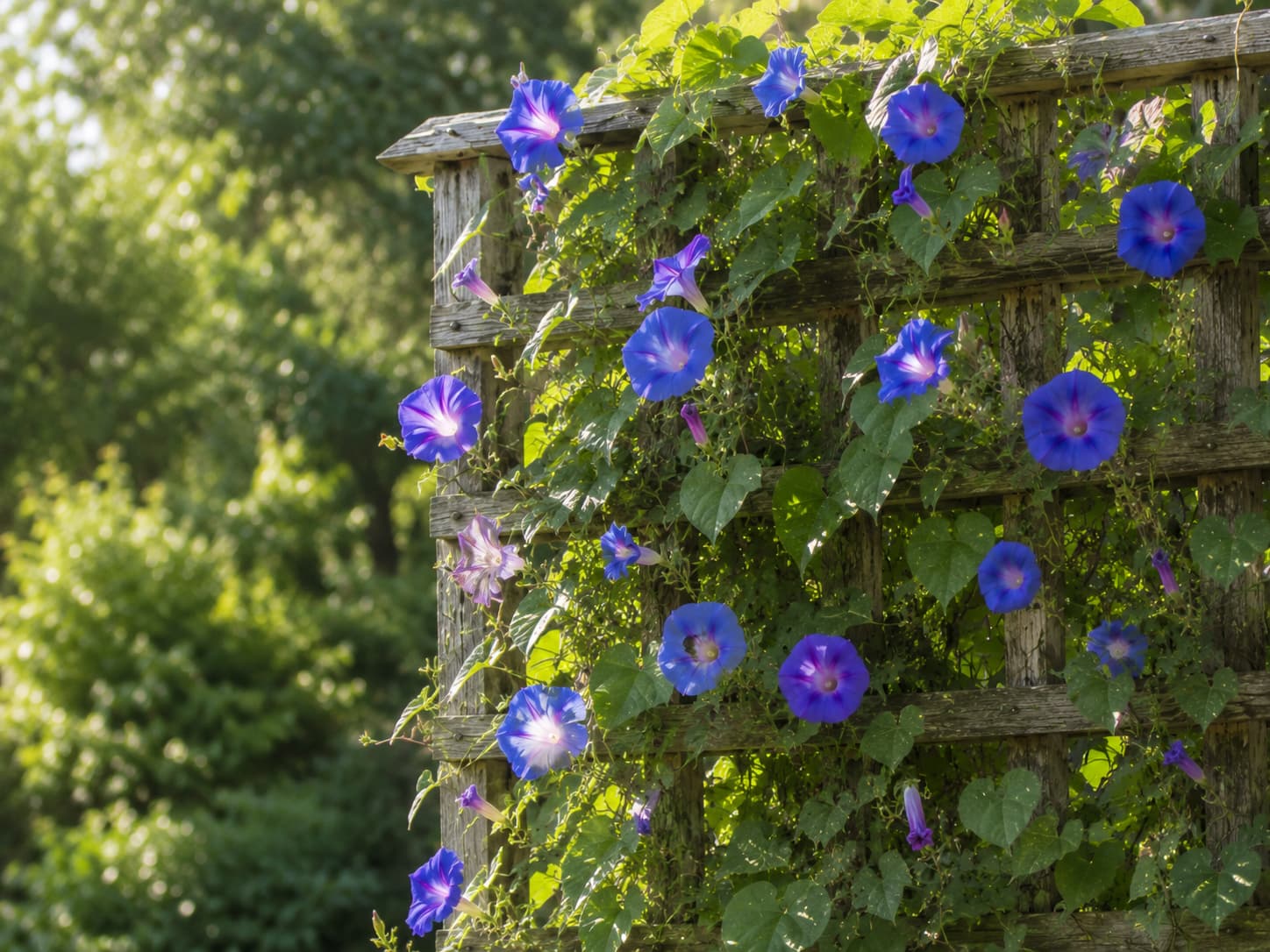
What is a morning glory? A morning glory is a fast-growing twining vine in the genus Ipomoea. Garden forms are usually grown as annuals and are recognized by heart-shaped leaves and funnel-shaped flowers that open in the morning.
Morning glories are fast-growing annual climbing vines in the genus Ipomoea (family Convolvulaceae), the same genus as sweet potatoes and moonflowers. The most commonly grown garden species are Ipomoea purpurea (common morning glory, purple/blue/pink), Ipomoea tricolor (the classic "Heavenly Blue"), and Ipomoea nil (Japanese morning glory, with larger and more varied flowers).
All share the same basic habit: twining vines that grow 6–15 feet in a single season, heart-shaped leaves, and funnel-shaped flowers that open at dawn and close by afternoon — each individual flower lasting exactly one day. New flowers open every morning through the growing season, creating the illusion of continuous bloom.
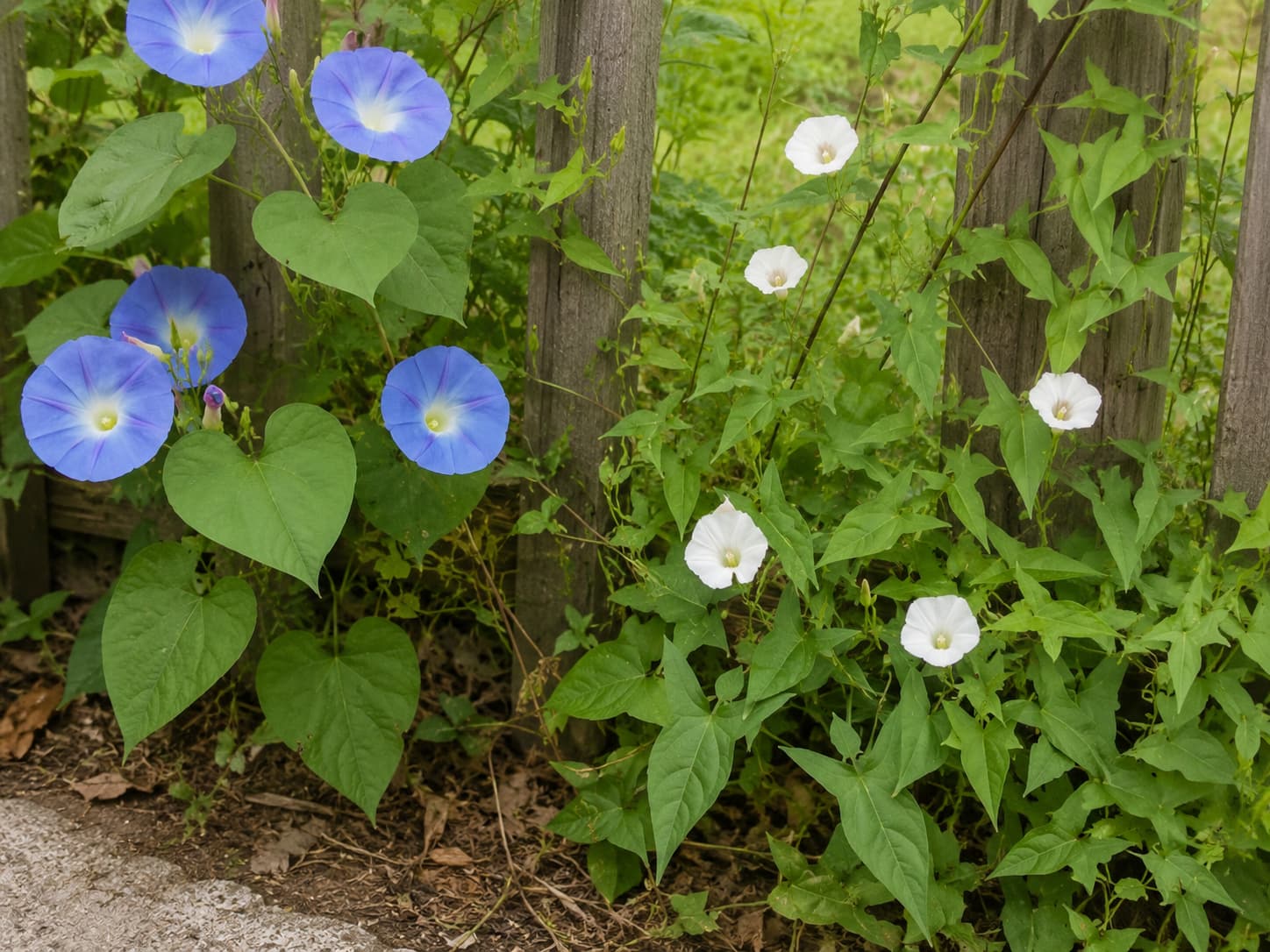
Here's a critical distinction most guides skip: morning glories are not the same as bindweed. Bindweed (Convolvulus arvensis and Calystegia sepium) is a perennial, deep-rooted, extremely invasive weed with smaller white or pink flowers and arrow-shaped leaves. It's difficult to eradicate once established because its roots can spread deeply and regenerate from fragments. Morning glories are annuals with shallow roots — they self-seed aggressively but are easy to pull. Don't confuse the two.
Morning Glory vs. Bindweed
Morning glory: Annual. Large showy flowers (2–5 inches). Heart-shaped leaves. Shallow roots. Easy to pull. Bindweed: Perennial. Small white/pink flowers (1–2 inches). Arrow-shaped leaves. Deep, spreading roots. Difficult to eradicate once established. If you see small white trumpet flowers in a perennial weed that keeps coming back no matter what you do, that's bindweed, not morning glory.
Morning Glory Care at a Glance
| Feature | Details |
|---|---|
| Common Name | Morning Glory |
| Scientific Name | Ipomoea purpurea, I. tricolor, I. nil |
| Plant Type | Annual twining vine |
| USDA Zones | Grown as annual in all zones; may self-seed and return |
| Mature Size | 6–15 ft tall, 2–3 ft wide |
| Bloom Time | Midsummer through first frost; each flower lasts 1 day |
| Flower Colors | Blue, purple, pink, red, white, bicolors, striped patterns |
| Sun Needs | Full sun — 6+ hours direct for best bloom |
| Soil | Well-drained, moderate fertility; tolerates poor soil |
| Seed Toxicity | Seeds contain LSA alkaloids — toxic if ingested in quantity |
| Self-Seeding | Aggressive — deadhead or expect volunteers for years |
Morning Glory Seed Safety
Morning glory seeds contain lysergic acid amide (LSA) — also called ergine — an ergoline alkaloid structurally related to LSD. The seeds of Ipomoea tricolor ('Heavenly Blue') and I. purpurea have the highest concentrations. Ingesting the seeds can cause serious symptoms, and commercially packaged seed may also be treated with agricultural coatings. Keep all seed packets and mature pods away from children and pets.
Safety note: Toxicity and treatment coatings can vary by species and seed source. Do not ingest ornamental seeds. For suspected ingestion, contact a medical professional, veterinarian, or local poison service.
Morning Glory Seeds Are Toxic
Do not ingest morning glory seeds. They contain LSA (lysergic acid amide), which causes nausea, vomiting, disorientation, hallucinations, and in high doses, serious medical complications. Commercial seeds are often treated with fungicides and other chemicals that add additional toxicity. Keep seeds away from children and pets. Store seed packets in a locked or childproof location. If you grow morning glories, deadhead spent flowers before seed pods form to reduce access to mature seed pods.
Safety Precautions
- Keep seed packets out of reach of children and teenagers. The seeds look harmless but are not.
- Deadhead spent flowers before seed pods form if you have concerns about seed access.
- Wash hands after handling seeds. Avoid touching your eyes or mouth while handling seeds, and wash your hands afterward.
- Pets: The seeds are also toxic to dogs and cats. Ingestion causes vomiting, disorientation, and tremors. Keep pets away from seed pods.
- The flowers and leaves are not significantly toxic — the seeds are the dangerous part. Small amounts of flower petals used as garnish are generally safe.
How to Grow Morning Glories from Seed
How do you grow morning glories from seed? Lightly nick the hard seed coat, soak the seeds for 12–24 hours, then sow them about ½ inch deep after the soil has warmed. Add support at planting time so the young vines can climb immediately.
Morning glory seeds have a hard, nearly waterproof seed coat. If you push them straight into soil without preparation, you might get 20–30% germination after 3–4 weeks. Here's how to get 80%+ germination in 7–10 days.
Step 1: Scarify (Nick the Seeds)
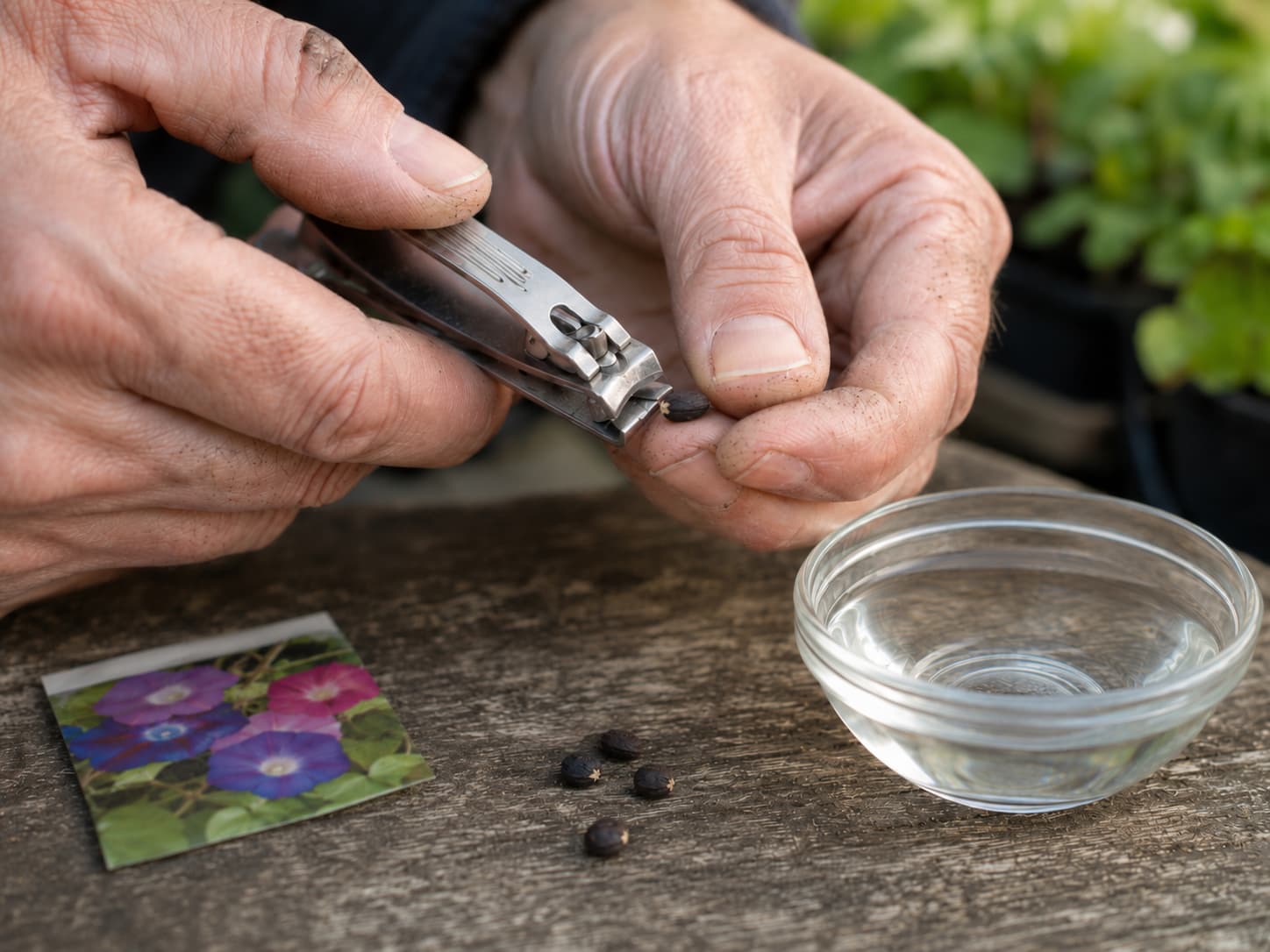
Use a nail clipper, small file, or sharp knife to nick a tiny notch in the seed coat — just deep enough to expose the lighter inner layer. Don't damage the embryo inside. Alternatively, rub seeds between two pieces of fine sandpaper. This is the same technique used for moonflowers, which are in the same genus.
Step 2: Soak Overnight
After nicking, soak the seeds in warm water for 12–24 hours. You'll see them swell — some may double in size. Seeds that don't swell after 24 hours can be nicked again and re-soaked.
Step 3: Sow at the Right Time
Morning glories are heat lovers and need warm soil to germinate. Two options:
- Direct sow outdoors: After all danger of frost, when soil temperature is at least 65°F (18°C). Sow ½ inch deep, 6–12 inches apart near a support.
- Start indoors: 4–6 weeks before last frost. Use individual biodegradable pots — morning glories dislike root disturbance. Keep at 70–75°F. Harden off before transplanting.
Step 4: Provide Support Immediately
Morning glories are twining vines that need something to climb from day one. Install a trellis, netting, or strings at planting time. They twine counterclockwise and can grow several inches per week in peak summer.
Staggered Planting for Continuous Bloom
Sow a new batch of seeds every 2–3 weeks from late spring through early summer. This extends the bloom period — as the first batch begins to slow down in late summer, the later plantings are hitting their peak.
How to Care for Morning Glories
What conditions do morning glories need? Give them full sun, well-drained soil, moderate water, and little or no high-nitrogen fertilizer. Leaner soil usually produces more flowers than heavily enriched soil.
Light
Full sun — 6+ hours direct. Morning glories bloom in proportion to sun exposure. In partial shade, they produce fewer flowers and more foliage. The flowers open in response to morning light and close as the sun intensifies — hence the name.
Soil
Well-drained soil of moderate to low fertility. This is critical — rich, heavily fertilized soil produces a jungle of leaves with almost no flowers. Morning glories bloom best in slightly lean conditions. If your soil is very rich, don't fertilize at all.
Watering
Water regularly during germination and early growth — keep soil consistently moist but not soggy. Once established, morning glories are moderately drought-tolerant. Water deeply once a week during dry spells. Overwatering reduces blooming.
Fertilizing — The Critical Detail
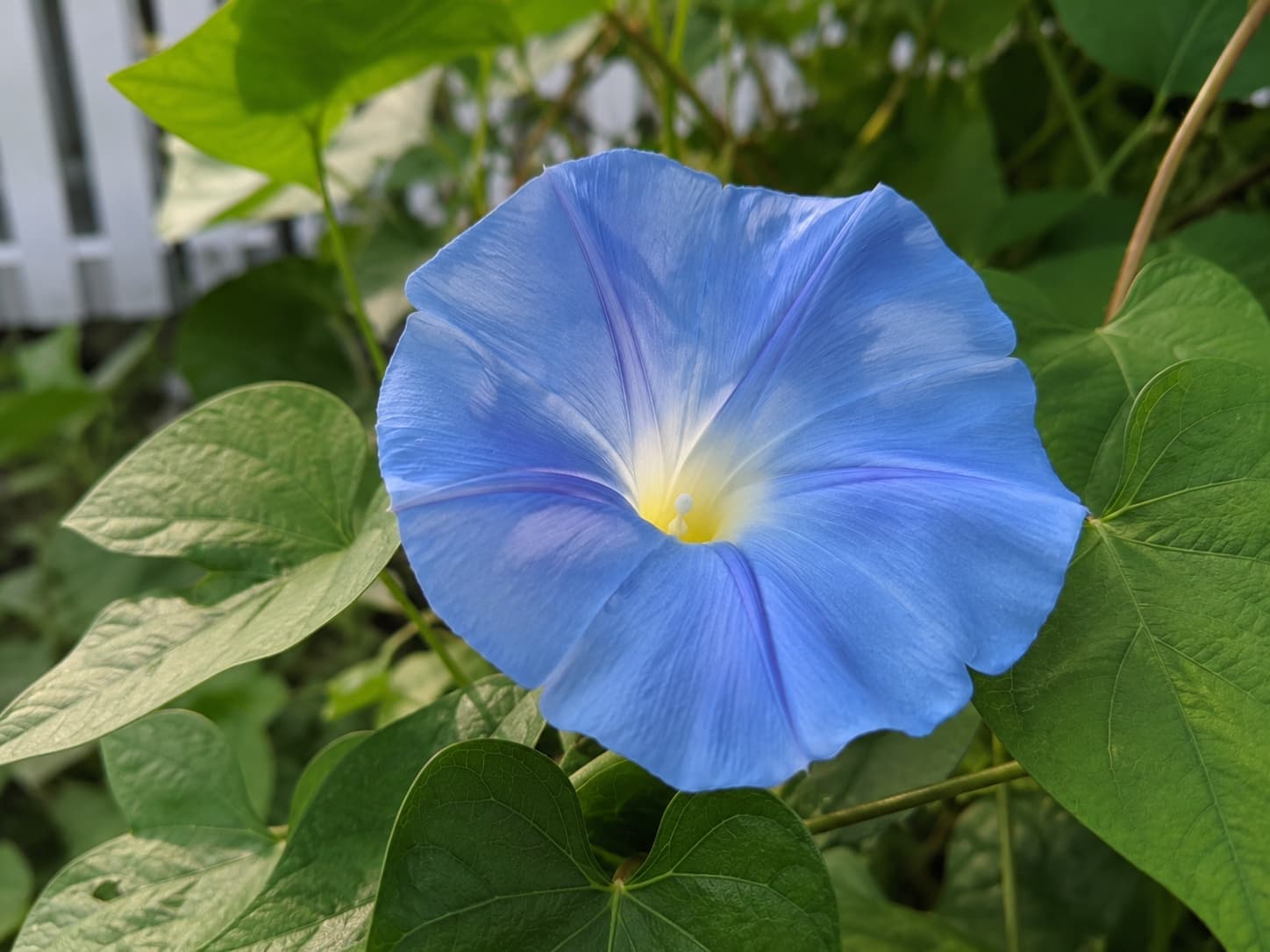
Do not use high-nitrogen fertilizer. Morning glories are in the same family as moonflowers, and they respond the same way: excess nitrogen produces lush, rampant foliage and almost no flowers. If you must fertilize, use a low-nitrogen, high-phosphorus bloom formula (like 5-10-10). Better yet, don't fertilize at all — most garden soil contains enough nutrients. If your morning glories are near a fertilized lawn, they're already getting nitrogen runoff.
Why Are My Morning Glories All Leaves and No Flowers?
Why is a morning glory not blooming? The most common causes are excess nitrogen, insufficient direct sun, late planting, or persistently wet soil. Lush dark foliage without buds points first to excess nitrogen.
This is the #1 complaint about morning glories, and it's almost always self-inflicted. Here are the causes, in order:
Quick diagnosis
1. Too Much Nitrogen (Most Common)
Lush, dark green, vigorous vines with zero flowers = nitrogen overdose. This usually comes from lawn fertilizer runoff, rich compost, or using a general-purpose plant food. Stop fertilizing entirely. The plant will redirect energy to flowering within 2–3 weeks.
2. Not Enough Sun
Morning glories need 6+ hours of direct sun to bloom well. In partial shade, they produce leaves but few flowers. If a tree has grown and cast more shade, that's your cause.
3. Started Too Late
Morning glories need 8–10 weeks from seed to first flower. If you planted in mid-summer in a short-season climate, the plants may not have time to mature before frost. Start seeds indoors 4–6 weeks before last frost for the earliest blooms.
4. Too Much Water
Constantly wet soil stresses the roots and reduces flowering. Let the soil dry slightly between waterings.
How to Prevent Morning Glories From Taking Over
How do you stop morning glories from spreading? Remove faded flowers before seed pods mature, collect pods before they split, and pull volunteer seedlings while they are small. Check local invasive-species guidance because behavior varies by species and region.
Morning glories are prolific self-seeders. A single plant can produce hundreds of seeds, and those seeds remain viable in the soil for 5–10 years. In warm climates (Zones 8+), morning glories can become a nuisance — volunteers appearing in garden beds, lawns, and neighboring properties year after year.
Regional note: “Morning glory” covers multiple species. A plant that behaves as a manageable annual in one climate may naturalize aggressively in another. Check your state, province, or national invasive-plant list before planting.
How to Control Spread
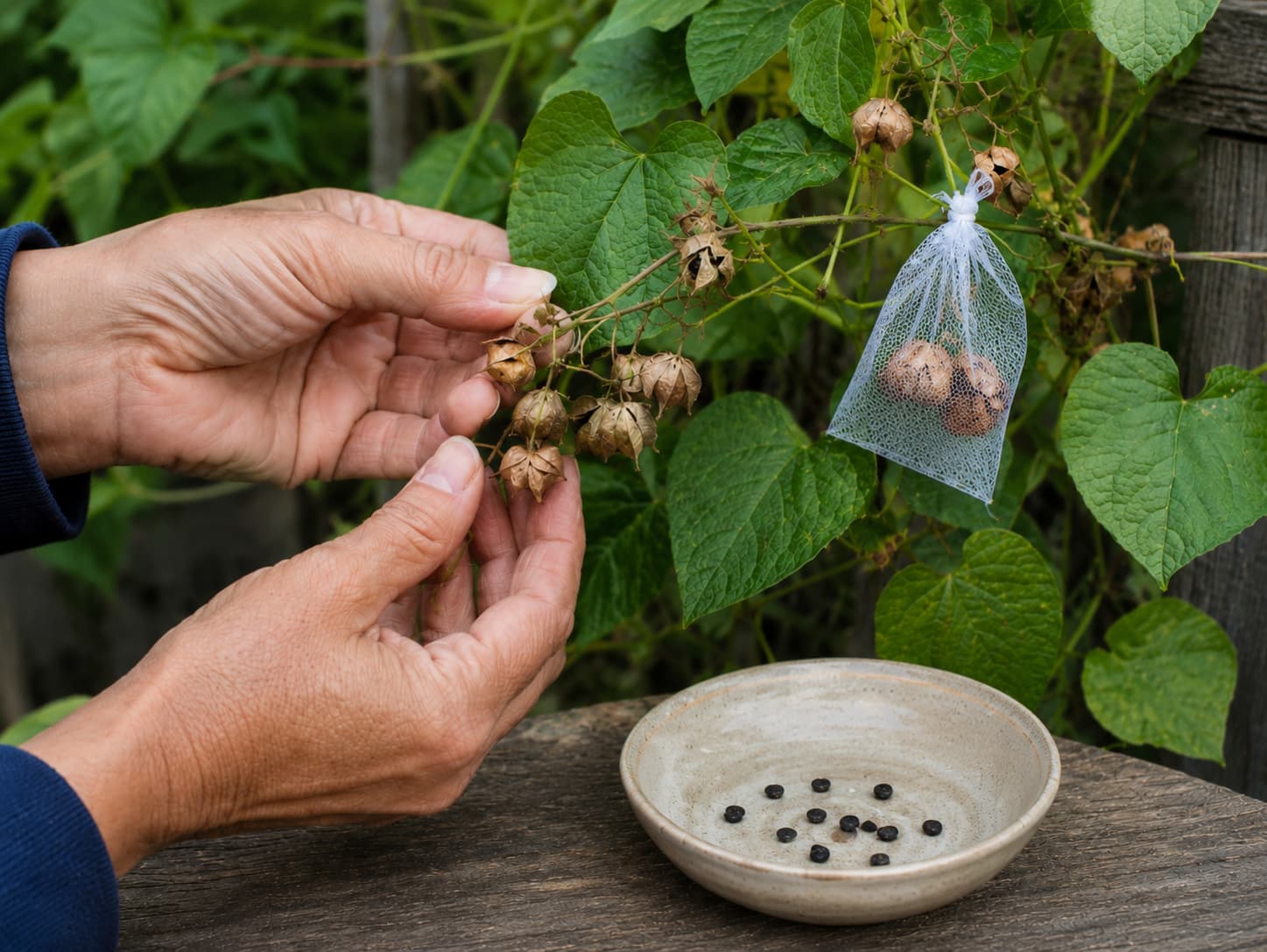
- Deadhead spent flowers before seed pods form. Each flower that's pollinated produces a small round pod containing 4–6 black seeds. Remove flowers as they fade. This is the single most effective control — but you must be consistent.
- Collect seed pods before they split open. If you want to save seeds for next year, bag the ripening pods with small mesh bags or collect them as soon as they turn brown and papery.
- Pull volunteer seedlings in spring. They're easy to identify (heart-shaped leaves) and pull easily when the soil is moist.
- Do not compost spent vines with seed pods. The seeds survive composting and will germinate wherever you spread the compost.
- In regions where morning glories are invasive (parts of the southeastern U.S.), consider native alternatives like Trumpet Honeysuckle (Lonicera sempervirens) or Passionflower (Passiflora incarnata).
Morning Glory Varieties Worth Growing
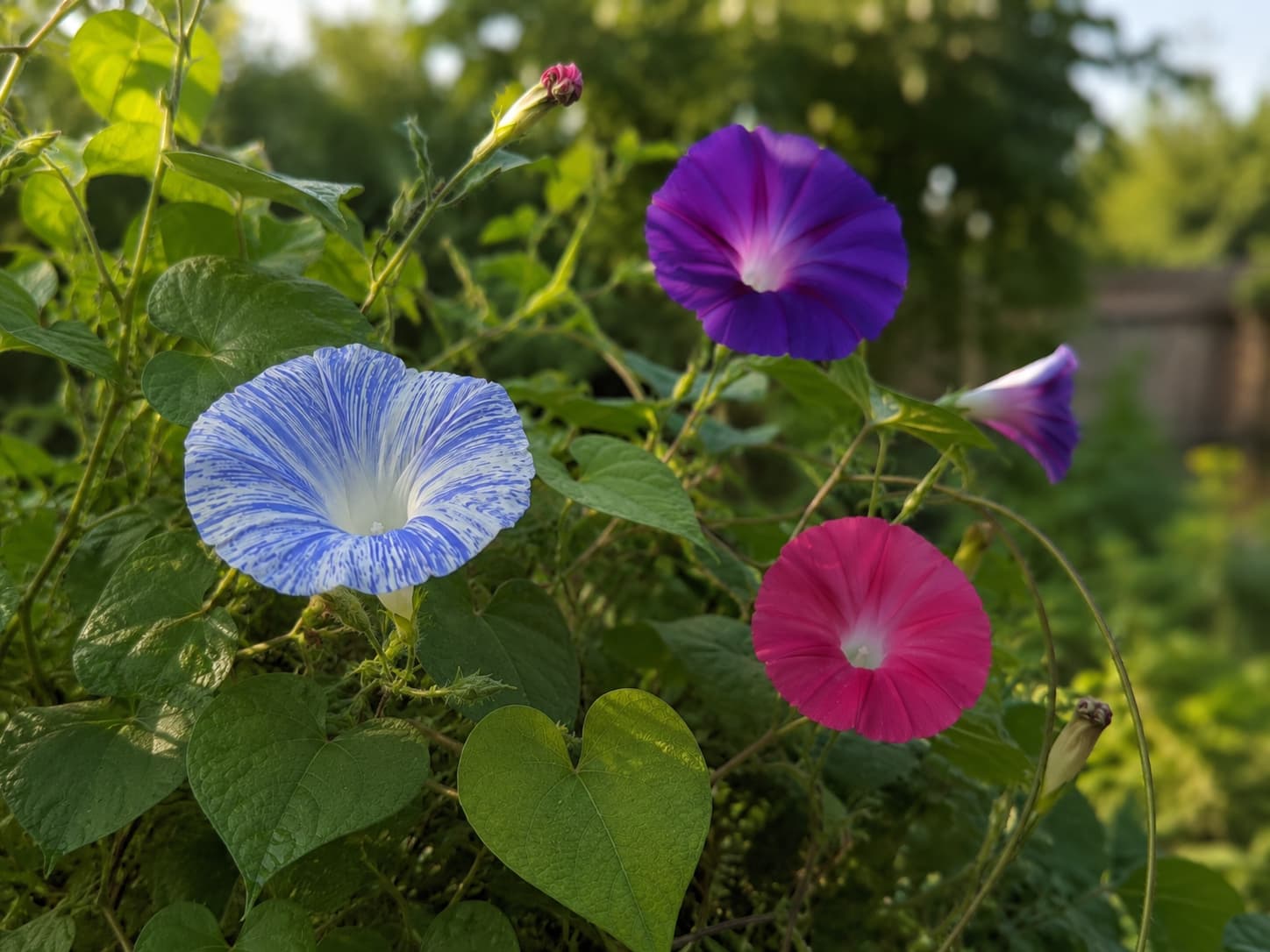
Which morning glory variety should you choose? Choose ‘Heavenly Blue’ for classic sky-blue flowers, ‘Grandpa Ott’ for deep purple blooms, or Japanese Ipomoea nil selections for larger patterned flowers.
| Variety | Flower Color | Size | Notes |
|---|---|---|---|
| Ipomoea tricolor 'Heavenly Blue' | Sky blue with white and yellow throat | 8–12 ft | The classic. Large 4–5" flowers. The most widely recognized morning glory. |
| Ipomoea purpurea 'Grandpa Ott' | Deep purple with magenta star | 8–10 ft | Heirloom Bavarian variety. Rich, intense color. Reliable and vigorous. |
| Ipomoea nil 'Scarlett O'Hara' | Bright crimson-red | 8–12 ft | Striking red blooms. Japanese-type morning glory. Early bloomer. |
| Ipomoea nil 'Mt. Fuji' Series | White, blue, pink, with striped and picotee patterns | 8–10 ft | Japanese morning glories with enormous 5–6" flowers and elaborate patterns. Show-stoppers. |
| Ipomoea purpurea 'Carnevale di Venezia' | Pink and white striped | 6–8 ft | Unique candy-stripe pattern. Each flower is different. Slightly smaller vines. |
| Ipomoea lobata (Spanish Flag) | Red-orange-yellow gradient spikes | 10–15 ft | Not a typical morning glory — tubular flowers in one-sided spikes that fade from red to cream. A different look entirely. |
Frequently Asked Questions
Are morning glory seeds poisonous?
Yes. The seeds contain lysergic acid amide (LSA), an ergoline alkaloid that causes nausea, vomiting, disorientation, and hallucinations. They are toxic to humans, dogs, and cats. Commercial seeds are often treated with fungicides that add additional toxicity. Keep seed packets out of reach. Deadhead spent flowers to prevent seed pod formation. See the seed toxicity section above for full safety information.
Why are my morning glories all leaves and no flowers?
The #1 cause is too much nitrogen — often from lawn fertilizer runoff or rich soil. Lush green growth with no flowers is the classic sign. Stop fertilizing and the plant should begin blooming within 2–3 weeks. Other causes: not enough sun (needs 6+ hours direct), started too late (needs 8–10 weeks from seed to flower), or too much water.
Do I need to soak morning glory seeds before planting?
Yes — and you need to nick them first. Morning glory seeds have an extremely hard, waterproof seed coat. Nick the seed with a nail clipper or file, then soak in warm water for 12–24 hours. This increases germination from 20–30% to 80%+ and cuts germination time from 3–4 weeks to 7–10 days. See the seed-starting section above for the full step-by-step.
How do I stop morning glories from taking over my garden?
Deadhead spent flowers before seed pods form. Each flower produces a pod with 4–6 seeds that remain viable in soil for 5–10 years. Be consistent — check vines every 2–3 days during peak bloom. Pull volunteer seedlings in spring while they're small. Do not compost spent vines with seed pods. In regions where morning glories are invasive, consider native alternatives like trumpet honeysuckle.
Are morning glories the same as bindweed?
No. Morning glories (Ipomoea spp.) are annuals with large showy flowers and shallow roots. Bindweed (Convolvulus arvensis and Calystegia sepium) is a perennial weed with small white/pink flowers, arrow-shaped leaves, and deep, persistent roots that regenerate from fragments. Bindweed is difficult to eradicate. Morning glories are easy to pull. If you have a perennial vine with small white trumpet flowers that keeps coming back, that's bindweed.
Can morning glories grow in containers?
Yes — use a large pot (at least 12–14 inches wide) with a trellis or obelisk for support. Container-grown morning glories need more frequent watering than in-ground plants but still prefer to dry out slightly between waterings. Use a well-drained potting mix with minimal fertilizer. Morning glories in rich potting soil will produce leaves at the expense of flowers — add extra perlite and skip the fertilizer.
How long do morning glory flowers last?
One day. Each individual flower opens at dawn, peaks by mid-morning, and closes by afternoon. The closed flower drops within a day or two. However, a healthy plant produces new flowers continuously from midsummer through frost — dozens of new blooms every morning. The plant itself blooms for 3–4 months even though each flower lasts only hours.
Can I grow morning glories and moonflowers together?
Yes — this is a classic combination. Morning glories bloom during the day in blues, purples, and pinks. Moonflowers (Ipomoea alba — same genus) bloom at dusk in white. Plant them on the same trellis for 24-hour coverage. Both need the same conditions: full sun, well-drained soil, scarified seeds. This is one of the most rewarding pairings in annual vine gardening.
A Simple Way to Succeed With Morning Glories
Morning glories are the vine equivalent of a sunrise — brief, beautiful, and worth getting up for. They're not complicated plants: give them sun, don't overfeed them, nick and soak the seeds, and provide something to climb. The flowers take care of the rest, opening fresh every morning from midsummer until frost.
The warnings are real — the seeds are toxic, the self-seeding is relentless — but both are manageable. Deadhead to prevent volunteers. Keep seeds away from children and pets. And never, ever use high-nitrogen fertilizer near them. Get those fundamentals right and morning glories will be the easiest, most rewarding vines in your garden.
Here's what to remember:
- Nick and soak seeds. Scarification is strongly recommended because it makes germination faster and more reliable.
- Do not fertilize with nitrogen. Rich soil = all leaves, no flowers.
- Seeds are toxic — LSA alkaloids. Keep away from children and pets. Deadhead to prevent pods.
- Deadhead or expect volunteers for years. Seeds can remain viable in soil for several years.
- Full sun, well-drained soil, moderate water. That's the care formula.
- Not bindweed. Morning glories are annuals with shallow roots — easy to pull.
If you found this guide helpful, you might also enjoy our guide on How to Grow Moonflowers — the night-blooming cousin that pairs perfectly with morning glories on the same trellis.
What Has Worked in Your Garden?
Morning glories behave differently in every climate. Share your variety, growing zone, and biggest challenge in the comments so other Greenmuse gardeners can learn from your experience.