Forsythia Plant Guide: How to Grow, Prune & Rejuvenate Forsythia
A practical guide to planting forsythia, pruning after flowering, restoring its natural arching shape, and bringing an overgrown shrub back into bloom.
Quick Summary
Forsythia (Forsythia × intermedia and related species) is the shrub that tells you spring has arrived — a fountain of brilliant yellow flowers that erupts before the leaves emerge, often while snow is still on the ground. It's also the most visibly mis-pruned plant in American landscaping. Drive through any suburban neighborhood and you'll see them: forsythias sheared into tight green meatballs, boxes, and gumdrops — with barely a flower in sight. The #1 reason forsythias don't bloom is pruning at the wrong time, in the wrong way. This guide covers the right pruning method, how to rescue an overgrown or butchered shrub, and the simple care that turns a green blob back into a spring spectacle.
In This Guide
- What Are Forsythias? (And Why They're the "Canary in the Coal Mine" of Bad Pruning)
- Plant Profile at a Glance
- How to Plant Forsythias
- Complete Care Guide: Sun, Water, Soil, Fertilizer
- Pruning Forsythias: The Right Way vs. The "Green Blob" Way
- How to Rescue an Overgrown or Butchered Forsythia
- Common Forsythia Problems
- Best Forsythia Varieties for Home Gardens
- Frequently Asked Questions
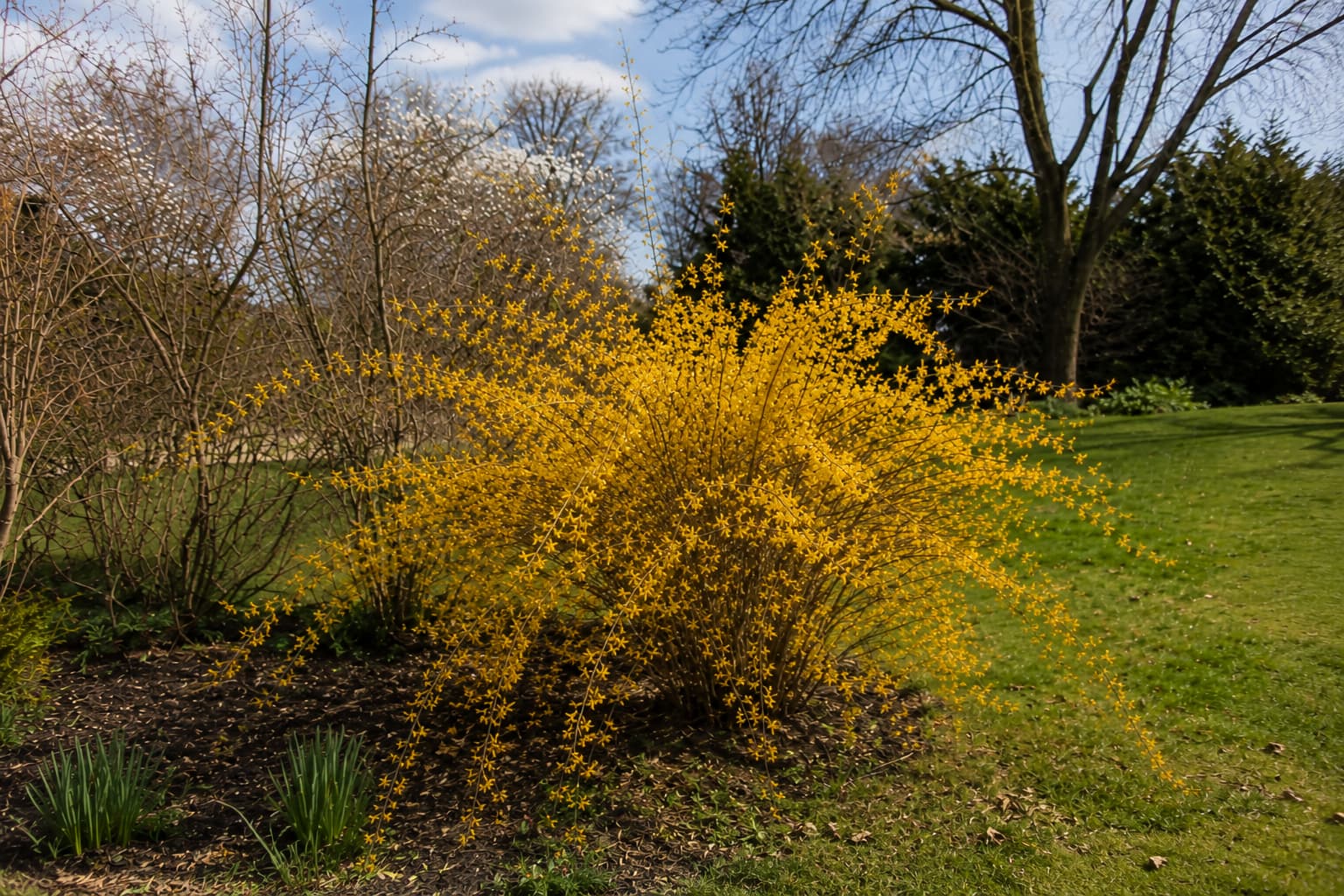
What Are Forsythias? (And Why They're the "Canary in the Coal Mine" of Bad Pruning)
Forsythias are deciduous shrubs in the olive family (Oleaceae) — the same family as lilacs, ash trees, and privet. Native to East Asia (primarily China and Korea), they were introduced to Western gardens in the 1800s and spread rapidly across North America and Europe. The most commonly planted garden varieties are hybrids of Forsythia suspensa (weeping forsythia) and Forsythia viridissima (greenstem forsythia), collectively sold as Forsythia × intermedia or "border forsythia."
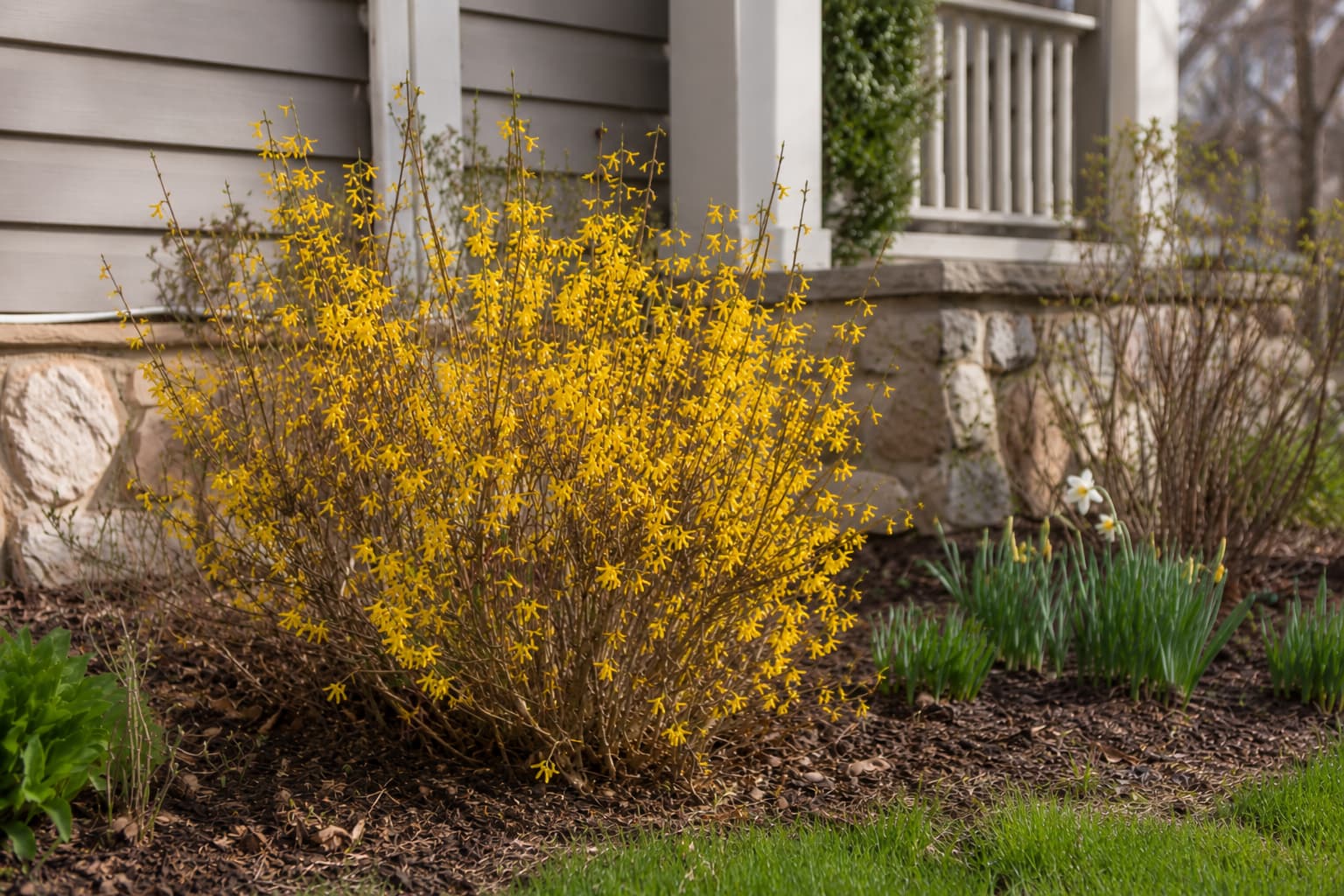
Their signature trait: flowers appear before leaves, typically in March or April, creating a solid mass of bright yellow on bare branches. It's one of the most dramatic early-spring displays in the plant world — and it's almost completely dependent on correct pruning.
Here's the problem. Forsythia's natural form is a fountain-shaped shrub with arching canes that can reach 8–10 feet tall and wide. It blooms most heavily on young, vigorous canes — one- and two-year-old wood. When people shear it into a tight ball, box, or hedge shape, they're removing the young growth that produces flowers and leaving only old, unproductive wood. The result: a dense green shell with a few lonely flowers poking through the surface.
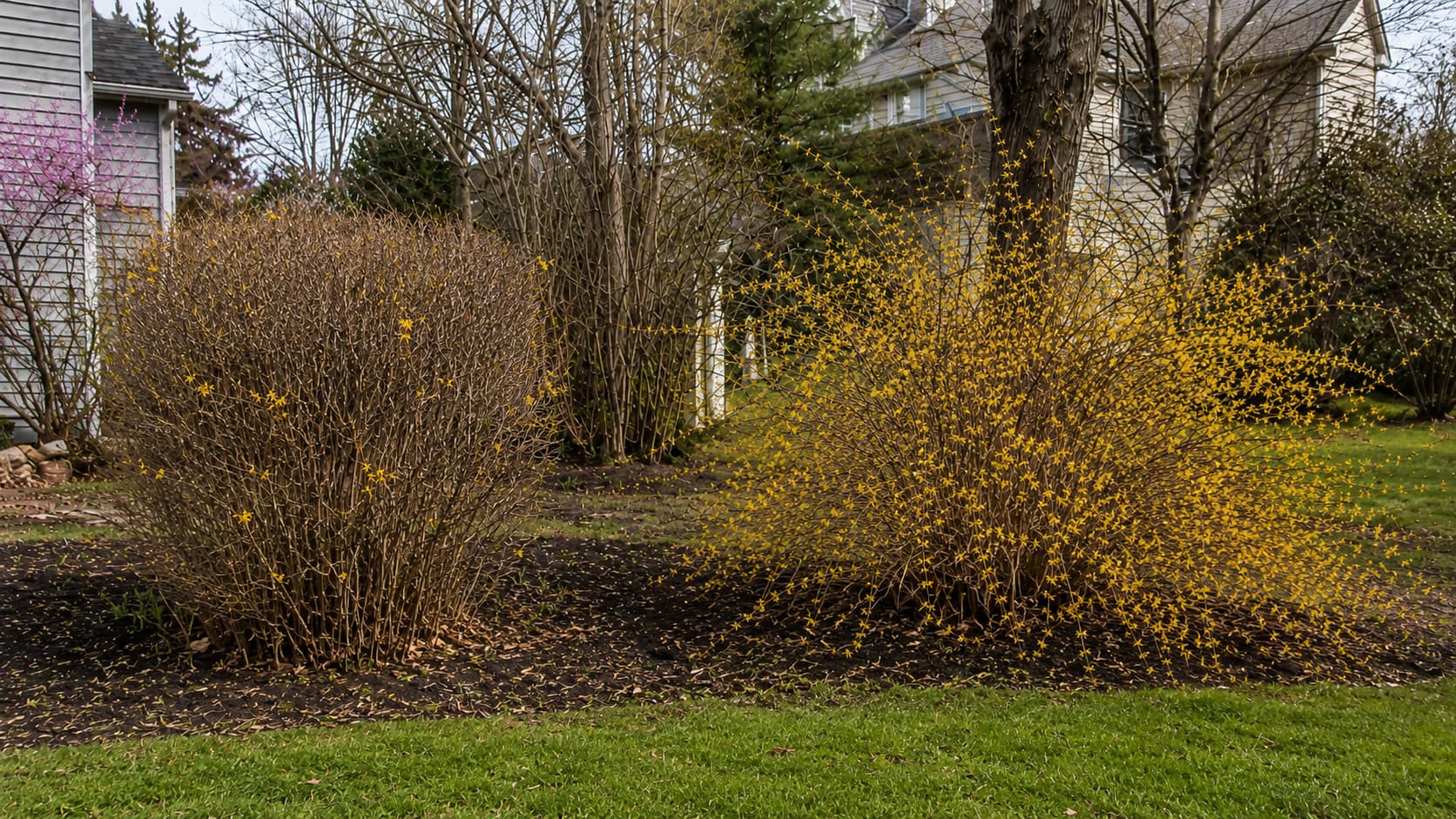
This is so common that landscape professionals have a name for it: "the forsythia meatball." It's the single most visible pruning mistake in American gardening. The fix is simple — stop shearing, start thinning — but it requires unlearning a habit.
Plant Profile at a Glance
| Feature | Details |
|---|---|
| Common Name | Forsythia, Border Forsythia, Golden Bells |
| Scientific Name | Forsythia × intermedia (most common garden type) |
| Plant Type | Deciduous shrub with arching canes |
| USDA Zones | 4–8 (some varieties to Zone 3) |
| Mature Size | 6–10 ft tall and wide (dwarf varieties 2–4 ft) |
| Bloom Time | Early spring (March–April), before leaves emerge |
| Flower Color | Bright to deep yellow |
| Fragrance | Light, honey-like; not a strong fragrance plant |
| Sun Needs | Full sun for best bloom; tolerates partial shade |
| Soil | Adaptable — tolerates clay, loam, sand; needs good drainage |
| Growth Rate | Fast — 1–2 ft per year |
| Toxicity | Non-toxic — safe for children and pets |
How to Plant Forsythias
When to Plant
Early spring or early fall. Container-grown forsythias can be planted any time the ground isn't frozen, but spring planting gives the longest establishment period before winter.
Where to Plant
- Full sun for maximum bloom. Forsythias flower most heavily in full sun (6+ hours direct). They tolerate partial shade but produce fewer flowers.
- Give them room. A standard forsythia reaches 8–10 feet wide. Planting one 3 feet from a foundation is a commitment to constant pruning — and constant pruning means fewer flowers. Choose a dwarf variety for small spaces, or give a standard variety the space it needs.
- Well-drained soil. Forsythias are remarkably adaptable to soil type — clay, loam, sand — but they won't tolerate standing water. If drainage is poor, plant on a slight mound.
- Excellent for slopes and banks. Their vigorous root systems make forsythias one of the best shrubs for erosion control on sunny slopes.
Planting Steps
- Dig a hole twice as wide as the root ball and exactly as deep.
- Position so the top of the root ball is level with the surrounding soil.
- Backfill with native soil. Forsythias aren't fussy — no heavy amending needed.
- Water deeply. Apply 2 inches of mulch, keeping it away from the stems.
- If planting a hedge, space plants 4–6 feet apart for a dense screen, or 6–8 feet for individual shrubs with room to arch naturally.
Complete Care Guide: Sun, Water, Soil, Fertilizer
Light
Forsythias bloom in proportion to sun exposure. Full sun (6+ hours) = wall of yellow. Partial shade = scattered blooms. Full shade = almost no blooms and leggy growth. If a forsythia that used to bloom well has stopped, check whether nearby trees have grown and cast more shade.
Watering
First year: Water deeply once a week during dry spells. Established plants: Forsythias are genuinely drought-tolerant. Water during extended dry periods (3+ weeks without rain), but they don't need regular irrigation. Overwatering reduces blooming and encourages weak, sappy growth.
Fertilizing
Forsythias are light feeders and bloom best when slightly under-fed. Too much nitrogen produces a jungle of green stems with few flowers. If growth is healthy and the shrub blooms well, don't fertilize at all. If growth is slow or leaves are pale, apply a balanced fertilizer (10-10-10) once in early spring at half the recommended rate. A 1-inch layer of compost spread around the root zone each spring is usually sufficient.
The Lawn Fertilizer Effect
If your forsythia is surrounded by a fertilized lawn, it's already getting more nitrogen than it needs from runoff. Additional fertilizer will push green growth and suppress blooming. In most suburban settings, the best fertilizer for forsythia is none at all.
Pruning Forsythias: The Right Way vs. The "Green Blob" Way
This section alone is why this guide exists. Forsythia pruning is not complicated, but it's completely different from how most people prune shrubs. If you learn one thing from this guide, learn this.
The Fundamental Rule
Forsythias bloom on old wood — specifically, on one- and two-year-old canes. The flower buds for next spring form on the growth made this summer. If you prune after mid-summer, you're cutting off next year's flowers.
The Pruning Calendar
- Immediately after blooming finishes (mid to late spring): The ONLY safe window for pruning that affects flowering. Do it within 3–4 weeks of the flowers fading.
- Summer (June–September): Flower buds are forming. Only remove dead, damaged, or hazardous branches.
- Fall and winter: Flower buds are fully formed and visible (small brown buds along the stems). Pruning now removes next spring's display.
The Right Pruning Method: Thinning, Not Shearing
Here's what to do every year, right after blooming:
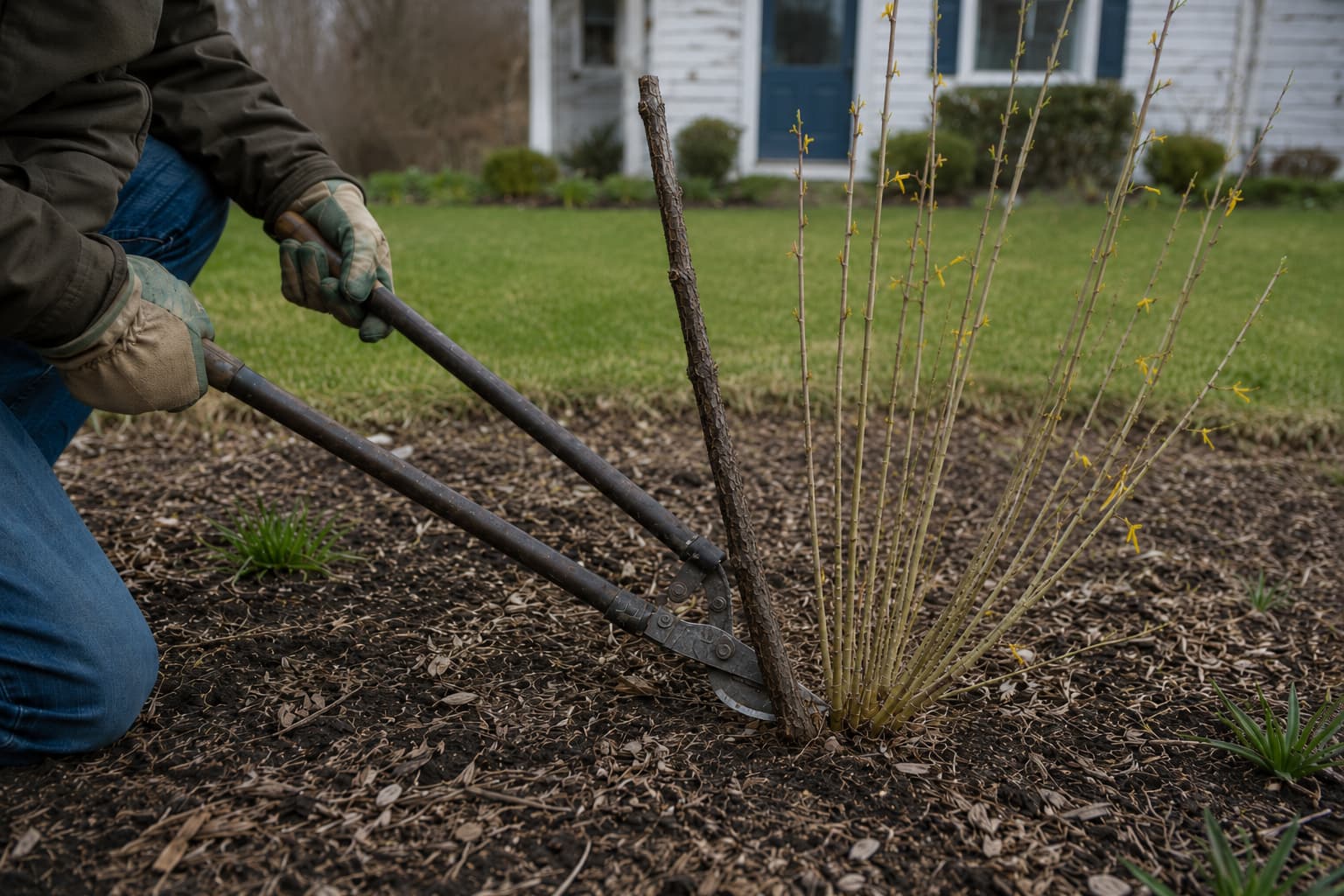
- Remove 20–25% of the oldest canes at ground level. These are the thickest, woodiest stems — 2+ inches in diameter, with rough bark. Cut them as close to the ground as possible. This is the most important step, and the one almost nobody does.
- Remove any dead, damaged, or crossing canes.
- If the shrub is too tall, cut the tallest remaining canes back to different heights — some at 4 feet, some at 5 feet, some at 6 feet. This preserves the natural arching form while reducing height. Never cut all canes to the same height (that's shearing).
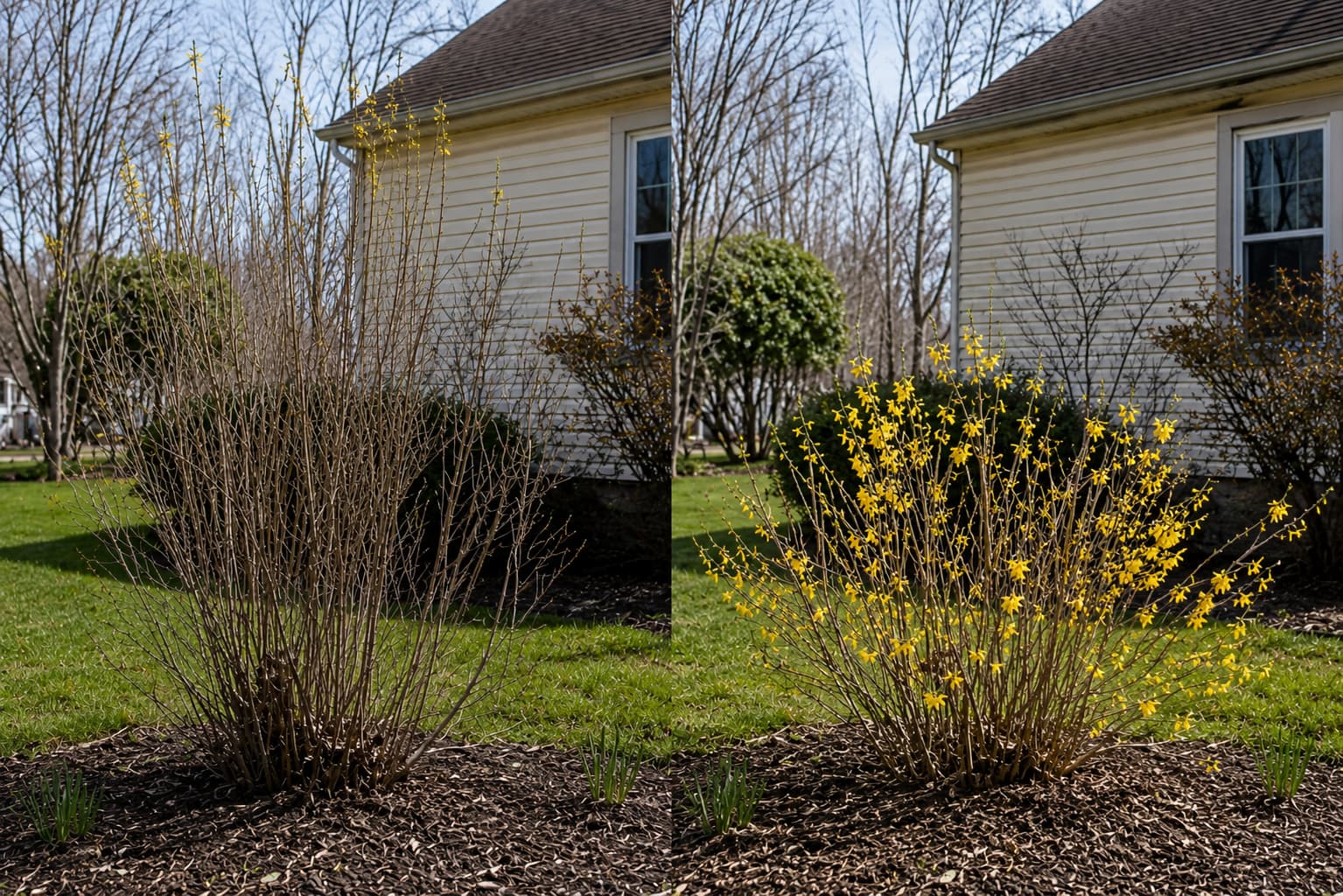
- Step back and assess. You want an open, vase-like structure with canes of different ages and heights, all arching outward.
What NOT to Do: The "Green Blob" Method
Do not shear forsythia with hedge trimmers into a ball, box, or any geometric shape. Shearing: (1) removes all the young growth at the surface where flowers form, (2) creates a dense outer shell with a dead, bare interior, and (3) turns the shrub into something that looks like a green marshmallow with three yellow flowers on top. If you've been doing this, stop. The rescue method is below.
How to Rescue an Overgrown or Butchered Forsythia
Scenario A: The Overgrown Giant
Your forsythia is 12 feet tall, impenetrably dense, and flowers only at the very top of a few stems that escaped the canopy. The interior is a tangle of dead wood.
The fix — 3-year gradual rejuvenation:
| Year | What to Do | What to Expect |
|---|---|---|
| Year 1 (after bloom) | Remove one-third of the oldest, thickest canes at ground level. Also remove all dead wood. | The shrub looks thinner. Vigorous new canes shoot up from the base over summer. Reduced bloom this year. |
| Year 2 (after bloom) | Remove half of the remaining old canes. Select the best 5–8 of last year's new canes — remove the rest. | New canes from Year 1 are now 4–6 feet tall with arching form. They'll produce some flowers. Overall shape is improving. |
| Year 3 (after bloom) | Remove the last of the original old canes. Thin new growth to keep 10–15 of the strongest, best-placed canes. | You now have a completely renewed shrub at a manageable size. Full bloom returns this year or next. |
Scenario B: The Sheared "Meatball"
Your forsythia has been hedge-trimmed into a tight ball for years. It has a dense outer shell, a hollow interior, and almost no flowers.
The fix:
- Stop shearing immediately. Put the hedge trimmers away.
- In late spring after what bloom there is fades, thin out 25–30% of the oldest canes at ground level — open up the interior.
- Let the remaining canes grow naturally for a full season. They'll look shaggy and uneven. That's good — that's the plant recovering.
- The following year, begin the annual thinning routine described above. Within 2–3 years, the natural fountain form will re-emerge.
Scenario C: The Nuclear Option (Hard Rejuvenation)
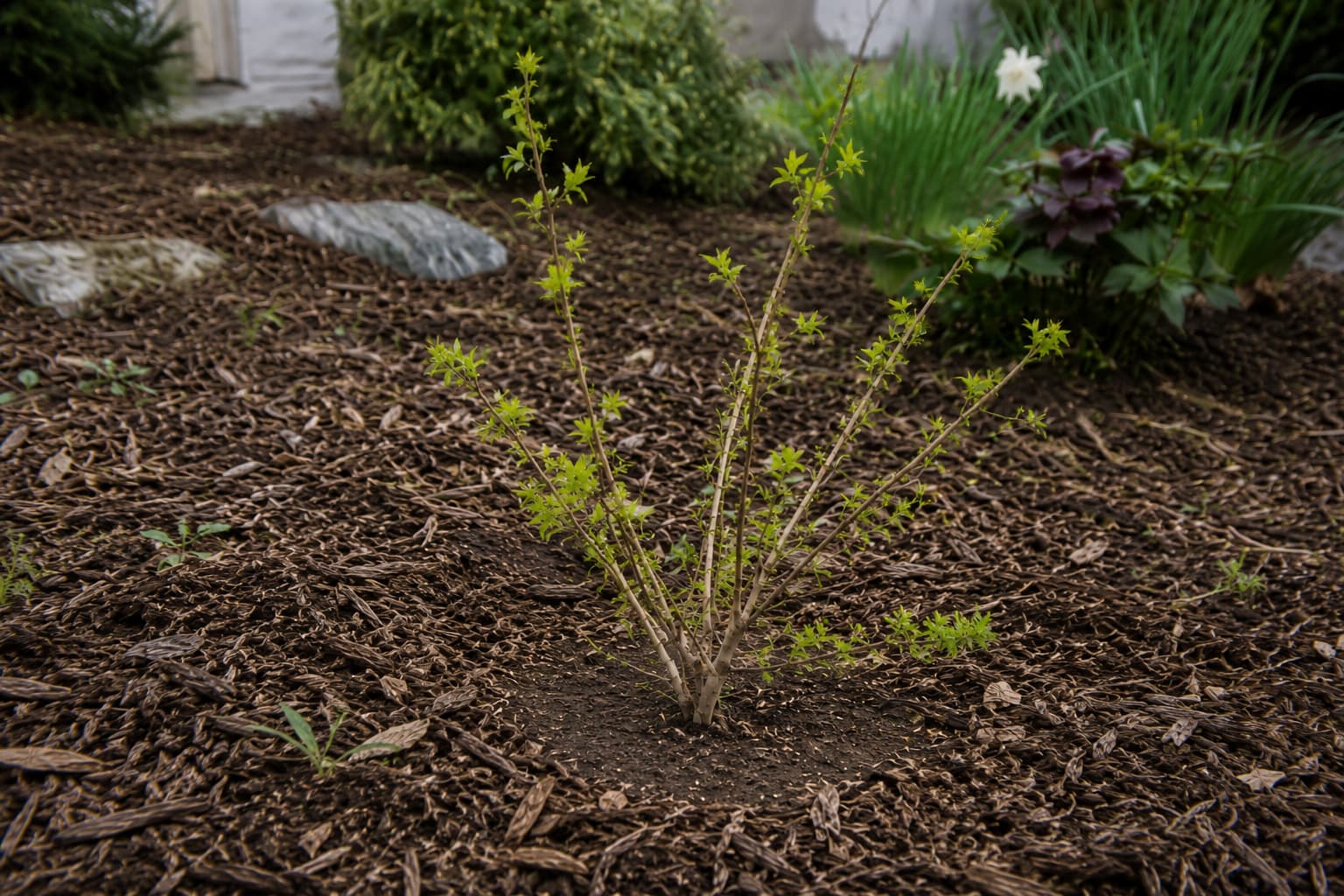
If the shrub is truly a lost cause — decades of neglect, mostly dead, or you just want to start over — you can cut the entire shrub to 4–6 inch stubs in late winter or very early spring. Forsythia is one of the few shrubs that reliably regenerates from this treatment. You'll lose all blooms for 1–2 years, but the plant will send up a forest of vigorous new canes. Thin these to the best 10–15 and begin the annual maintenance routine.
After Rejuvenation: The Maintenance Routine
Once your forsythia is in good shape, maintain it by removing 2–3 of the oldest canes at ground level every year after blooming. This perpetual renewal prevents the shrub from ever becoming overgrown again. Five minutes a year with a pair of loppers is all it takes.
Common Forsythia Problems
1. Not Blooming (or Very Few Flowers)
The #1 cause: Pruning at the wrong time or shearing instead of thinning. Forsythia blooms on old wood — buds form in summer for the following spring. Prune after mid-summer and you've removed them. Other causes: Not enough sun (needs 6+ hours), too much nitrogen from lawn fertilizer, or winter flower bud kill (in Zones 4–5, extreme cold can kill exposed flower buds even though the plant itself survives).
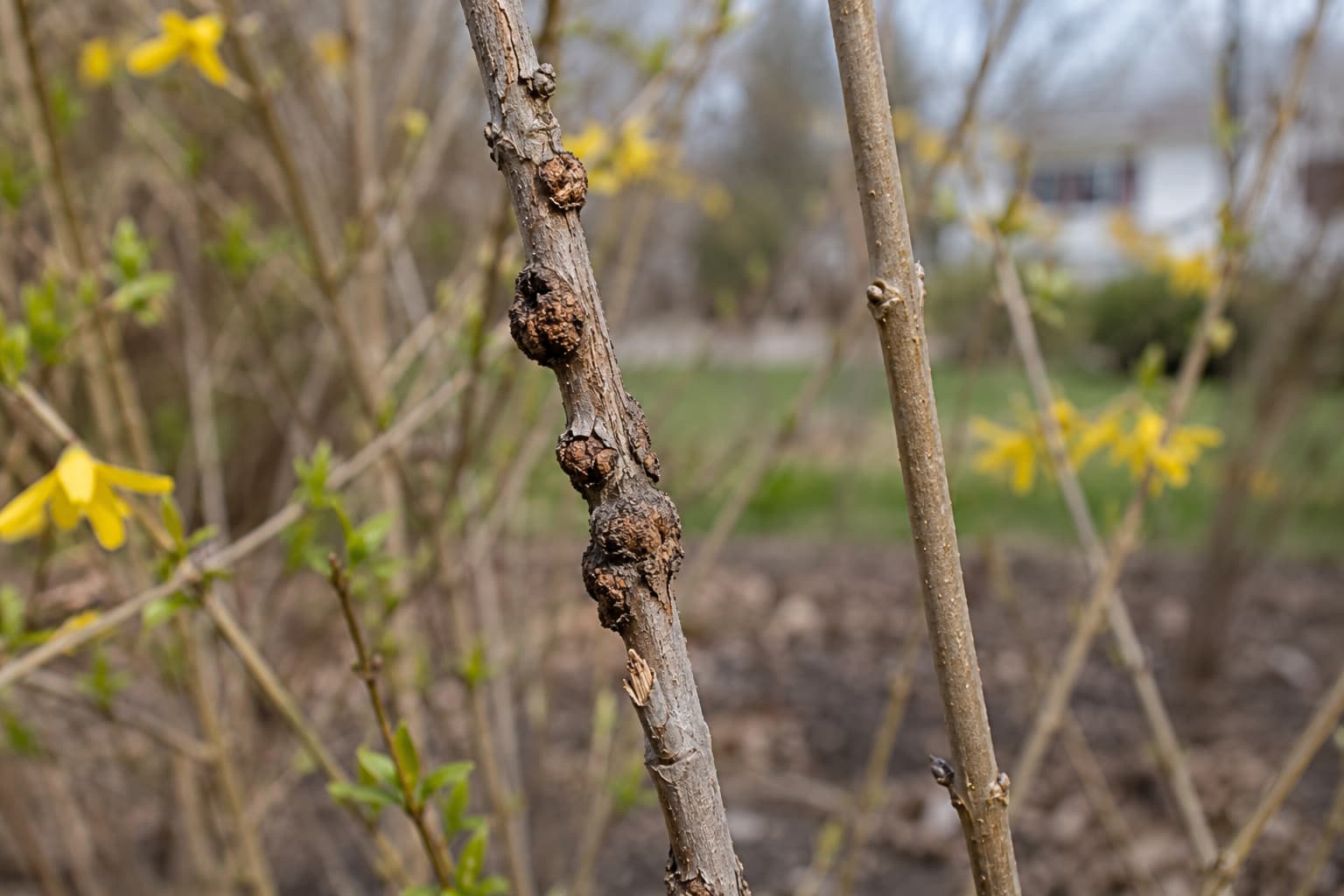
2. Forsythia Gall
Symptoms: Rough, knobby, tumor-like growths on stems, ranging from pea-sized to golf ball-sized. Branches beyond the gall may die back.
Cause: The bacterium Pseudomonas savastanoi (related to olive knot), which enters through wounds — pruning cuts, frost cracks, insect damage.
Fix: Prune out galled branches 6–8 inches below the gall, cutting into healthy wood. Sterilize tools between cuts. Dispose of pruned material — don't compost. Prevent by pruning in dry weather and avoiding unnecessary wounds. There is no chemical cure — removal of infected tissue is the only control.
3. Winter Flower Bud Kill
Symptoms: The shrub leafs out normally in spring, but produces few or no flowers. On close inspection, flower buds (visible as small brown nubs along stems in winter) are dried out, shriveled, or missing.
Cause: Extreme cold or rapid temperature swings in late winter kill the exposed flower buds. The vegetative buds (which produce leaves) are hardier and survive. This is common in Zones 4–5, especially during winters with little snow cover.
Fix: Plant cold-hardy varieties bred for bud hardiness — 'Northern Gold', 'Meadowlark', and 'New Hampshire Gold' were developed specifically to withstand cold winters and still bloom. Planting in a sheltered location (near a building or evergreen windbreak) also helps.
Best Forsythia Varieties for Home Gardens
| Variety | Size | Features | Zones | Best For |
|---|---|---|---|---|
| 'Lynwood Gold' | 6–8 ft | Classic bright yellow; most common variety | 4–8 | Hedges, mass plantings, general landscape use |
| 'Meadowlark' | 8–10 ft | Exceptional flower bud hardiness; blooms reliably in Zone 3 | 3–8 | Cold-climate gardens where other forsythias lose buds |
| 'Show Off' | 3–5 ft | Compact, dense; flowers packed tightly along stems | 4–8 | Small gardens, foundation plantings, containers |
| 'Gold Tide' / 'Courtasol' | 2–3 ft | Very dwarf, groundcover habit; spreading rather than upright | 4–8 | Front of border, slopes, rock gardens |
| 'Northern Gold' | 6–8 ft | Canadian-bred for bud hardiness; golden yellow with slight orange tinge | 3–8 | Northern gardens; reliable bloom after harsh winters |
| 'Kumson' | 4–6 ft | Unique — dark green leaves with silver veins; a foliage accent as well as spring bloomer | 4–8 | Specimen plant; adds interest after flowers fade |
Frequently Asked Questions
1.Why isn't my forsythia blooming?
The #1 cause is pruning at the wrong time or the wrong way. Forsythias bloom on old wood — buds form in summer for the following spring. If you prune after mid-summer, shear with hedge trimmers, or cut all stems to the same height, you're removing the flower buds. Other causes: not enough sun (needs 6+ hours), too much nitrogen from lawn fertilizer, or winter flower bud kill in very cold zones (the vegetative buds survive but flower buds freeze).
2.When is the right time to prune forsythia?
Immediately after the flowers fade — within 3–4 weeks. The buds for next spring's flowers form on this summer's new growth. Prune in fall or winter and you've removed next year's display. The method matters too: thin out the oldest canes at ground level rather than shearing the surface. Remove 20–25% of the oldest stems each year to keep the shrub renewing itself.
3.How do I fix a forsythia that's been sheared into a ball?
Stop shearing immediately. In late spring, thin out 25–30% of the oldest canes at ground level to open up the interior. Let the shrub grow naturally for a full season — it will look shaggy at first. The following year, begin annual thinning (remove 2–3 of the oldest canes at ground level after blooming). Within 2–3 years, the natural fountain form and heavy blooming will return. See the rejuvenation section above for the full step-by-step.
4.Can I cut my forsythia all the way to the ground?
Yes — forsythia is one of the few shrubs that reliably regenerates from a hard cut to 4–6 inch stubs. Do this in late winter or very early spring before growth begins. You'll lose all blooms for 1–2 years while the shrub regrows. This is the "nuclear option" for truly neglected shrubs. A gentler 3-year gradual rejuvenation (removing one-third of old canes each year) preserves some bloom each year and is less shocking to the plant.
5.Why does my forsythia have knobby growths on the stems?
This is forsythia gall, caused by a bacterial pathogen (Pseudomonas savastanoi) that enters through wounds. Prune out affected branches 6–8 inches below the gall, cutting into healthy wood. Sterilize tools between cuts with rubbing alcohol or 10% bleach solution. Dispose of pruned material — don't compost. There is no chemical cure; removal of infected tissue is the only effective control.
6.Do forsythias need a lot of water?
No. Once established (after the first year), forsythias are genuinely drought-tolerant. Water during extended dry periods (3+ weeks without rain), but they don't need regular irrigation. Overwatering reduces blooming and encourages weak, sappy growth. This is one of the most forgiving shrubs you can plant in terms of water needs.
7.Which forsythia is best for cold climates?
Look for varieties specifically bred for flower bud hardiness: 'Meadowlark' (Zone 3), 'Northern Gold' (Zone 3), and 'New Hampshire Gold' (Zone 3) were developed by university breeding programs to withstand harsh winters where standard forsythia flower buds freeze. Standard varieties like 'Lynwood Gold' may survive in Zone 4–5 but frequently lose their flower buds, producing leaves but no flowers.
8.Are forsythias toxic to dogs or children?
No. Forsythias are non-toxic to humans, dogs, and cats. The flowers are technically edible — they've been used in traditional medicine and as a garnish, though they're not particularly flavorful. Unlike many flowering shrubs (daphne, rhododendron, yew), forsythias are safe to plant in gardens used by children and pets.
Sources & Further Reading
- Royal Horticultural Society — Forsythia Growing Guide
- University of Minnesota Extension — Forsythia for the Home Landscape
- Clemson Cooperative Extension — Forsythia Factsheet
- Missouri Botanical Garden — Forsythia × intermedia Plant Finder
- Arnold Arboretum of Harvard — Forsythia Collection
- ASPCA — Toxic and Non-Toxic Plants List
Final Thoughts
Forsythias are one of the toughest, most forgiving shrubs in the landscape — and one of the most abused. They survive drought, poor soil, neglect, and temperatures well below zero. The one thing they won't survive with their dignity intact is bad pruning.
The good news: the fix is simple, and it takes about five minutes a year once you know what to do. Stop shearing. Start thinning. Remove the oldest canes at ground level after the flowers fade. Let the shrub grow into its natural fountain shape. That's it.
Here's what to remember:
- Prune right after blooming, and thin — don't shear. Remove 20–25% of the oldest canes at ground level.
- Full sun = maximum bloom. Shade = fewer flowers.
- Go easy on fertilizer. Especially near lawns. Too much nitrogen = green blob, no yellow.
- Rescue overgrown shrubs with the 3-year rejuvenation method. Or cut to the ground as a last resort.
- In cold zones (3–4), plant bud-hardy varieties like 'Meadowlark' or 'Northern Gold'.
- Non-toxic and safe for kids and pets. One less thing to worry about.
If you found this guide helpful, you might also enjoy our guides on Lilac Care and Daphne Plant Care — two more spring-flowering shrubs, with very different personalities.
Is your forsythia flowering poorly or losing its natural shape? Share its sunlight, pruning history, age, climate zone, and symptoms with the Greenmuse community.